


Treasury Board of Canada Secretariat
www.tbs-sct.gc.ca
Common menu bar links
Breadcrumb Trail
ARCHIVED - 2007-2008 DPRs - User Fees / External Fees
 This page has been archived.
Archived Content
Information identified as archived on the Web is for reference, research or recordkeeping purposes. It has not been altered or updated after the date of archiving. Web pages that are archived on the Web are not subject to the Government of Canada Web Standards. As per the Communications Policy of the Government of Canada, you can request alternate formats on the "Contact Us" page.
- Agriculture and Agri-Food Canada
- Canada Border Services Agency
- Canada Revenue Agency
- Canada School of Public Service
- Canadian Centre for Occupational Health and Safety
- Canadian Environmental Assessment Agency
- Canadian Food Inspection Agency
- Canadian Grain Commission
- Canadian Heritage
- Canadian International Development Agency
- Canadian Nuclear Safety Commission
- Canadian Radio-television and Telecommunications Commission
- Canadian Space Agency
- Canadian Transportation Agency
- Citizenship and Immigration Canada
- Commission for Public Complaints Against the RCMP
- Correctional Service Canada
- Department of Finance Canada
- Department of Foreign Affairs and International Trade
- Department of Justice Canada
- Economic Development Agency of Canada for the Regions of Quebec
- Environment Canada
- Fisheries and Oceans Canada
- Hazardous Materials Information Review Commission
- Health Canada
- Human Resources and Social Development Canada
- Indian and Northern Affairs Canada and Canadian Polar Commission
- Industry Canada
- Library and Archives Canada
- National Defence
- National Energy Board
- National Parole Board
- National Research Council Canada
- Natural Resources Canada
- Office of the Commissioner of Official Languages
- Office of the Registrar of Lobbyists
- Office of the Superintendent of Financial Institutions Canada
- Parks Canada
- Privy Council Office
- Public Health Agency of Canada
- Public Safety Canada
- Public Service Commission of Canada
- Public Works and Government Services Canada
- RCMP External Review Committee
- Royal Canadian Mounted Police
- Statistics Canada
- Status of Women Canada
- Supreme Court of Canada
- The Correctional Investigator Canada
- The National Battlefields Commission
- Transport Canada
- Transportation Safety Board of Canada
- Treasury Board of Canada Secretariat
- Western Economic Diversification Canada
Agriculture and Agri-Food Canada
Table 5-A: User Fees Act (1)
| A. | 2007-08 | Planning Years | |||||||||
|---|---|---|---|---|---|---|---|---|---|---|---|
| User Fee | Fee Type | Fee Setting Authority | Date Last Modified (B) | Forecast Revenue ($000) | Actual Revenue ($000) | Full Cost ($000) | Performance Standard | Performance Results | Fiscal Year | Forecast Revenue ($000) | Estimated Full Cost ($000) |
| Farm Improvement and Marketing Cooperatives Loans Act(FIMCLA) Registration Fees | R | FIMCLA Regulations | May 31, 1999 | 495.0 | 602.0 | 1,496.0 | Loans from lenders registered within 15 business days of receipt. Target is 90%. | 100% of loans were registered within 15 business days of receipt. | 2008-09 | 671.0 | 1,652.0 |
| 2009-10 | n/a | n/a | |||||||||
| 2010-11 | n/a | n/a | |||||||||
| Fees charged for the processing of access requests filed under the Access to Information Act (ATIA)(2) | O | Access to Information Act | 1992 | 2.5 | 2.5 | 738.4 |
Response provided within 30 days following receipt of request; the response time may be extended pursuant to section 9 of the ATIA. Notice of extension to be sent within 30 days after receipt of request.
The Access to Information Act provides fuller details. |
Statutory deadlines met 94.3 % of the time | 2008-09 | 2.5 | 950.0 |
| 2009-10 | 2.5 | 950.0 | |||||||||
| 2010-11 | 2.5 | 950.0 | |||||||||
| 2007-2008 | Sub-total (R) Regulatory Service | 495.0 | 602.0 | 1,496.0 | |||||||
| Sub-total (O) Other Products and Service | 2.5 | 2.5 | 738.4 | ||||||||
| Total | 497.5 | 604.5 | 2,234.4 | ||||||||
| 2008-2009 | Sub-total (R) Regulatory Service | 671.0 | 1,652.0 | ||||||||
| Sub-total (O) Other Products and Service | 2.5 | 950.0 | |||||||||
| Total | 673.5 | 2,602.0 | |||||||||
| 2009-2010 | Sub-total (R) Regulatory Service | n/a | n/a | ||||||||
| Sub-total (O) Other Products and Service | 2.5 | 961.0 | |||||||||
| Total | 2.5 | 950.0 | |||||||||
| 2010-2011 | Sub-total (R) Regulatory Service | n/a | n/a | ||||||||
| Sub-total (O) Other Products and Service | 2.5 | 950.0 | |||||||||
| Total | 2.5 | 950.0 | |||||||||
B. Date Last Modified: N/A
C. Other Information:
(1) The DPR instructions advised that this table be used only for revenues under the User Fee Act. The preliminary advice from our legal counsel indicated that only the FIMCLA program as well as the fees charged under ATIA are subject to the User Fee Act.
(2) It is the Department's practice to waive fees where the total owing per request amounts to less than $25.
Notes:
According to prevailing legal opinion, where the corresponding fee introduction or most recent modification occurred prior to March 31, 2004 the:
- Performance standard, if provided, may not have received Parliamentary review;
- Performance standard, if provided, may not respect all establishment requirements under the UFA (e.g. international comparison; independent complaint address)
- Performance result, if provided, is not legally subject to UFA section 5.1 regarding fee reduction for failed performance.
Table 5-B: Policy on Service Standards for External Fees
A.
| External Fee | Service Standard | Performance Result | Stakeholder Consultation |
|---|---|---|---|
| Farm Improvement and Marketing Cooperatives Loans Act (FIMCLA) Registration Fees | Loans from lenders registered within 15 business days of receipt. Target is 90%. | 100% of loans were registered within 15 business days of receipt. | Although stakeholders were not consulted in the past, this will be done in 2008-09 for the establishment of the Performance Standard as well as for stakeholder satisfaction of the Performance Results |
| Fees charged for the processing of access requests filed under the Access to Information Act (ATIA) | Response provided within 30 days following receipt of request; the response time may be extended pursuant to section 9 of the ATIA. Notice of extension to be sent within 30 days after receipt of request. | Statutory deadlines met 94.3% of the time. | The service standard is established by the Access to Information Act and the Access to Information Regulations. Consultations with stakeholders were undertaken by the Department of Justice and the Treasury Board Secretariat for amendments done in 1986 and 1992. |
| The Access to Information Act provides fuller details. http://laws.justice.gc.ca/en/A-1/index.html | |||
| Canadian Agriculture Income Stabilization (CAIS) Program - Administrative Cost Sharing (ACS) Fee |
Process interim applications within 30 days, 100% of the time.
Process final applications within 75 days, 75% of the time. Program year delivery occurs in the year following an economic event. The 2007 tax/program year final performance results related to delivery of ensuing payments to producers will not be available until the 2008/09 fiscal year, once the 2007 tax/program year is complete and applications are received. Therefore, results achieved are reported for the 2006 program year. |
As of July 30, 2007, where Canada delivers, all 2006 program year Interim application processing was complete, 77.5% of applications received were processed within the 30 day standard.
As of March 31, 2008, where Canada delivers 91.76% of the 2006 program year final applications were processing complete, 47% were processed within the 75 day standard. Complete information has not been received from other delivery agents to calculate an accurate National standard. The Administration has made steady progress on service standard performance from 2004 to 2005 (from 26 percent within standard to 38 percent), and this trend continued into 2006 CAIS processing. The Administration anticipates continuing these trends through 2007 application processing, which is currently underway. |
The ACS fee is established by Federal/Provincial/Territorial (FPT) agreement.
The CAIS program service standards are communicated to producers through industry advisories and toll free speaking points. The Administration is working with provincial partners to meet the 75 day standard on a target of 75% of 2007 files. While this target has not been met in previous years, earlier system releases and preparation for 2007 processing will enable better performance for the program year. |
B. Other Information:
It is the Department's practice to waive fees where the total owing per request amounts to less than $25.
Notes:
As established pursuant to the Policy on Service Standards for External Fees:
- Service standards may not have received Parliamentary review;
- Service standards, may not respect all performance standard establishment requirements under the UFA (e.g. international comparison; independent complaint address)
- Performance results are not legally subject to UFA section 5.1 regarding fee reduction for failed performance.

Canada Border Services Agency
User Fees/External Fees
Table 3.7: The User Fees Act
| Broker Licence and Examination Fees | ||
|---|---|---|
| Fee Type | Fee-setting Authority | Date Last Modified |
| Regulatory | Customs Act | 1992 |
| 2007–2008 (thousands of dollars) | ||
| Forecast Revenue | Actual Revenue | Full Cost |
| 375 | 412 | 753 |
| Performance Standard | ||
| Results received 4–6 weeks from the date of exam. | ||
| Performance Results | ||
| Results were received within nine weeks from the date of exam. This is due to a change in how the exams are marked. Corrective action has been taken to ensure the performance standard is met. | ||
| Planning Years (thousands of dollars) | ||
| Fiscal Year | Forecast Revenue | Estimated Full Cost |
| 2008–2009 2009–2010 2010–2011 |
400 400 400 |
750 750 750 |
| Customs Sufferance Warehouse Licence Fees | ||
|---|---|---|
| Fee Type | Fee-setting Authority | Date Last Modified |
| Regulatory | Customs Act | 1996 |
| 2007–2008 (thousands of dollars) | ||
| Forecast Revenue | Actual Revenue | Full Cost |
| 600 | 581 | 1,550 |
| Performance Standard | ||
| Application processed in 60 business days. | ||
| Performance Results | ||
| 95% of all applications that were fully completed according to the requirements of the Customs Sufferance Warehouses Regulations were processed within 60 business days. | ||
| Planning Years (thousands of dollars) | ||
| Fiscal Year | Forecast Revenue | Estimated Full Cost |
| 2008–2009 2009–2010 2010–2011 |
600 600 600 |
1,550 1,550 1,550 |
| Customs Bonded Warehouse Licence Fees | ||
|---|---|---|
| Fee Type | Fee-setting Authority | Date Last Modified |
| Regulatory | Customs Tariff | 1996 |
| 2007–2008 (thousands of dollars) | ||
| Forecast Revenue | Actual Revenue | Full Cost |
| 500 | 475 | 1,600 |
| Performance Standard | ||
| Operator to receive notice of determination within four weeks after an audit or examination. | ||
| Performance Results | ||
| Operator receives notice of determination 100% of the time within four weeks after an audit or examination. |
||
| Planning Years (thousands of dollars) | ||
| Fiscal Year | Forecast Revenue | Estimated Full Cost |
| 2008–2009 2009–2010 2010–2011 |
500 500 500 |
1,600 1,600 1,600 |
| Storage Charges for Queen's and Frontier Warehouses | ||
|---|---|---|
| Fee Type | Fee-setting Authority | Date Last Modified |
| Regulatory | Customs Act | 1992 |
| 2007–2008 (thousands of dollars) | ||
| Forecast Revenue | Actual Revenue | Full Cost |
| 250 | 115 | 415 |
| Performance Standard | ||
| Goods to be handled with care and stored in a secure manner to safeguard against damage or loss. | ||
| Performance Results | ||
| One successful claim made against the Crown. | ||
| Planning Years (thousands of dollars) | ||
| Fiscal Year | Forecast Revenue | Estimated Full Cost |
| 2008–2009 2009–2010 2010–2011 |
250 250 250 |
415 415 415 |
| Customs Special Services Fees | ||
|---|---|---|
| Fee Type | Fee-setting Authority | Date Last Modified |
| Regulatory | Customs Act | 1986 |
| 2007–2008 (thousands of dollars) | ||
| Forecast Revenue | Actual Revenue | Full Cost |
| 400 | 234 | 750 |
| Performance Standard | ||
| The Special Services (Customs) Regulations are currently under review. Service standards are being developed as part of this review. | ||
| Performance Results | ||
| These fees are collected once services are rendered (e.g. verification of paperwork). There are no delays or waiting periods associated with the services in question. To date (since the CBSA took over the collection of these fees from the CFIA), the CBSA has not received any complaints from the public regarding the fees or the method used to collect the fees. | ||
| Planning Years (thousands of dollars) | ||
| Fiscal Year | Forecast Revenue | Estimated Full Cost |
| 2008–2009 2009–2010 2010–2011 |
250 250 250 |
650 650 650 |
| Canadian Food Inspection Agency (CFIA) Fees Notice | ||
|---|---|---|
| Fee Type | Fee-setting Authority | Date Last Modified |
| Regulatory | Canadian Food Inspection Agency Act | 1997 |
| 2007–2008 (thousands of dollars) | ||
| Forecast Revenue | Actual Revenue | Full Cost |
| 2,300 | 2,213 | 6,583 |
| Performance Standard | ||
| Inspection activities are to be provided in accordance with corresponding federal regulations. | ||
| Performance Results | ||
| Inspection activities were provided in accordance with corresponding federal regulations. | ||
| Planning Years (thousands of dollars) | ||
| Fiscal Year | Forecast Revenue | Estimated Full Cost |
| 2008–2009 2009–2010 2010–2011 |
2,300 2,300 2,300 |
6,600 6,600 6,600 |
| NEXUS Program | ||
|---|---|---|
| Fee Type | Fee-setting Authority | Date Last Modified |
| Regulatory | Customs Act | 2002 |
| 2007–2008 (thousands of dollars) | ||
| Forecast Revenue | Actual Revenue | Full Cost |
| 3,900 | 2,708 | 5,750 |
| Performance Standard | ||
| 4–6 weeks | ||
| Performance Results | ||
| 80% processed within 4–6 weeks.* | ||
| Planning Years (thousands of dollars) | ||
| Fiscal Year | Forecast Revenue | Estimated Full Cost |
| 2008–2009 2009–2010 2010–2011 |
2,500 1,875 1,875 |
5,800 5,800 5,800 |
| Free and Secure Trade (FAST) Program | ||
|---|---|---|
| Fee Type | Fee-setting Authority | Date Last Modified |
| Regulatory | Customs Act | 2002 |
| 2007–2008 (thousands of dollars) | ||
| Forecast Revenue | Actual Revenue | Full Cost |
| 700 | 487 | 3,625 |
| Performance Standard | ||
| 4–6 weeks | ||
| Performance Results | ||
| 4–6 weeks* | ||
| Planning Years (thousands of dollars) | ||
| Fiscal Year | Forecast Revenue | Estimated Full Cost |
| 2008–2009 2009–2010 2010–2011 |
425 1,200 575 |
3,700 3,700 3,700 |
| CANPASS Program | ||
|---|---|---|
| Fee Type | Fee-setting Authority | Date Last Modified |
| Regulatory | Customs Act | 2006 |
| 2007–2008 (thousands of dollars) | ||
| Forecast Revenue | Actual Revenue | Full Cost |
| 500 | 693 | 3,658 |
| Performance Standard | ||
| 4–6 weeks | ||
| Performance Results | ||
| 80% processed within 4–6 weeks.* | ||
| Planning Years (thousands of dollars) | ||
| Fiscal Year | Forecast Revenue | Estimated Full Cost |
| 2008–2009 2009–2010 2010–2011 |
500 500 500 |
3,700 3,700 3,700 |
| Sub-total: Regulatory | ||
|---|---|---|
| 2007–2008 (thousands of dollars) | ||
| Forecast Revenue | Actual Revenue | Full Cost |
| 9,525 | 7,918 | 24,684 |
| Planning Years (thousands of dollars) | ||
| Fiscal Year | Forecast Revenue | Estimated Full Cost |
| 2008–2009 2009–2010 2010–2011 |
7,725 7,875 7,250 |
24,765 24,765 24,765 |
| Fees Charged for Processing Access Requests Filed Under the Access to Information Act | ||
|---|---|---|
| Fee Type | Fee-setting Authority | Date Last Modified |
| Other products and services | Access to Information Act | 1992 |
| 2007–2008 (thousands of dollars) | ||
| Forecast Revenue | Actual Revenue | Full Cost |
| 5 | 8 | 2,547 |
| Performance Standard | ||
| Response provided within 30 days following receipt of request; the response time may be extended pursuant to section 9 of the Access to Information Act. Notice of extension to be sent within 30 days after receipt of request. The Act provides more details. | ||
| Performance Results | ||
| There were 1,197 access requests completed in 2007–2008: 45.2% were completed on time; 54.8% were completed late. The results reflect a significant effort to reduce the accumulated inventory of requests while managing a growing workload. Significant resources were expended to address workload (including the remaining inventory) and to otherwise support the function while permanent staffing and training activities are under way. Overall compliance with legislative time frames continues to improve as investments are made and elements of the CBSA’s three-year plan to strengthen and stabilize the access to information and privacy function are completed. | ||
| Planning Years (thousands of dollars) | ||
| Fiscal Year | Forecast Revenue | Estimated Full Cost |
| 2008–2009 2009–2010 2010–2011 |
8 8 9 |
2,250 2,100 2,100 |
| Sub-total: Other Products and Services | ||
|---|---|---|
| 2007–2008 (thousands of dollars) | ||
| Forecast Revenue | Actual Revenue | Full Cost |
| 5 | 8 | 2,547 |
| Planning Years (thousands of dollars) | ||
| Fiscal Year | Forecast Revenue | Estimated Full Cost |
| 2008–2009 2009–2010 2010–2011 |
8 8 9 |
2,250 2,100 2,100 |
| Total User Fees | ||
|---|---|---|
| 2007–2008 (thousands of dollars) | ||
| Forecast Revenue | Actual Revenue | Full Cost |
| 9,530 | 7,926 | 27,231 |
| Planning Years (thousands of dollars) | ||
| Fiscal Year | Forecast Revenue | Estimated Full Cost |
| 2008–2009 2009–2010 2010–2011 |
7,733 7,883 7,259 |
27,015 26,865 26,865 |
* The performance results provided reflect the Canadian portion of the application process up to inviting applicants to attend an office to finalize their memberships. The CBSA will review the existing published performance standards for processing applications with its partner (U.S. Customs and Border Protection) and consult with stakeholders (including the public) to clarify the processing standards and adjust time frames as required. Revised time frames will be made available to the public on the Internet and in program brochures and guides.
Table 3.8: Policy on Service Standards for External Fees
| Policy on Service Standards for External Fees | |||
|---|---|---|---|
| External Fee | Service Standard | Performance Result | Stakeholder Consultation |
| Broker licence and examination fees | Results received 4–6 weeks from date of exam. |
Results were received within nine weeks from the date of exam. This is due to a change in how the exams are marked. Corrective action has been taken to ensure the performance standard is met. | Consultation undertaken through the Border Commercial Consultative Committee. |
| Customs sufferance warehouse licence fees | Application processed in 60 business days. | 95% of all applications that were fully completed according to the requirements of the Customs Sufferance Warehouse Regulations were processed within 60 business days. | |
| Customs bonded warehouse licence fees | Operator to receive notice of determination within four weeks after an audit or examination. | Operator receives notice of determination 100% of the time within four weeks after an audit or examination. | |
| Storage charges for Queen's and frontier warehouses | Goods to be handled with care and stored in a secure manner to safeguard against damage or loss. | One successful claim made against the Crown. | |
| NEXUS program | 4–6 weeks* | 80% processed within 4–6 weeks.* |
*The performance results provided reflect the Canadian portion of the application process up to inviting applicants to attend an office to finalize their memberships. The CBSA will review the existing published performance standards for processing applications with its partner (U.S. Customs and Border Protection) and consult with stakeholders (including the public) to clarify the processing standards and adjust time frames as required. Revised time frames will be made available to the public on the Internet and in program brochures and guides. |
| FAST program | 4–6 weeks* | 4–6 weeks* | |
| CANPASS program (Private Boats, Private and Corporate Aircraft, Air) | 4–6 weeks* | 80% processed within 4–6 weeks.* |
|
| Customs special services fees | The Special Services (Customs) Regulations are currently under review. Service standards are being developed as part of this review. | These fees are collected once services are rendered (e.g. verification of paperwork). There are no delays or waiting periods associated with the services in question. To date (since the CBSA took over the collection of these fees from the CFIA), the CBSA has not received any complaints from the public regarding the fees or the method used to collect the fees. | |
| Fees charged for processing access requests filed under the Access to Information Act | Response provided within 30 days following receipt of request; the response time may be extended pursuant to section 9 of the Act. Notice of extension to be sent within 30 days after receipt of request. The Act provides more details. | There were 1,197 access requests completed in 2007–2008: 45.2% were completed on time, 54.8% were completed late. The results reflect a significant effort to reduce the accumulated inventory of requests while managing a growing workload. Significant resources were expended to address workload (including the remaining inventory) and to otherwise support the function while permanent staffing and training activities are under way. Overall compliance with legislative time frames continues to improve as investments are made and elements of the CBSA’s three-year plan to strengthen and stabilize the access to information and privacy function are completed. | The service standard is established by the Act and the Access to Information Regulations. Consultations with stakeholders were undertaken by the Department of Justice and the Treasury Board of Canada Secretariat for amendments made in 1986 and 1992. |
| CFIA fees notice | Inspection activities are to be provided in accordance with corresponding federal regulations. | Inspection activities were provided in accordance with corresponding federal regulations. | |
Canada Revenue Agency
Table 5 User Fees/External Fees
Table 5.1 a) User Fees Act (UFA) – Advance Income Tax Ruling Fee
|
Performance Standard[Footnote 1]
|
The key service standard target is to issue advance income tax rulings to taxpayers within an average of 60 calendar days of receipt of all essential information. The Income Tax Rulings Directorate’s Quality Management System requires a telephone acknowledgement of receipt of the request within 24 business hours. Within
14 days, a review of the file for completeness is conducted and an acknowledgement letter, complete with a contact name and request for any missing information (if required) is sent to the client. The client is again contacted by telephone when the file is assigned for processing. Where a delay is unavoidable, clients are contacted and delays are discussed with
them.
|
|
|
Performance Results[Footnote 1]
|
||
According to prevailing legal opinion, where the corresponding fee introduction or most recent modification occurred prior to March 31, 2004 the:
- Performance standard, if provided, may not have received Parliamentary review;
- Performance standard, if provided, may not respect all establishment requirements under the User Fees Act (UFA) (e.g. international comparison; independent complaint address); and
- Performance result, if provided, is not legally subject to UFA section 5.1 regarding fee reductions for failed performance.
Table 5.1 b) Policy on Service Standards for External Fees – Advance Income Tax Ruling Fee
|
Service Standard[Footnote 1]
|
The key service standard target is to issue advance income tax rulings to taxpayers within an average of 60 calendar days of receipt of all essential information. The Income Tax Rulings Directorate’s (ITRD) Quality Management System requires a telephone
acknowledgement of receipt of the request within 24 business hours. Within 14 days, a review of the file for completeness is conducted and an acknowledgement letter, including a contact name and request for any missing information (if required) is sent to the client. The client is again contacted by telephone when the file is assigned for processing. Where a delay
is unavoidable, clients are contacted and delays are discussed with them.
|
|
Performance Results[Footnote 1]
|
|
|
Client satisfaction questionnaires were sent out to all advance income tax ruling clients for a 2-year period from October 2002 through October 2004. At that time, responding clients from this group indicated a satisfaction rate in excess of 95%. More recently, client feedback is largely received informally during
ITRD’s attendance at major tax conferences. Generally, there is a very high degree of satisfaction with the quality of advance income tax rulings albeit the clients would like to receive them faster.
|
|
As established pursuant to the Policy on Service Standards for External Fees:
- Service standards may not have received Parliamentary review;
- Service standards may not respect all performance standard establishment requirements under the User Fees Act (UFA) (e.g. international comparison; independent complaint address); and
- Performance results are not legally subject to UFA section 5.1 regarding fee reduction for failed performance.
Table 5.2 a) User Fees Act (UFA) – Taxation Statistical Analysis and Data Processing Fee
According to prevailing legal opinion, where the corresponding fee introduction or most recent modification occurred prior to March 31, 2004 the:
- Performance standard, if provided, may not have received Parliamentary review;
- Performance standard, if provided, may not respect all establishment requirements under the User Fees Act (UFA) (e.g. international comparison; independent complaint address); and
- Performance result, if provided, is not legally subject to UFA section 5.1 regarding fee reductions for failed performance.
Table 5.2 b) Policy on Service Standards for External Fees – Taxation Statistical Analysis and Data Processing Fee
As established pursuant to the Policy on Service Standards for External Fees:
- Service standards may not have received Parliamentary review;
- Service standards may not respect all performance standard establishment requirements under the User Fees Act (UFA) (e.g. international comparison; independent complaint address); and
- Performance results are not legally subject to UFA section 5.1 regarding fee reduction for failed performance.
Table 5.3 a) User Fees Act (UFA) – Access to Information Processing Fee
According to prevailing legal opinion, where the corresponding fee introduction or most recent modification occurred prior to March 31, 2004 the:
- Performance standard, if provided, may not have received Parliamentary review;
- Performance standard, if provided, may not respect all establishment requirements under the User Fees Act (UFA) (e.g. international comparison; independent complaint address); and
- Performance result, if provided, is not legally subject to UFA section 5.1 regarding fee reductions for failed performance.
Table 5.3 b) Policy on Service Standards for External Fees – Access to Information Processing Fee
As established pursuant to the Policy on Service Standards for External Fees:
- Service standards may not have received Parliamentary review;
- Service standards may not respect all performance standard establishment requirements under the User Fees Act (UFA) (e.g. international comparison; independent complaint address); and
- Performance results are not legally subject to UFA section 5.1 regarding fee reduction for failed performance.
Canada School of Public Service
Table 4: User Fees/External Fees
| 2007–2008 | Planning Years | ||||||||||
| A. User Fee | Fee Type | Fee-setting Authority | Date Last Modified | Forecast Revenue($000) | Actual Revenue ($000) | Full Cost ($000) | Performance Standard1 | Performance Results1 | Fiscal Year | Forecast Revenue ($000) | Estimated Full Cost ($000) |
| Fees charged for the processing of access requests filed under the Access to Information Act (ATIA) | Other products and services | Access to Information Act | 1992 | 0 | 0.06 | 52.76 | Response provided within 30 days following receipt of request; the response time may be extended pursuant to section 9 of the ATIA. Notice of extension to be sent within 30 days after receipt of request | 30 day processing standard met | 2008-2009 2009-2010 2010-2011 |
0.25 0.25 0.25 |
70.08 70.08 70.08 |
Canadian Centre for Occupational Health and Safety
Table 3 B User Fee Reporting Template – Policy on Service Standards for External Fees
| External Fee | Service Standard | Performance Result | Stakeholder Consultation |
|---|---|---|---|
| Subscription Services | www.ccohs.ca/ccohs/standards.html Clients not satisfied with products can request a refund |
See table 1 | http://www.ccohs.ca/ccohs/reports/cust_survey.htm |
| Publications | www.ccohs.ca/ccohs/standards.html | 94% satisfied with the publication | http://www.ccohs.ca/ccohs/reports/cust_survey.htm |
| E-learning | Satisfaction or refund | 98.4% Satisfied with the course | Client consultations were completed prior to this new revenue item. Detailed client survey available for each participant. Detailed results available in Table 1 |
| Special Projects | Clients determine standards for each project | Not applicable to contracts | Not applicable to contracts |
B.Other Information
Subscription services are based upon an agreement with the client for levels of services. CCOHS monitors its service delivery by requesting client feedback, conducting periodic formal evaluations and client satisfaction surveys. Ongoing client satisfaction surveys are conducted. Results are reported in the Departmental Performance Report. CCOHS’ service pledge, standards and complaints policy are located at: www.ccohs.ca/ccohs/standards.html. Links are also provided to our ongoing feedback reporting system. Evaluations of client satisfaction are located at: http://www.ccohs.ca/ccohs/reports.html
Canadian Environmental Assessment Agency
Table 4-A: User Fees Act
| User Fee | Fee Type | Fee-Setting Authority | Date Last Modified | 2007-2008 ($000s) | Planning Years | ||||||
|---|---|---|---|---|---|---|---|---|---|---|---|
| Forecast Revenue ($000s) | Actual Revenue ($000s) | Full Cost ($000s) | Performance Standard | Performance Results | Fiscal Year | Forecast Revenue ($000s) | Estimated Full Cost ($000s) | ||||
| Environmental assessment services | R | Environmental Assessment Review Panel Services Charges Order | 2002 | 7,751.0 | 6,027.9 | 8,692.6 | An internal review of the existing performance standards, specifically with regard to the sufficiency of the Cost Recovery Order, began in 2007-2008. While in the midst of designing the parameters for evaluation, the Agency underwent a substantial modification to its structure. In order to reflect the new operating environment, the Agency is re-developing its Participant Satisfaction Survey to establish indicators (such as Fairness, Accessibility, Timeliness, Efficiency and Value for Investment) to allow for qualitative performance evaluation within the new structure. | The Agency will use these measures in the 2008-2009 DPR. | 2008-2009 2009-2010 2010-2011 |
7,751.0 7,751.0 7,751.0 |
11,006.4 11,006.4 11,006.4 |
| Fees charged for the processing of access requests filed under the Access to Information Act | O | Access to Information Act | 1992 | 0.1 | 0.1 | 122.1 | Service standards are in the Access to Information Act, section 7: http://laws.justice.gc.ca/en/a-1/218072.html | Statutory deadlines were met 46% of the time | 2008-2009 2009-2010 2010-2011 |
0.5 0.6 0.6 |
116.6 132.5 148.3 |
| Sub-total (R) |
7,751.0 | 6,027.9 | 8,692.6 | Total 2007-2008 | 7,751.6 | 11,123.0 | |||||
| Sub-total (O) |
— | 0.1 | 122.1 | Total 2008-2009 | 7,751.6 | 11,138.9 | |||||
| Total | 7,751.1 | 6,028.0 | 8,814.7 | Total 2009-2010 | 7,751.6 | 11,154.7 | |||||
For 2007-2008, environmental assessment services constituted the main source of revenues of the Agency. This amount is subject to variation depending on the level of review panel activity that is eligible for cost recovery. Reflected forecasted revenues of $7,751K are based on authorities. As review panel activity increases additional authorities will be sought. Full costs of environmental assessment services are based on actual revenues for 2007-2008 and forecasted revenues for 2008-2009, 2009-2010 and 2010-2011 adjusted for an estimated portion of the cost provided without charge * and other costs that cannot be recovered under the current authorities.
Actual and forecasted revenues for Access to Information and Privacy (ATIP) are based on a set fee per request as prescribed in the Access to Information Act . Full costs are based on actual costs related to generating the required information adjusted by an estimated portion of the cost provided without charge.
* Accommodations are provided by Public Works and Government Services Canada. Contributions covering the employer's share of employees' insurance premiums and expenditures are paid by the Treasury Board Secretariat. Salary and associated expenditures of legal services are provided by Justice Canada.
Table 4-B: Policy on Service Standards for External Fees
| External Fee | Service Standard | Performance Result | Stakeholder Consultation |
|---|---|---|---|
| Fees charged for the processing of access requests filed under the Access to Information Act (ATIP) | Service standards are in the Access to Information Act, section 7: http://laws.justice.gc.ca/en/a-1/218072.html | Statutory deadlines were met 46% of the time | The service standard is established by the Access to Information Act and the Access to Information Regulation. Consultations with stakeholders were undertaken for amendments made in 1986 and 1992. |
| Environmental Assessment Fees | Environmental Assessment Review Panel Service Charges Order | Individual service-level agreements were signed and administered between the Agency and project proponents in support of 93% of the environmental assessments conducted by review panels, in accordance with the Canadian Environmental Assessment Act. | Before the development of the Order, public comments were solicited at stakeholder meetings held across Canada, and consultations were held over the course of several meetings with the Minister's multi stakeholder Regulatory Advisory Committee. All the comments received were considered and, where appropriate, incorporated into the design of the Order. |
|
Other Information
ATIP requests received by the Agency during the reporting period were more complicated and larger than usual. The Agency was required to request extensions to finalize its work. In addition, consultation with some departments took longer than expected to review and approve the requests. |
|||
Canadian Food Inspection Agency
| Table 3–4A: User Fees Act | |||||||||
|---|---|---|---|---|---|---|---|---|---|
| A. User Fee | Fee Type46 | Fee- setting Auth- ority |
Date Last Modi-fied | 2007–2008 | Planning Years | ||||
| Forecast Revenue ($000) |
Actual Revenue ($000) |
Full Cost ($000)47 |
Fiscal Year | Forecast Revenue ($000) |
Estimated Full Cost ($000)48 |
||||
| Managing food safety risks | R | CFIA Act | 1998 | 31,396 | 32,641 | 330,775 | 2008– 2009 |
31,396 | 305,766 |
| 2009– 2010 |
31,396 | 286,827 | |||||||
| 2010– 2011 |
31,396 | 280,807 | |||||||
| Protecting consumers and the market-place from unfair practices | R | CFIA Act | 1998 | 3,741 | 3,761 | 24,956 | 2008– 2009 |
3,741 | 23,069 |
| 2009– 2010 |
3,741 | 21,640 | |||||||
| 2010– 2011 |
3,741 | 21,186 | |||||||
| Certifying exports | R | CFIA Act | 1998 | 13,949 | 15,619 | 35,655 | 2008– 2009 |
13,949 | 32,959 |
| 2009– 2010 |
13,949 | 30,918 | |||||||
| 2010– 2011 |
13,949 | 30,269 | |||||||
| Protecting Canada’s crops and forests | R | CFIA Act | 1998 | 3,476 | 3,760 | 89,687 | 2008– 2009 |
3,476 | 82,906 |
| 2009– 2010 |
3,476 | 77,771 | |||||||
| 2010– 2011 |
3,476 | 76,139 | |||||||
| Protecting Canada’s livestock | R | CFIA Act | 1998 | 2,063 | 2,196 | 91,067 | 2008– 2009 |
2,063 | 84,182 |
| 2009– 2010 |
2,063 | 78,967 | |||||||
| 2010– 2011 |
2,063 | 77,310 | |||||||
| Assessing agricultural products | R | CFIA Act | 1998 | 369 | 396 | 12,442 | 2008– 2009 |
369 | 11,501 |
| 2009– 2010 |
369 | 10,789 | |||||||
| 2010– 2011 |
369 | 10,562 | |||||||
| Access to Infor-mation and Privacy (ATIP) | O | Access to Infor-mation Act | 1992 | 6 | 9 | 415 | 2008– 2009 |
6 | 384 |
| 2009– 2010 |
6 | 360 | |||||||
| 2010– 2011 |
6 | 353 | |||||||
| Total | 55,000 | 58,382 | 586,095 | 2008– 2009 |
55,000 | 540,767 | |||
| 2009– 2010 |
55,000 | 507,272 | |||||||
| 2010– 2011 |
55,000 | 496,626 | |||||||
| Table 3–4B: Policy on Service Standards for External Fees | |||
|---|---|---|---|
| External Fee | Service Standard | Performance Results | Stakeholder Consultation |
| Fees charged for the processing of access requests filed under the Access to Information Act (ATIA) | Response provided within 30 days following receipt of request; response time may be extended pursuant to Section 9 of the ATIA. Notice of extension to be sent within 30 days of receipt of request. | Of the 416 requests completed under the ATIA last fiscal year, 274 (66%) were completed under 30 days; 49 (12%) were completed in 31 to 60 days; 81 (19%) were completed in 61 to 120 days; and 12 (3%) were completed 121 or over. | The service standard is established by the ATIA and the Access to Information Regulations. Consultations with stakeholders were undertaken by the Department of Justice and the Treasury Board Secretariat for amendments done in 1986 and 1992. |
| Destination Inspection Service (fresh fruits and vegetables) http://www.inspection.gc.ca/ english/fssa/frefra/dis/dise.shtml |
Goal is to achieve inspector response to 80% of the inspection requests within eight hours and 100% of requests within 24 hours by 2011. | First year national results: 70% in 8 hours and 85% within 24 hours. | Service standards were established for the newly created Destination Inspection Service, in consultation with Industry. |
|
Veterinary Biologics Program Service Standards (The service standards refer to VBS calendar days, unless specified otherwise)
|
In fiscal year 2007–2008, the Veterinary Biologics Section made significant progress in eliminating backlogs, and is now meeting service standards for all key indicators, with very few exceptions. | To address stakeholders’ concerns about capacity and timeliness of the regulatory approval process for animal health products, the CFIA Veterinary Biologics Section has formed a Canadian Animal Health Products Regulatory Advisory Committee (CAHPRAC) in collaboration with Health Canada’s Veterinary Drugs Directorate. | |
| Dossier Review (new submission, change in product formulation or change in label claim) | Met | ||
| Canadian Manufacturers | |||
| 1. Review initial submission and prepare response |
1) Response time 4 months maximum Average response time is 3 months |
Met | |
| 2. Review supplemental data and prepare response |
2) Response time 6 weeks maximum Average response time is 4 weeks |
Met | |
| American Manufacturers | |||
| 3. Review initial submission and prepare response |
3) Response time 4 months maximum Average response time is 3 months |
Met | |
| 4. Review supplemental data and prepare response |
4) Response time 6 weeks maximum Average response time is 4 weeks |
Met | |
| Manufacturers from other countries | |||
| 5. Review initial submission and prepare response |
5) Response time 6 months maximum Average response time is 4 months |
Met | |
| 6. Review supplemental data and prepare response |
6) Response time 6 weeks maximum Average response time is 4 weeks |
Met | |
| Laboratory Testing | |||
| 7. Each master cell line |
7) Response time 4 months maximum Average response time is 3 months |
Met | |
| 8. Each master seed culture |
8) Response time 4 months maximum Average response time is 3 months |
Met | |
| 9. Each pre-licensing serial tested, to a maximum of three |
9) Response time is maximum 4 months Average response time is 3 months |
Met | |
| Facility Inspections/Audits | |||
| 10. Canadian manufacturers |
10) Annual Average is annual. |
Met | |
| 11. Canadian importers |
11) Minimum every 3 years Average is every three years |
Met | |
| 12. American manufacturers |
12) Minimum every 3 years Average is every three years |
Met | |
| 13. Other non-Canadian manufacturers |
13) Minimum every 4 years Average is every four years |
Met | |
| 14. Issuance of Permits, Licenses and Export Certificates |
14) Response time maximum 2 weeks Average response time is 2 weeks. |
Met | |
| Serial Release | |||
| 15. If not tested |
15) Response time maximum 5 days Average response time is 2–3 days. |
Met | |
| 16. If tested |
16) Response time maximum 35 days Average response time is 2 weeks. |
Met | |
| 17. Label Review and Approval |
17) Response time maximum 4 weeks Average response time is 2 weeks. |
Met | |
| 18. Advertising Review and Approval |
18) Response time maximum 4 weeks Average response time is 2 weeks. |
Met | |
| 19. Protocol Review for Efficacy/Safety Studies |
19) Response time maximum 45 days Average response time is 30 days. |
Met | |
| 20. Production Outline Revisions |
20) Response time maximum 4 weeks Average response time is 2 weeks. |
Met | |
| 21. Suspected Adverse Reactions |
21) Response time maximum 4 weeks Average response time is 2 weeks. |
Met | |
|
Application for Feed Registration and Ingredient Approval (i) Timeliness: For 90 percent or more of the applications received |
|||
| (a) Feed Section screens applications within ten days of receiving it. | TBD | ||
| (b) For products requiring a review of efficacy data, a preliminary review is conducted within 10 days of the screening date, and the results of the review are communicated to the applicant. | Met | ||
| (c) Feed Section conducts efficacy, livestock, human and environmental safety reviews and responds to applicant within 90 days. | Not met | ||
| (d) The laboratory does a desk review of proposed method of analysis within 4 weeks of receiving it. If laboratory testing is required, it will be done within 12 weeks of receiving a suitable method and test samples depending on availability of specialized equipment. | TBD | ||
| (ii) Quality | |||
| (a) The Feeds Regulations are consistently interpreted and applied in registration/approval decisions. | Met | ||
| (b) Information is openly exchanged between clients and evaluation specialists. | Met | ||
| (c) Analytical methods are evaluated for specificity, selectivity, reliability and accuracy, using internationally standardized method validation procedures. | Met | ||
Canadian Grain Commission
Table 5 – A: 2007-2008 User Fee Reporting - User Fees Act
| 2007-2008 ($ thousands) | ||||||||
|---|---|---|---|---|---|---|---|---|
| User Fee | Fee Type | Fee Setting Authority | Date Last Modified | Forecast Revenue | Actual Revenue | Full Cost | Performance Standard1 | Performance Results1 |
| Inward Inspection | R | Schedule 1 - Canada Grain Regulations (CGR) |
1991 | 5 870 | 8 216 | 11 594 | See Annex 1 | See Annex 1 |
| Outward Inspection | R | Schedule 1- CGR | 1991 | 13 328 | 15 218 | 13 453 | See Annex 1 | See Annex 1 |
| Inward Weighing | R | Schedule 1- CGR | 1999 | 1 653 | 1 848 | 3 863 | See Annex 1 | See Annex 1 |
| Outward Weighing | R | Schedule 1- CGR | 1991 | 6 662 | 8 037 | 6 917 | See Annex 1 | See Annex 1 |
| Registration and Cancellation |
R | Schedule 1- CGR | 1991 | 3 547 | 4 061 | 1 149 | See Annex 1 | See Annex 1 |
| Licensing and Producer Cars | R | Schedule 1- CGR | 1991 | 459 | 438 | 1 659 | See Annex 1 | See Annex 1 |
| Total | 31 519 | 37 818 | 38 635 | |||||
1 According to prevailing legal opinion, where the corresponding fee introduction or most recent modification occurred prior to March 31, 2004:
- the performance standard may not have received parliamentary review;
- the performance standard may not respect all establishment requirements under the User Fees Act (UFA) (e.g. international comparison, independent complaint address), and
- the performance result is not legally subject to section 5.1 of the UFA regarding fee reductions for unachieved performance.
Table 5 – A Continued : 2007-2008 User Fee Reporting - User Fees Act
| Planning Years ($ thousands) | |||||||
|---|---|---|---|---|---|---|---|
| 2008-2009 | 2009-2010 | 2010-2011 | |||||
| User Fee | Fee Type | Forecast Revenue | Estimated Full Costs | Forecast Revenue | Estimated Full Costs | Forecast Revenue | Estimated Full Costs |
| Inward Inspection | R | 5 870 | 11 884 | 5 870 | 12 180 | 5 870 | 12 485 |
| Outward Inspection | R | 13 328 | 13 788 | 13 328 | 14 133 | 13 328 | 14 486 |
| Inward Weighing | R | 1 653 | 3 959 | 1 653 | 4 058 | 1 653 | 4 159 |
| Outward Weighing | R | 6 662 | 7 090 | 6 662 | 7 267 | 6 662 | 7 449 |
| Registration and Cancellation |
R | 3 547 | 1 178 | 3 547 | 1 207 | 3 547 | 1 237 |
| Licensing and Producer Cars | R | 459 | 1 701 | 459 | 1 743 | 459 | 1 787 |
| Total | 31 519 | 39 600 | 31 519 | 40 588 | 31 519 | 41 603 | |
Most CGC revenue is generated from fees charged for mandated inspection and weighing of grain exported through licensed terminal or transfer elevators.
Annex 1: Performance Standards and Results
| User Fee | Performance Standard | Performance Results 2007-2008 |
|---|---|---|
| Inward Inspection |
|
From April 1, 2007 to March 31, 2008, CGC staff inspected 265,056 inward grain cars. The grading of inward grain cars was 99.03% accurate. Service standards were met 100% of the time. |
| Outward Inspection |
|
From April 1, 2007 to March 31, 2008, CGC staff issued 5,267 certificates of quality representing 26,712,829 tonnes of Canadian export grain. Service Standards were met 100% of the time. |
| Inward Weighing |
|
From April 1, 2007 to March 31, 2008, CGC staff officially weighed 282,385 inward grain cars. Service Standards were met 100% of the time. |
| Outward Weighing |
|
From April 1, 2007 to March 31, 2008, CGC staff officially weighed 27,059,734 tonnes of grain for export from Canada. Service Standards were met 100% of the time. |
| Registration and Cancellation |
|
Service Standards were met 100% of the time. |
| Licensing |
|
As of March 31, 2008, the CGC had 163 licensees as required by the CGA and CGR. It should be noted that some licensees hold multiple licences (e.g., primary, process, grain dealer, transfer). Service standards were met 100% of the time. |
Table 5 – B: User Fee Reporting - Policy on Service Standards for External Fees
| External Fee | Service Standard1 | Performance Results2 2007-2008 | Stakeholder Consultation |
|---|---|---|---|
| Inward Inspection |
|
From April 1, 2007 to March 31, 2008, CGC staff inspected 265,056 inward grain cars. The grading of inward grain cars was 99.03 % accurate. Service standards were met 100% of the time. |
Constant daily contact with and feedback from stakeholders, combined with formal stakeholder meetings and review of service performance. |
| Outward Inspection |
|
From April 1, 2007 to March 31, 2007, CGC staff issued 5,267 certificates of quality representing 26,712,829 tonnes of Canadian export grain. Service Standards were met 100% of the time. |
Constant daily contact with and feedback from stakeholders, combined with formal stakeholder meetings and review of service performance (e.g., Vessel Loading Protocol). |
| Inward Weighing |
|
From April 1, 2007 to March 31, 2008, CGC staff officially weighed 282,385 inward grain cars. Service Standards were met 100% of the time. |
Constant daily contact with and feedback from stakeholders, combined with formal stakeholder meetings and review of service performance (e.g., Grain Receival Service). |
| Outward Weighing |
|
From April 1, 2007 to March 31, 2008, CGC staff officially weighed 27,059,734 tonnes of grain for export from Canada. Service Standards were met 100% of the time. |
Constant daily contact with and feedback from stakeholders, combined with formal stakeholder meetings and review of service performance (e.g., Vessel Loading Protocol). |
| Registration and Cancellation |
|
Service Standards were met 100% of the time. | Informal feedback from stakeholders on a daily basis. |
| Licensing |
|
As of March 31, 2008, the CGC had 163 licensees. It should be noted that some licensees hold multiple licences (e.g., primary, process, grain dealer, transfer). Service standards were met 100% of the time. |
Daily contact with and feedback from stakeholders, combined with formal stakeholder meetings and review of service performance. |
1 As established pursuant to the Policy on Service Standards for External Fees:
- service standards may not have received parliamentary review; and
- service standards may not respect all performance standard establishment requirements under the UFA (e.g. international comparison; independent complaint address).
2 Performance results are not legally subject to section 5.1 of the UFA regarding fee reductions for unachieved performance.
Canadian Heritage
Table 5: User Fees: A) User Fees Act and B) Policy on Service Standards for External Fees, 2007-08
| A. User Fee | Fee Type | Fee-Setting Authority | Date Last Modified | 2007–2008 | Planning Years | ||||||
|---|---|---|---|---|---|---|---|---|---|---|---|
| Forecast Revenue ($000) | Actual Revenue ($000) | Full Cost ($000) | Performance Standard | Performance Results | Fiscal Year | Forecast Revenue ($000) | Estimated Full Cost ($000) | ||||
| Fees charged for processing access requests filed under the Access to Information Act | Other products and services | Access to Information Act | 1992 | See Note 1 | 4.8 | 470 See Note 4 |
Response provided within 30 days of receipt of request. Response time may be extended pursuant to s. 9 of the Act. Notice of extension to be sent within 30 days of receipt of request. For details: http://laws.justice.gc.ca/en/a-1/8.html | See Note 2 | 2008-09 2009-10 2010-11 |
See Note 3 See Note 3 See Note 3 |
470 See Note 5 See Note 5 |
| B. Date last modified: (N/A) | |||||||||||
| C. Other information: (N/A) | |||||||||||
* Note : According to prevailing legal opinion, where the corresponding fee introduction or most recent modification occurred prior to March 31, 2004 the:
- performance standard, if provided, may not have received Parliamentary review;
- performance standard, if provided, may not respect all establishment requirements under the User Fee Act (e.g., international comparison, independent complaint address); and
- performance results, if provided, are not legally subject to section 5.1 of the User Fee Act regarding fee reductions for failed performance.
Note: This figure cannot be provided as revenue is based on actual information requests received under the Access to Information Act.
Note 2 : Taking into account external factors, 80% of requests were completed within the prescribed time frame.
Note 3 : This figure cannot be provided as revenue is based on information requests received under the Access to Information Act.
Note 4 : This figure consists of salary and O & M costs in relation to the administration of the Access to Information Act.
Note 5 : Budget information not provided in advance. Cannot provide figures for 2009–2010 and 2010–2011.
| A. External Fee | Service Standard | Performance Result | Stakeholder Consultation |
|---|---|---|---|
| Fees charged for processing access requests filed under the Access to Information Act (ATIA) | Response provided within 30 days of receipt of request. Response time may be extended pursuant to s. 9 of the ATIA. Notice of extension to be sent within 30 days of receipt of request. For details of the Act: http://laws.justice.gc.ca/en/a-1/218072.html. |
80% of requests were completed within the prescribed time. Complex requests require additional time. |
This service standard is established by the ATIA and its Regulations. Consultations with stakeholders were undertaken by the Department of Justice and the Treasury Board Secretariat for amendments done in 1986 and 1992. |
| B. Other Information: Website on Access to Information: http://laws.justice.gc.ca/en/a-1/8.html Website on Access to Information Regulations: http://laws.justice.gc.ca/en/a-1/sor-83-507/45.html |
|||
| A. External Fee | Service Standard | Performance Result | Stakeholder Consultation |
|---|---|---|---|
| Certification Fees. | CAVCO is committed to issuing Certificates within 10 weeks of receiving a complete application. | CAVCO met its performance standards more than 90% of the time. 616 applications were deemed complete; all certified within 10 weeks, in fact, 16% of completed applications were certified within 5 weeks. | Our most recent client survey indicates a high level of satisfaction among stakeholders. |
| B. Other Information N/A. |
|||
| A. External Fee | Service Standard | Performance Results | Stakeholder Consultation |
|---|---|---|---|
| Special publications and products Special publications and products prices are determined by comparing market prices and prices of other CCI publications, and by considering the size, content, and printing costs for the product. |
CCI responds to general questions or requests about service within 2 working days if requests are telephoned or e-mailed to Publications Sales or to Customer Service; or sent through online forms on the CCI or the "Preserving My Heritage" websites. CCI processes publications and special products orders within a week of receiving payment. Packaging materials and procedures ensure that less than 2% of its material arrives defective. |
Data unavailable until September 2009. (Note B1) | N/A |
| Learning opportunities-workshops CCI offers 14 workshops costing $500 each. Clients are eligible for one regional workshop per fiscal year. Additional workshops are available at $500 each plus all expenses (transportation, accommodation, daily allowance, travel time, materials, transportation, and equipment rental). |
CCI maintains an overall client satisfaction rate of 95%, based on 11 quality parameters. (Note B2). CCI responds to general questions or requests about service within 2 working days if requests are telephoned or e-mailed to Publications Sales or to Customer Service; or sent through online forms on the CCI or the "Preserving My Heritage" websites. CCI responds to new requests within 3 weeks. Clients are notified of acceptance or rejection within 8 weeks and informed of whatever terms, conditions, and fees apply. For regional workshops, clients are notified of acceptance or rejection within 8 weeks of the December 1 application deadline. |
99% would recommend the course to someone else. Satisfaction with each workshop ranged from 99%–100%. |
Provincial museum representatives took part in a consultation organized by CCI in February, 2008, to identify clients needs and set up the programming for the 2008–2009 workshops |
| Library services Photocopies, facsimiles, book and video cassette loans: no fees for Canadian clients and libraries; small fees for foreign clients: US$10 for up to 20 pages (including shipping and handling); US$.20 for each additional page; facsimiles: US$1 per page; Loans: US$10 per book (including shipping and handling). Replacement costs for loss or damage: cost of the item plus a $50 processing fee. |
CCI responds to general questions or requests about service within 2 working days if requests are telephoned or e-mailed to Publications Sales or to Customer Service; or sent through online forms on the CCI or the "Preserving My Heritage" websites. CCI processes requests for photocopies, books or facsimile transmissions within 1 week of receiving the request. |
100% of requests are processed within 1 week. | N/A |
| B. Other information: B1: Preservation information management system: Under preparation: due to technical difficulties, the system will be unavailable until 2009–2010. Proteus, CCI's existing system, can only partly verify processing times and cannot give exact data on effective response times by type of service. B2: Quality parameters (client satisfaction survey): Processing of the request, acknowledgment of receipt of the initial request, explanation of fees, explanation of service provided, communications in the course of the project, speed of service, quality of service, usefulness of service, quality of documents supplied (reports), attitude of personnel (friendly, courteous, competent), overall value. B3: Client categories: CCI places clients in 18 categories to determine eligibility for various services and fees payable. |
|||
Canadian International Development Agency
Table 3: User fees
| 2007-2008 | Planning Years | ||||||||||
|---|---|---|---|---|---|---|---|---|---|---|---|
| User Fee | Fee type | Fee-setting Authority | Date Last Modified | Forecast Revenue | Actual Revenue | Full Cost | Performance Standard | Performance Results | Fiscal Year | Forecast Revenue ($000) | Estimated Full Cost ($000) |
| Fees charges for the processing of access requests filed under the Access to Information Act | R | Access to Information Act | 1992 | 0.0 | 1,272.0 | - | Response within the time limit prescribed by the Act; minimum of 80% | Response time of 74.3% for 2007-2008 | 2007-2008 | n.a | n.a |
| Sub-total R | 0.0 | 1,272.0 | - | 2008-2009 | n.a | n.a | |||||
| Sub-total (O) | 0.0 | 0.0 | - | 2009-2010 | n.a | n.a | |||||
| Total | 0.0 | 1,272.0 | - | ||||||||
Table 4: Policy on service standards for external fees
| External Fee | Service Standard | Performance Standard | Stakeholder Consultation |
|---|---|---|---|
| Fees charges for the processing of access requests filed under the Access to Information Act | Minimum of 80% | 74.3% in 2007-2008 | Not applicable, as per policies and guidelines issued by the Treasury Board Secretariat, institution responsible for the ATIP program |
Canadian Nuclear Safety Commission
Table 4: User Fees/External Fees
|
2007–2008 |
Planning Years |
||||||||||
| A. User Fee |
Fee Type |
Fee-setting |
Date Last |
Forecast Revenue |
Actual Revenue |
Full Cost |
Performance |
Performance Results |
Fiscal Year |
Forecast Revenue |
Estimated Full Cost |
| CNSC Cost Recovery Fees Regulations* - regulate the use of nuclear energy and substances in Canada |
Regulatory (R) |
Nuclear Safety and Control Act CNSC Cost Recovery Fees Regulations |
01-Jul-03 |
61,415 |
72,572 |
113,434 |
See Section IV – External Performance Standards |
See Section IV – External Performance Standards |
2008-2009 |
73,712 81,234 82,399 |
115,176 126,454 127,289 |
| Fees charged for the processing of access requests filled under the Access to Information Act (ATIA) |
Other products and services (O) |
Access to Information Act |
1992 |
0 |
4 |
4 |
Response provided within 30 days following receipt of request; the response time may be extended pursuant to section 9 of the ATIA. Notice of extension to be sent within 30 days after receipt of request. The ATIA provides fuller details: http://laws.justice.gc.ca./en/A-1/218072.html |
61% of ATIA requests closed during the reporting period were closed within the legislated timelines. 100% of Privacy Act requests closed during the reporting period were closed within the legislated timeline. |
2008-2009 |
0 0 0 |
0 0 0 |
|
Subtotal (R) |
Subtotal (R) |
Subtotal (R) |
Subtotal Subtotal Subtotal |
2008-2009 |
2008-2009 |
||||||
|
B. Date Last Modified Extensive consultations with licensees and other key stakeholders took place prior to publication of the new CNSC Cost Recovery Fees Regulations in the Canada Gazette. On July 1, 2003, new CNSC Cost Recovery Fees Regulations were implemented, which replaced the former AECB Cost Recovery Fees Regulations (1996). The Cost Recovery Advisory Group (CRAG) met in October 2003 to discuss the CNSC’s Cost Recovery Program. CRAG members viewed the forum as a positive mechanism for information sharing. The agenda and minutes of the meeting are available on the CNSC’s Web site at www.nuclearsafety.gc.ca. |
|||||||||||
|
C. Other Information * Additional information may be found at www.nuclearsafety.gc.ca |
|||||||||||
Table 4–B: Policy on Service Standards for External Fees
|
A. External Fee |
Service Standard |
Performance Results |
Stakeholder Consultation |
|
CNSC Cost Recovery Fees Regulations |
See Section IV – External Performance Standards |
See Section IV – External Performance Standards |
See Table 4-A (Sect. B) |
| Access to Information Act (ATIA) |
See Table 4-A |
See Table 4-A |
Established under the Access to Information Act |
|
B. Other Information Response provided within 30 days following receipt of request; the response time may be extended pursuant to section 9 of the ATIA. Notice of extension to be sent within 30 days after receipt of request. |
|||
- As established pursuant to the Policy on Service Standards for External Fees:
- service standards may not have received parliamentary review; and
- service standards may not respect all performance standard establishment requirements under the UFA (e.g. international comparison; independent complaint address).
- Performance results are not legally subject to section 5.1 of the UFA regarding fee reductions for unachieved performance.
Canadian Radio-television and Telecommunications Commission
User Fees
- The only fee that the CRTC currently collects, and which is subject to the reporting requirements of the User Fees Act, is for processing requests filed under the Access to Information Act.
2007-2008 User Fee - User Fees Act
| Name of Fee | Fee Type | Fee Setting Authority | Date Last Modified | 2007-2008 | Planning Years | |||
|---|---|---|---|---|---|---|---|---|
| Actual Revenue ($000) | Full Cost ($000) | Fiscal Year | Forecast Revenue ($000) | Estimated Full Cost ($000) |
||||
| Access to Information Fees | Other Products and Services (O) | Access to Information Act | 1992 | Note 1 | Note 1 | 2008-2009 2009-2010 2010-2011 |
Note 1 Note 1 Note 1 |
$ - $ - $ - |
| Performance Standards |
Requests are completed as per the standards indicated in the Access to Information Act. Section 7 of the Act states that access to a record requested under this Act shall, subject to sections 8, 9 and 11, be made available within 30 days after the request is received. |
|||||||
| Performance Results |
During 2007–2008, 15 requests out of 17 were completed: 11 were completed within 30 days, two within 31 and 60 days and two within 61 and 120 days. Two requests are still pending at the end of 2007–2008. |
|||||||
Note 1: The Access to Information revenue and cost for 2007–2008 are negligible: $50.00 received and approximately $11,000 in cost. The CRTC forecasts that the revenue associated with these fees and the full cost in future years will be negligible.
CRTC External Fees and Policy on Service Standard for External Fees
CRTC assesses fees pursuant to the Broadcasting Licence Fee Regulations 1997 and the Telecommunications Fee Regulations 1995. These regulations can be located on the CRTC website at www.crtc.gc.ca. The CRTC has received a legal opinion indicating that the Part I broadcasting licence fees and telecommunications fees are considered to be external ‘regulatory fees’ and not ‘user fees’ as defined in the User Fees Act (UFA). Thus these fees, and the external reporting of any information related to these fees, are not subject to the provisions of the UFA, but rather the Treasury Board Policy on Service Standards for External Fees. Information on broadcasting and telecommunications fees is included below.
CRTC External Fees
| Name of Fee | Fee Type | Fee Setting Authority | Date Last Modified | 2007-2008 | Planning Years | |||
|---|---|---|---|---|---|---|---|---|
| Actual Revenue ($000) | Full Cost ($000) | Fiscal Year | Forecast Revenue ($000) | Estimated Full Cost ($000) | ||||
|
Broadcasting Licence Fees
Part I Part II (notes 1 & 2) |
Regul-atory (R)
Right & Privi-lege |
Broadcasting Act (Section 11)
Broadcasting Licence Fee Regulations 1997 |
1997
1997 |
$28.1M
$0.7M |
$28.7 M
$10.0 M |
2008-2009 2009-2010 2010-2011 2008-2009 |
$27.2M $32.8M $33.3M $- |
$27.2M $32.8M $33.3M $10.0M |
| Telecommuni-cations Fees | Regul-atory (R) |
Telecommuni-cations Act (Section 68)
Telecommuni-cations Fee Regulations 1995 |
1995 | $26.1M | $26.1M | 2008-2009 2009-2010 2010-2011 |
$29.9M $29.5M $24.5M |
$29.9M $29.5M $24.5M |
| $54.9M | $64.2M | 2008-2009 2009-2010 2010-2011 |
$57.1M $62.3M $57.8M |
$57.1M $62.3M $57.8M |
||||
Note 1: The rationale for assessing Part II fee is three-fold:
- to earn a fair return for the Canadian public for access to, or exploitation of, a publicly owned or controlled resource,
- to recover Industry Canada costs associated with the management of the broadcasting spectrum (approximately $10 million annually), and
- to represent the privilege of holding a broadcasting licence for commercial benefit.
Note 2: The CRTC collected $674,000 in outstanding Part II licence fees pertaining to the 2005 and 2006 return years. No revenues for Part II licence fees are forecasted for these years as a result of the litigation which pertains to a challenge of the CRTC’s Part II broadcasting licence fees. The amounts reflected in the estimated full cost column pertain to Industry Canada costs associated with broadcasting spectrum management.
Canadian Space Agency
3.3.2) User Fee Reporting - User Fees Act

Click to enlarge
3.3.3) Policy on Service Standards for External Fees
A. External Fee |
Service Standard |
Performance Result |
Stakeholder |
Fees charged for the processing of access requests filed under the Access to Information Act (ATIA). |
Response provided within 30 days following receipt of request; the response time may be extended pursuant to section 9 of the ATIA. Notice of extension to be sent within 30 days after receipt of request. The Access to Information Act provides fuller details. |
The most common performance measurement is the percentage of "on-time" responses as stipulated by the performance standard. For this reporting period the figures were 85% for the Access to Information Act and 100% for the Privacy Act. |
The Access to Information Act and the Access to Information Regulations establish the service standard. Consultations were undertaken by the Department of Justice and the Treasury Board Secretariat for amendments made in 1986 and 1992. |
|
B. Other Information In November 2004, Treasury Board ministers approved the Policy on Service Standards for External Fees. The Policy requires departments to report on the establishment of service standards for all external fees charged on a non-contractual basis. In CSA's context, this policy applies to the ATI Program, for fees charged for the processing of access requests filed under the Access to Information Act (ATIA). |
|||
Canadian Transportation Agency
2007-2008 User Fee Reporting
A User Fees Act
| A. User Fee | Fee Type | Fee Setting Authority | Date Last Modified | 2007-2008 | Planning Years | ||||||
|---|---|---|---|---|---|---|---|---|---|---|---|
| Forecast Revenue ($000) | Actual Revenue ($000) | Full Cost ($000) | Performance Standard | Performance Results | Fiscal Year | Forecast Revenue ($000) | Estimated Full Cost ($000) | ||||
| Fees charged for the processing of access requests filed under the Access to Information Act (ATIA) | Other products and services (O) | Access to Information Act | 1992 | < 1 | < 1 | 6 |
Responses provided within 30 days following receipt of request; the response time may be extended pursuant to section 9 of the ATIA. Notice of extension to be sent within 30 days after receipt of request The Access to Information Act provides fuller details: http://laws.justice.gc.ca/en/A-1/218072.html |
60-day processing standard met 80 per cent of the time. |
08-09 09-10 10-11 |
< 1 < 1 < 1 |
9 9 9 |
| Total (O) | < 1 | < 1 | 6 | Total |
08-09 09-10 10-11 |
< 1 < 1 < 1 |
9 9 9 |
||||
2007-2008 User Fee Reporting
B Policy on Service Standards for External Fees
| A. External Fee | Service Standard | Performance Result | Stakeholder Consultation |
|---|---|---|---|
| Fees charged for the processing of access requests filed under the Access to Information Act (ATIA) |
Response provided within 30 days following receipt of request; the response time may be extended pursuant to section 9 of the ATIA. Notice of extension to be sent within 30 days after receipt of request. The Access to Information Act provides fuller details: http://laws.justice.gc.ca/en/A-1/218072.html. |
60-day processing standard met 80 % of the time. | The service standard is established by the Access to Information Act and the Access to Information Regulations. Consultations with stakeholders were undertaken by the Department of Justice and the Treasury Board Secretariat for amendments done in 1986 and 1992. |
Citizenship and Immigration Canada
User Fees
|
User Fee |
Fee Type |
Fee-Setting |
Date Last Modified |
2007–2008 |
Planning Years |
||||||
|
Forecast Revenue |
Actual Revenue |
Full Cost |
Performance Standard |
Performance Results |
Fiscal Year |
Forecast Revenue |
Estimated Full Cost |
||||
| Right of Permanent Residence Fee (RPRF) | Regulatory |
Financial Administration Act (FAA); IRPA and IRP Regulations. |
May 3, 2006 | $87,000 | $79,511 | Costs associated with this fee are related to the overall cost of the immigration regulatory scheme and the fee charged is in recognition of the tangible and intangible benefits of acquiring permanent resident status in Canada. This fee was established in association with the 1995 Federal Budget and subsequently reduced by half as a result of Budget 2006. |
This fee is payable by persons who acquire permanent resident status in Canada. (See table entitled “New Permanent Residents in 2007” in Section II – Strategic Outcome 1.) Protected persons and dependent children do not pay the RPRF. |
This fee is closely linked to the processing of permanent resident applications. |
2008-09 2009-10 2010-11 |
$87,000 $87,000 $87,000 |
There is no cost associated with this fee as it is charged in recognition of the tangible and intangible benefits of acquiring permanent resident status in Canada. This fee was established in association with the 1995 federal budget.
|
|
Permanent Residence Application Fee, Permanent Resident Card Fee, Permanent Resident Travel Document Fee, and Sponsorship Application Fee for Family Classes |
Regulatory | IRPA and IRP Regulations. | June 28, 2002 | $158,000 | $181,389 | $295,100 |
Permanent Residence Applications: Overseas: Contributes to the achievement of Government immigration levels by issuing visas in line with established annual targets. Domestic: Recent average processing times for Case Processing Centres are published on CIC’s website. The processing times are estimates only and are updated weekly. Permanent Resident Card: Permanent Resident Travel Document: |
Permanent Residence Applications: Overseas: Immigrant Visas – In calendar year 2007, overseas missions delivered 100% of the overall visa target. A total of 217,604 immigrant visas were issued abroad. In calendar year 2007, missions finalized 50% of immediate Family Class applications within five (5) months, 70% within seven (7) months and 80% within eight (8) months. Missions finalized 50% of Provincial Nominees within seven (7) months, 70% within 10 months and 80% within 11 months. Domestic: Sponsorship – 99% of undertakings (spouse, child) are currently processed within 42 days. Other classes – First-stage approval for in-Canada PR applications is currently between two –six (2-6) months depending on the immigrant category. Permanent Resident Card: Permanent Resident Travel Document: |
2008-09 2009-10 2010-11 |
$161,000 $161,500 $161,500 |
$295,100 $295,100 $295,100 |
| Work Permit Fee (individual and performing artist groups) | Regulatory | IRPA and IRP Regulations. | January 2, 1997 | $32,400 | $43,685 | $62,200 |
Overseas: Processed expeditiously. Past processing times by overseas mission and by category appear on CIC’s website. Domestic: Recent average processing times for Case Processing Centres are published on CIC’s website. The processing times are estimates only and are updated weekly. |
Overseas: In calendar year 2007, 36% of applications were finalized within seven (7) days, 49% within 14 days and 63% within 28 days.
Domestic: Recent average processing times are 44 calendar days at CPC-Vegreville. |
2008-09 2009-10 2010-11 |
$32,400 $32,400 $32,400 |
$62,200 $62,200 $62,200 |
| Study Permit Fee | Regulatory | IRPA and IRP Regulations. | June 1, 1994 | $23,000 | $20,230 | $29,000 | Same as previous |
Overseas: In calendar year 2007, 54% of applications were finalized within 14 days and 71% within 28 days. Domestic: Recent average processing times are 26 calendar days at CPC-Vegreville. |
2008-09 2009-10 2010-11 |
$23,000 $23,000 $23,000 |
$29,000 $29,000 $29,000 |
| Temporary Resident (TR) Visa Application Fee and Extension of Authorization to Remain in Canada as a Temporary Resident Fee | Regulatory | IRPA and IRP Regulations. | January 2, 1997 | $113,000 | $92,924 | $121,200 |
Overseas: Temporary Resident Visas – Processed expeditiously. Past processing times by overseas mission and by category appear on CIC’s website. Domestic: |
Overseas: In calendar year 2007, 59% of TR visa applications were finalized within two (2) days and 78% within seven (7) days.
Domestic: |
2008-09 2009-10 2010-11 |
$113,000 $113,000 $113,000 |
$121,200 $121,200 $121,200 |
| Temporary Resident Permit (TRP) Fee | Regulatory | IRPA and IRP Regulations. | January 2, 1997 | $2,500 | $2,690 | $4,900 |
Overseas: Processed expeditiously Domestic: Recent average processing times for Case Processing Centres are published on CIC’s website. The processing times are estimates only and are updated weekly. |
Temporary Resident Permit: Recent processing times are 44 calendar days at CPC-Vegreville. Overseas: TRPs are processed to overcome an inadmissibility identified during the processing of any type of visa application. There are no data on processing times for TRPs. They are processed expeditiously but the variability in the complexity of the cases and the inadmissibilities being addressed means that there can be no meaningful service standard. |
2008-09 2009-10 2010-11 |
$2,500 $2,500 $2,500 |
$4,900 $4,900 $4,900 |
| Restoration of Temporary Resident Status Fee | Regulatory | IRPA and IRP Regulations. | June 28, 2002 | $1,500 | $2,062 | Costs of Restoration of Temporary Resident Status are not reported separately in CIC’s Cost Management Model. These costs are included in Temporary Resident Visa, Study Permit, and Work Permit Costs. | Recent average processing times are published on CIC’s website and are updated regularly. http://www.cic.gc.ca/english/information/times/index.asp | Recent processing times are 44 calendar days at CPC-Vegreville. |
2008-09 2009-10 2010-11 |
$1,500 $1,500 $1,500 |
Costs of Restoration of Temporary Resident Status are not reported separately in CIC’s Cost Management Model. These costs are included in Temporary Resident Visa, Study Permit, and Work Permit Costs. |
| Other immigration services (Rehabilitation; Authorization to return to Canada; Immigration Statistical Data; Certification and replacement of immigration documents) | Regulatory | IRPA and IRP Regulations. | Various | $2,200 | $1,878 |
$2,700 [Note 8] |
Certification and replacement of immigration document within six-eight (6–8) weeks. Overseas: Authorizations to Return to Canada (ARCs) are processed expeditiously but the extremely variable nature and complexity of ARC cases means that there can be no meaningful performance standard. |
Replacement of immigration documents currently within six-eight (6–8) weeks. Overseas: See comments for performance standards. |
2008‑09 2009-10 2010-11 |
$2,200 $2,200 $2,200 |
$2,700 $2,700 $2,700 [Note 8] |
| Right of Citizenship Fee (ROCF) | Regulatory | FAA; Citizenship Act and Citizenship Regulations. | January 2, 1997 | $16,000 | $16,656 | This fee was established in association with the 1995 Federal Budget. It is charged in recognition of the tangible and intangible benefits of acquiring citizenship status in Canada. Costs associated with this fee are related to the overall cost of the citizenship regulatory scheme. |
This fee is payable by persons obtaining citizenship status. (See Section II – Citizenship Program for details.) Persons under 18 years of age do not pay the ROCF. |
This fee is linked to acquisition of citizenship status. (See Change of Citizenship Fees.)
|
2008-09 2009-10 2010-11 |
$16,000 $16,000 $16,000 |
This fee was established in association with the 1995 federal budget. It is charged in recognition of the tangible and intangible benefits of acquiring citizenship status in Canada. There is no cost associated with this fee. |
| Change of Citizenship Fees: Grant, Retention, Resumption, Renunciation of Citizenship | Regulatory | Citizenship Act and Citizenship Regulations. | January 2, 1997 | $19,200 | $19,964 |
$94,400 [Note 9] |
Recent average processing times are published on CIC’s website and are updated regularly. http://www.cic.gc.ca/english/information/times/index.asp | In 2006–2007, processing times for individuals applying to become a citizen (grant of citizenship) were reduced to 12–15 months from 15–18 months. |
2008-09 2009-10 2010-11 |
$19,200 $19,200 $19,200 |
$94,400 $94,400 $94,400 [Note 9] |
| Citizenship Status Document Fees: Proof of Citizenship and Search for Record of Citizenship | Regulatory | Citizenship Act and Citizenship Regulations. | January 2, 1997 | $4,800 | $4,013 |
$26,100 [Note 9] |
Recent average processing times for proof of citizenship are published on CIC’s website and are updated regularly. http://www.cic.gc.ca/english/information/times/index.asp | In 2006–2007, processing times for the issuance of a citizenship certificate (proof of citizenship) were reduced to five (5) months from five-seven (5–7) months. |
2008-09 2009-10 2010-11 |
$4,800 $4,800 $4,800 |
$26,100 $26,100 $26,100 [Note 9] |
| Fees charged for the processing of access requests filed under the Access to Information Act (ATIA) | Other products and services | Access to Information Act | 1992 | $100 | $81 |
$2,000 [Note 10] |
Response provided within 30 days following receipt of request; the response time may be extended pursuant to section 9 of the ATIA. Notice of extension to be sent within 30 days after receipt of request.
|
CIC received 11,434 requests under the ATIA in 2007–2008 and completed 11,600 requests during the same period (requests carried over from previous year). CIC provided a response within 30 days following receipt of the request in 64.4% of cases. Response time was extended in 35.6% of cases. Overall, CIC met deadlines for 93.9% of the requests over the course of the year. |
2008-09 2009-10 2010-11 |
$100 $100 $100 |
$2,000 $2,000 $2,000 [Note 10] |
| User Fees |
Total $459,700 |
Total $465,083 |
Total $637,600 |
Subtotal: Subtotal: Subtotal: |
$462,700 $463,200 $463,200 |
$637,600 $637,600 $637,600 |
|||||
Notes:
1: Source: 2007–2008 Report on Plans and Priorities.
2: All amounts are net of current year remissions.
3: 2006–2007 full costs and estimated full costs include an estimate for other government departments (OGDs) and represent the best available cost data. Participating OGDs in CIC’s Cost Management Model for 2006–2007 are Foreign Affairs and International Trade Canada; Public Works and Government Services Canada; Social Sciences Humanities and
Research Council of Canada; Immigration and Refugee Board; Royal Canadian Mounted Police; Court Administration Services; Federal Court; Federal Court of Appeal; Human Resources and Social Development Canada; Canadian Security Intelligence Service; and Canada Border Services Agency – Mission Integrity Officers only.
The following OGDs did not participate in the 2006–2007 Cost Management Process: Canada Border Services Agency and Department of Justice.
4: Processing times change regularly depending on a number of factors including application intake. Domestic processing times are expressed as average while overseas processing times are expressed as “x% in y days”.
5: All fees or modifications to fees that existed prior to the User Fees Act (UFA) coming into effect on March 31, 2004, are not subject to that legislation. Therefore:
- performance standard, if provided, may not have received parliamentary review;
- performance standard, if provided, may not respect all establishment requirements under the UFA (e.g., international comparison; independent complaint address); and
- performance result, if provided, is not legally subject to the UFA.
6: Statistics for domestic regions were current as of March 31, 2008.
7: Source: 2007–2008 Report on Plans and Priorities.
8: Full costs include only rehabilitation cases and authorization to return to Canada costs.
9: In 2006–2007, CIC expended additional funding in this business line. Estimated full costs in 2007–2008 will be lower in future years due to termination of this funding. The 2006–2007 estimated full cost is the best available information at this time.
10: Source: Annual Report 2006–2007 — Privacy Act, Access to Information Act.
Policy on Service Standards for External Fees
|
A. External Fee |
Service Standard |
Performance Results |
Stakeholder Consultation |
| Right of Permanent Residence Fee (RPRF, formerly Right of Landing Fee) | This fee is not a processing fee, but rather a fee that is paid in order to receive the right of permanent residence. Legally, this fee is only required to be paid prior to the time of the issuance of PR visas abroad or prior to the granting of PR status in Canada. The timing of its payment is, to a certain degree, voluntary on the part of the applicant, i.e., either at any time during the processing of the PR application prior to the issuance of the PR visa at a visa office, prior to finalization of the PR visa abroad, or prior to being granted PR status in Canada. Because the client determines when the fee is paid, no specific service standards are attached to it. Instead, the service standard and processing times are attached to processing the application itself, which carries a separate fee. (See next item in table.) |
This fee is closely linked to the processing of Permanent Resident applications. RPRF fees are, to a certain degree, subject to the wishes of the individual client as to when they are paid. Legally, the only requirement is that they be paid prior to the issuance of a PR visa abroad and prior to the granting of PR status in Canada. |
The Government has indicated its desire to eliminate the RPRF during its mandate. The fee was reduced by half at the beginning of fiscal year 2006–2007. |
|
Permanent Residence Application Fee, Permanent Resident Card Fee, and Permanent Resident Travel Document Fee |
Immigration levels are set by Cabinet once a year. In order to comply with levels, and since demand (intake) far outweighs set levels, once levels’ targets are met, excess applications may wait in a queue for lengthy periods until “levels room” opens up the following year. Without intake controls, and without being in contempt of Parliament, it is not
possible to set service standards for applications outside of the priority processing queue. Highest-priority processing is given to immediate Family Class (spouses, partners and dependant children). At overseas missions and in Canada, the service standard is to finalize the majority of cases within six (6) months. Second-priority processing is given to Provincial Nominees and Quebec Economic (skilled worker and business) Classes at overseas missions. Permanent Resident Cards: |
Permanent Residence Applications Overseas: Immigrant Visas – In calendar year 2007, overseas missions delivered 100% of the overall visa target. A total of 217,604 immigrant visas were issued abroad. In calendar year 2007, missions finalized 50% of immediate Family Class applications within five (5) months, 70% within seven (7) months and 80% within eight (8) months. Missions finalized 50% of Provincial Nominees within eight (8) months, 70% within nine (9) months and 70% of Quebec Economic Class applications within 13 months. Domestic: Permanent Resident Card: Domestic: Cards for new PRs are processed within three-four (3-4) weeks. Initial, replacement or renewal of PR card for existing PRs is currently 72 days at the CPC. Permanent Resident Travel Document: |
All the current fees are to the Government of Canada regulatory process for cost recovery fees, which includes consultation requirements. Consultations took place at the time each fee was imposed as part of the regulatory process. The Standing Committee on Citizenship and Immigration holds regular consultations on various issues related to its mandate including fees and service standards. CIC consults regularly with stakeholders including the Canadian Bar Association, the Canadian Council for Refugees, immigration practitioners, etc. Future processing fees will be subject to the User Fee Act. Section 4 of the Act specifies the consultative requirements that will apply when new user fees are considered. |
| Work Permit Fee (individual and performing artist groups) |
Overseas: Four (4) weeks for the majority of cases. Domestic: 40 calendar days (includes 10 days’ mailing time) for majority of cases. |
Overseas: In calendar year 2007, 63% of applications were finalized within 28 days. Domestic: Recent average processing times are 44 calendar days at CPC-Vegreville. |
See previous |
| Study Permit Fee | Same as previous. |
Overseas: In calendar year 2007, 54% of applications were finalized within 14 days, 71% within 28 days. Domestic: Recent average processing times are 26 calendar days at CPC-Vegreville. |
See previous |
| Temporary Resident Visa (TRV) Application Fee and Extension of Authorization to Remain in Canada as a Temporary Resident Fee |
Overseas: Two (2) days for the majority of cases. Domestic: 40 calendar days (includes 10 days for mailing time) for majority of cases. |
Overseas: In calendar year 2007, 59% of TRV applications were finalized within two (2) days. Domestic: Extension of status—Recent average processing times are 44 calendar days at CPC-Vegreville. |
See previous |
| Temporary Resident Permit (TRP) Fee |
Overseas: TRPs are processed to overcome an inadmissibility identified during the processing of any type of visa application. They are processed expeditiously, but variability in the complexity of the cases and the inadmissibility that is being addressed means that there can be no meaningful performance standard. Domestic: 40 calendar days (includes 10 days for mailing time) for majority of cases. |
Temporary Resident Permit: Domestic: Recent processing times are 44 calendar days at CPC-Vegreville. |
See previous |
| Restoration of Temporary Resident Status Fee | Domestic: 40 calendar days (includes 10 days for mailing time). | Recent processing times are 44 calendar days at CPC-Vegreville. | See previous |
| Other immigration services (various) |
Certification and replacement of immigration document: six-eight (6-8) weeks for majority of cases. Overseas: Authorizations to Return to Canada (ARCs) are processed expeditiously, but the extremely variable nature and complexity of ARC cases means that there can be no meaningful performance standard. |
Replacement of immigration documents: currently within six-eight (6-8) weeks. | See previous |
| Right of Citizenship Fee | Service standard is linked to the processing of the application for a grant of citizenship, similar to the Right of Permanent Residence Fee. | This fee is linked to acquisition of citizenship status (see Change of Citizenship Fees). | See previous |
| Change of Citizenship Fees: Grant, Retention, Resumption, Renunciation of Citizenship | 12-15 months for majority of cases. | In 2007–2008, processing times for individuals applying to become a citizen (grant of citizenship) were reduced to 12-15 months from 15-18 months. | See previous |
| Citizenship Status Document Fees: Proof of Citizenship and Search for Record of Citizenship | Five (5) months for majority of cases. | In 2007–2008, processing times for the issuance of a citizenship certificate (proof of citizenship) were reduced to five (5) months from five-seven (5-7) months. | See previous |
| Fees charged for the processing of access requests filed under the Access to Information Act (ATIA) | 30 days following receipt of request unless an extension is requested. |
CIC received 11,434 requests under ATIA in 2007–2008 and completed 11,600 requests during the same period (requests carried over from previous year). CIC provided a response within 30 days following receipt of the request in 64.4% of cases. Response time was extended in 35.6% of
cases. Overall, CIC met deadlines for 93.9% of the requests over the course of the year. |
The service standard is established by the ATIA and the Access to Information Regulations. Consultations with stakeholders were undertaken by the Department of Justice and the Treasury Board Secretariat for amendments made in 1986 and 1992. |
| B. Other information: |
Notes:
1: Service standards for immigration and citizenship processes are not published, but are internal benchmarks. Processing times for most processes are published on CIC’s website at http://www.cic.gc.ca/english/information/times/index.asp and are updated regularly. Processing times change regularly depending on a number of factors including application intake. Domestic processing times are expressed as averages, while overseas processing times are expressed as “x% in y days/months”. Providing good service for fees paid is not only a question of processing time. Often, faster processing would be poor client service for example, by affording an unreasonably brief time frame to provide needed documentation; or by rejecting a reasonable excuse from applicants as to why they cannot attend a scheduled interview. Many elements of processing time are outside the control of CIC, and within the control of the applicant or other agencies such as CSIS, RCMP, CBSA. Due to case complexity and legal requirements, processing standards cannot represent finalization of all cases, but rather for a given percentage within a given time frame or as averages.
2: As part of the CIC service standards initiative, CIC is currently reviewing processing times for all business lines. Within a three-year framework, the intent is to implement, publish and measure performance against service standards of timeliness for 80% of cases for major lines of business (sub-services). Implementation of the first phase of service standards is planned for fall 2008, and currently includes study permits, sponsorship of spouses and minor children, proof of citizenship, asylum claim appointments, and accessibility of the CIC Call Centre.
3: All fees or modifications to fees that existed prior to the User Fees Act (UFA) coming into effect on March 31, 2004, are not subject to that legislation. Therefore:
- the performance standard, if provided, may not have received parliamentary review;
- the performance standard, if provided, may not respect all establishment requirements under the UFA (for example, international comparison, independent complaint address); and
- the performance result, if provided, is not legally subject to UFA section 5.1.
Commission for Public Complaints Against the RCMP
Table - User Fees Act
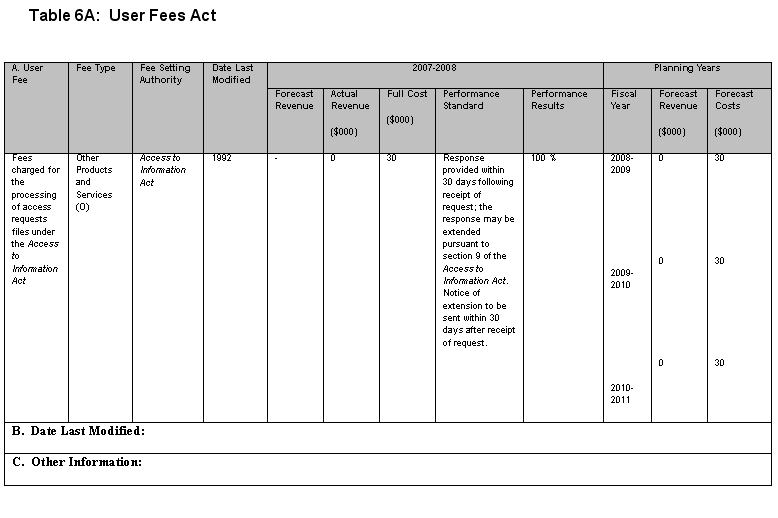
Click on image to enlarge.
Correctional Service Canada
Table 6a - User Fees Act (Online Table)
| A. User Fee |
Fee Type | Fee setting Authority |
Date Last Modified | 2007-2008 | Planning Years | ||||||
|---|---|---|---|---|---|---|---|---|---|---|---|
| Forecasted Revenues ($000) |
Actual Revenues ($000) |
Full Cost ($000) |
Performance Standards | Performance Results | Fiscal Year | Forecasted Revenue ($000) |
Estimated Full Cost ($000) |
||||
| Fees charged for the processing of access requests filed under the Access to Information Act (ATIA) | R | Access to Information Act | April 2004 | 3.3 | 3.0 | 2,400 | Requests should be responded to within 30 working days, unless extensions are warranted as per section 9 of the Act. TB Secretariat is presently reviewing all policies related to the ATI legislation. For more info, see ATI legislation on the Justice website. | 68% on time | 2008-09 2009-10 2010-11 |
3.3 3.5 3.5 |
3,800 5,300 5,300 |
| Sub-Total (O) Sub-Total (R) Total |
0.0 3.3 3.3 |
0.0 3.0 3.0 |
0.0 2,400 2,400 |
2008-09 2009-10 2010-11 |
3.3 3.5 3.5 |
3,800 5,300 5,300 |
|||||
|
B. Date Last Modified: N/A |
|||||||||||
|
C. Other Information N/A |
|||||||||||
Table 6b - Policy on Service Standards for External Fees
| A. External | Service Standard | Performance Result | Stakeholder Consultation |
|---|---|---|---|
| Fees charged for the processing of access requests filed under the Access to Information Act (ATIA) | Response provided within 30 days following receipt of request; the response time may be extended pursuant to section 9 of the ATIA. Notice of extension to be sent within 30 days after receipt of request. Due to staff shortage and a realignment of ATI responsibilities, there has been a significant decrease in the compliance rate. | 68 percent on time for ATI requests | The service standard is established by the Access to Information Act and the Access to Information Regulations. Consultations with stakeholders were undertaken by the Department of Justice and the Treasury Board Secretariat for amendments done in 1986 and 1992. |
Department of Finance Canada
Table 5: User Fees and External Fees
| A. User Fee | Fee Type |
Fee Setting Authority |
Date Last Modified |
2007–08 | Planning Years | ||||||
|
Forecast Revenue ($000) |
Actual Revenue ($000) |
Full Cost ($000) |
Performance Standard |
Performance Results | Fiscal Year |
Forecast Revenue ($000) |
Estimated Full Cost ($000) |
||||
| Fees charged for the processing of access requests filed under the Access to Information Act | Other products and services (O) | Access to Information Act | 1992 | 14 | 5 | 979 | Performance standards in accordance with the Access to Information Act and its associated regulations | Statutory deadlines were met 92% of the time |
2008–09 2009–10 2010–11 |
4 4 4 |
940 960 980 |
|
B. Date Last Modified Not applicable |
|||||||||||
|
C. Other Information It is the Department's practice to waive fees when the fee is less than $25. Exceptionally, when the circumstances warrant it, additional fees may be waived. |
|||||||||||
Table 5–B: Policy on Service Standards for External Fees
| A. External Fee | Service Standard | Performance Result | Stakeholder Consultation |
| Fees charged for the processing of access requests filed under the Access to Information Act |
Performance standards in accordance with the Access to Information Act and its associated regulations (see http://laws.justice.gc.ca/ en/A-1) |
Statutory deadlines were met 92% of the time | The service standard is established under the Access to Information Act and its associated regulations. Consultations with stakeholders were undertaken for amendments to regulations made in 1986 and 1992. |
|
B. Other Information Not applicable |
|||
Department of Foreign Affairs and International Trade
Table 6: User Fees/External Fees
Table 6.1–A: User Fees Act-Access to Information
| 2007-2008 | Planning Years | ||||
| Forecast Revenue |
Actual Revenue |
Full Cost | Fiscal Year | Forecast Revenue |
Estimated Full Cost |
| (in thousands of dollars) | |||||
| 8.5 | 98.4 | 2,530 (note 1) |
2008-2009 2009-2010 2010-2011 |
103 108 113 |
5,021 3,900 3,900 |
| User Fee: Fees charged for the processing of access requests filed under the Access to Information Act (ATIA) | |||||
| Fee Type: Other products and services | |||||
| Fee Setting Authority: Access to Information Act and Access to Information Regulations | |||||
| Date Last Modified: 1992 | |||||
| Performance Standard: Response provided within 30 days following receipt of request; the response time may be extended pursuant to section 9 of the ATIA. Notice of extension to be sent within 30 days after receipt of request. The Access to Information Act provides fuller details: http://laws.justice.gc.ca/en/A-1/218072.html |
|||||
| Performance Results: Statutory deadlines met 63% of the time | |||||
| Other information: The department has experienced an average annual increase in ATIA-related activities of 13.2% over the last 12 years. The department is implementing a comprehensive business plan to address the performance gap in processing of access requests and intends to significantly improve service in the short and long term. Estimated costs for future years are based on the approval of a business plan that would increase the size of the Access to Information and Privacy Protection Division by 22 positions and include a one-time allocation of funds for consultants in order to clear the backlog. | |||||
1. This reflects only those costs incurred directly by the Access to Information and Privacy Protection Division and does not reflect the total cost to the department.
Table 6.1–B: Policy on Service Standards for External Fees–Access to Information
|
External Fee |
Service Standard1 |
Performance Results2 |
Stakeholder Consultation |
| Fees charged for the processing of access requests filed under the Access to Information Act (ATIA) pursuant to the Access to Information Regulations. |
Response provided within 30 days following receipt of request; the response time may be extended pursuant to section 9 of the ATIA. Notice of extension to be sent within 30 days after receipt of request. The Access to Information Act provides fuller details: http://laws.justice.gc.ca/en/A-1/218072.html. The Office of the Information Commissioner has, in the past, considered a performance rate of 85% as standard and 80% as failure. |
Statutory deadlines met 63% of the time. | The service standard is established by the Access to Information Act and the Access to Information Regulations. Consultations with stakeholders were undertaken by the Department of Justice and the Treasury Board Secretariat for amendments done in 1986 and 1992. |
| Other Information: The department has experienced an average annual increase in ATIA-related activities of 13.2% over the last 12 years. The department is implementing a comprehensive business plan to address the performance gap in processing of access requests and intends to significantly improve service in the short and long term. Estimated costs for future years are based on the approval of a business plan that would increase the size of the Access to Information and Privacy Protection Division by 22 positions and include a one-time allocation of funds for consultants in order to clear the backlog. | |||
1. As established pursuant to the Policy on Service Standards for External Fees:
- service standards may not have received parliamentary review; and
- service standards may not respect all performance standard establishment requirements under the User Fees Act (e.g. international comparison; independent complaint address).
2. Performance results are not legally subject to section 5.1 of the User Fees Act regarding fee reductions for unachieved performance
Table 6.2–A: User Fees Act–International Youth Program
| 2007-2008 | Planning Years | ||||
| Forecast Revenue |
Actual Revenue |
Full Cost | Fiscal Year | Forecast Revenue |
Estimated Full Cost |
| (in thousands of dollars) | |||||
| 5,500 | 4,532 | 4,532 | 2008-2009 2009-2010 2010-2011 |
7,100 7,900 8,800 |
7,100 7,900 8,800 |
| User Fee: International Youth Program (IYP) | |||||
| Fee Type: Other: program participation fee | |||||
| Fee Setting Authority: TBS Charging Policy Authorization No. 828483 pursuant to section 19(1)(b) of the Financial Administration Act and subsection 4(2) of the User Fees Act | |||||
| Date Last Modified: October 2007 | |||||
| Performance Standard: Young foreigners who pay the $150 fee and who are eligible to participate in the IYP can expect to have their applications reviewed and processed and to receive their "Letters of Introduction" or rejection notice from Citizenship and Immigration Canada (CIC) within approximately 4 weeks. Refunds are issued to non-eligible applicants. | |||||
| Performance Results: 63% of all applications were finalized within 28 days of receipt | |||||
Table 6.2–B: Policy on Service Standards for External Fees–International Youth Program
|
External Fee |
Service Standard1 |
Performance Results2 |
Stakeholder Consultation |
| International Youth Program participation fee | 4 weeks | 63% of all applications were finalized within 28 days of receipt. | Consultations for the implementation and level of fee were undertaken with stakeholders for the countries to which the fee was applied in January 2008. For Australia and New Zealand, which have been charging a fee since 2000, yearly consultations are conducted with relevant stakeholders to ensure reciprocity of fees and that costs do not exceed revenues as per the User Fees Act. |
| Other Information: The International Youth Program facilitates access to work permits for Canadian and international youths with which Canada has either bilateral or multi-lateral arrangements. The Program Participation Fees are only paid by international youths participating in the program. The rate of response to an applicant's request for a letter of introduction (which accesses a work permit) is the performance on which the standard is based. The IYP uses the performance standards set by Citizenship and Immigration Canada for the rate of response to requests for work permits, which is four (4) weeks. Further information on this CIC user fee is available at The International Youth Program facilitates access to work permits for Canadian and international youths with which Canada has either bilateral or multi-lateral arrangements. The Program Participation Fees are only paid by international youths participating in the program. The rate of response to an applicant's request for a letter of introduction (which accesses a work permit) is the performance on which the standard is based. The IYP uses the performance standards set by Citizenship and Immigration Canada for the rate of response to requests for work permits, which is four (4) weeks. Further information on this CIC user fee is available at www.tbs-sct.gc.ca/dpr-rmr/2006-2007/inst/imc/imc06-eng.asp. | |||
1. As established pursuant to the Policy on Service Standards for External Fees:
- service standards may not have received parliamentary review; and
- service standards may not respect all performance standard establishment requirements under the User Fees Act (e.g. international comparison; independent complaint address).
2. Performance results are not legally subject to section 5.1 of the User Fees Act regarding fee reductions for unachieved performance
Table 6.3–A: User Fees Act–Export/Import Fees
| 2007-2008 | Planning Years | ||||
| Forecast Revenue |
Actual Revenue |
Full Cost | Fiscal Year | Forecast Revenue |
Estimated Full Cost |
| (in thousands of dollars) | |||||
| 12,500 | 9,500 | 20,255 | 2008-2009 2009-2010 2010-2011 |
12,000 12,000 12,000 |
12,000 12,000 12,000 |
| User Fee: Fees for the issuance of export and import certificates and permits | |||||
| Fee Type: Other product and services | |||||
| Fee Setting Authority: Export and Import Permits Act (EIPA) Export and Import Permits and Certificates Fees Order. | |||||
| Date Last Modified: 1995 | |||||
| Performance Standard: Deliver non-routed permits within 15 minutes of the time of application; process within 4 business hours import and export permit applications that are automatically redirected (routed) to the bureau’s officers or which have been flagged for an officer’s review by the applicant when no additional information or documentation is required. | |||||
| Performance Results: 98.66% success rate on the processing of 844,000 + applications. | |||||
Table 6.3–B: Policy on Service Standards for External Fees–Export/Import Fees
|
External Fee |
Service Standard1 |
Performance Results2 |
Stakeholder Consultation |
| Fees for the issuance of export and import certificates and permits | Deliver non-routed permits within 15 minutes of the time of application; process within 4 business hours import and export permit applications that are automatically redirected (routed) to the bureau's officers or which have been flagged for an officer's review by the applicant when no additional information or documentation is required. | 98.66% success rate on the processing of 844,000 + applications in 2007-2008. | The Export Import Control Bureau is fully committed to compliance with the TB Policy on Service Standards for External Fees. Service standards are currently being reviewed. Stakeholder surveys are being prepared and will be distributed in early fall. |
| Other Information: Performance will be evaluated and results will be communicated to stakeholders as per the TB Policy. | |||
1. As established pursuant to the Policy on Service Standards for External Fees:
- service standards may not have received parliamentary review; and
- service standards may not respect all performance standard establishment requirements under the User Fees Act (e.g. international comparison; independent complaint address).
2. Performance results are not legally subject to section 5.1 of the User Fees Act regarding fee reductions for unachieved performance
Table 6.4/6.5–A: User Fees Act–Consular
1. Consular Service Fee
| 2007-2008 | Planning Years | ||||
| Forecast Revenue |
Actual Revenue |
Full Cost (note 1) |
Fiscal Year | Forecast Revenue |
Estimated Full Cost |
| (in thousands of dollars) | |||||
| 70,000 | 96,727 | 72,617 | 2008-2009 2009-2010 2010-2011 |
110,000 100,000 100,000 |
85,000 100,000 100,000 |
| 2006-2007 (note 2) | |||||
| 64,900 | 76,453 | 133,838 | |||
| 2005-2006 (note 2) | |||||
| 66,200 | 65,175 | 74,249 | |||
| User Fee: Consular Service Fee | |||||
| Fee Type: Other products and services | |||||
| Fee-Setting Authority: Consular Services Fees Regulations http://laws.justice.gc.ca/en/E-22/SOR-95-538/index.html pursuant to the Department of Foreign Affairs and International Trade Act | |||||
| Date Last Modified: The Consular Service Fee was introduced on November 8, 1995. It has not been modified. (See note 1, below.) | |||||
2. Specialized Consular Services Fees
| 2007-2008 | Planning Years | ||||
| Forecast Revenue |
Actual Revenue |
Full Cost (note 1) |
Fiscal Year | Forecast Revenue |
Estimated Full Cost |
| (in thousands of dollars) | |||||
| 3,100 | 3,618 | 3,818 | 2008-2009 2009-2010 2010-2011 |
4,000 3,600 3,600 |
4,000 3,800 3,800 |
| 2006-2007 (note 2) | |||||
| 64,900 | 76,453 | 133,838 | |||
| 2005-2006 (note 2) | |||||
| 66,200 | 65,175 | 74,249 | |||
| User Fee: Specialized Consular Services Fees | |||||
| Fee Type: Other products and services | |||||
| Fee-Setting Authority: Consular Fees (Specialized Services) Regulations www.voyage.gc.ca/main/about/consular_fees-en.asp#1 pursuant to paragraph 19(1) (a) of the Financial Administration Act | |||||
| Date Last Modified: Fees have been collected since 1958 pursuant to the Regulations Respecting the Fees to Be Charged for Consular Services, SOR/58-133. The most recent modification occurred in 1998 with the coming into force of the Consular Fees (Specialized Services) Regulations. | |||||
|
Consular Service Fee and Specialized Consular Services Fees Performance standards: Services are based on written service standards, which detail the services to be provided, along with qualitative and quantitative standards to be used by employees. The service standards are available at www.voyage.gc.ca/main/about/service_standards-en.asp as well as at all missions abroad, where they are either in public view or can be provided by employees. These service standards were established in 1995 and are in need of a comprehensive review. As well, technical and resource constraints have impeded
the department’s ability to report on performance against the full range of these standards (with the exception of passport, citizenship and arrest/detention services). This reporting gap was noted in the May 2008 Report of the Auditor General of Canada. It is the department’s intention to initiate a review of the standards in 2008-2009 with a view to
establishing more meaningful standards and, in turn, better public reporting. Consular services are provided to Canadians abroad 24 hours a day, 7 days a week, at more than 260 points of service around the world. Outside regular business hours, calls are forwarded to the Emergency Operations Centre in Ottawa. Emergency situations are dealt with immediately. Every effort is made to obtain solutions for specific problems and to provide the required service. However, the department’s ability to do so and its success are conditioned, in many instances, by the laws and regulations of other countries as well as the quality and level of cooperation offered by persons and organizations outside the Government of Canada. |
|
Consular Service Fee Performance Results: In 2007-2008, consular officers dealt with over 1.3 million requests for consular services, which resulted in 255,605 cases being opened. Feedback indicated that 93% of respondents were satisfied or very satisfied with the overall service that they received. Efforts to increase the number of client feedback forms
returned, and to expand the number of participating missions, have shown results. The number of client feedback forms received in 2007-2008 was more than double that of the year before, rising from 1,205 to 2,708. As well, the number of participating missions has grown to 129, which represents nearly half of the consular points of service around the world. An airport
survey undertaken in March 2008 found that travellers who were familiar with the travel advisories on the consular website (www.voyage.gc.ca) were very positive in their assessment of this information source, with 87% saying it was very or somewhat useful. The same survey also found that 95% of travellers trusted the information provided by the government. In previous years, the department has reported performance against passport, citizenship and arrest/detention service standards in the consular narrative portion of the DPR. For 2007-2008, this information is noted below:
|
| Specialized Consular Services Fees Performance Results: Missions abroad reported dealing with 85,778 legal/notary cases (which included service delivery and related inquiries) in 2007. Client feedback from 222 clients demonstrated an overall satisfaction level with the legal/notary service of 91.6%. |
| Other Information: The May 2008 Report of the Auditor General of Canada found that "Foreign Affairs and International Trade Canada has approved standards for the consular services fee and tracks performance against some of these standards, but does not report performance against any of these standards to Parliament and the public. Instead, the Department
reports on levels of client satisfaction based on a small-scale survey of Canada’s more than 200 consular offices and range of consular services provided." The report recommended that the department "should consider improving transparency of their fees that were subject to this audit by providing more complete public reporting of their financial and non-financial
performance information." The department agrees with this recommendation and will be reviewing the existing Consular Services Standards in light of the department’s recently approved Program Activity Architecture and the soon to be approved Performance Measurement Framework, with the intention of establishing more meaningful standards and, in turn, better public reporting. Appropriate changes will be initiated in accordance with the provisions of the User Fees Act and reflected in the department’s reporting to Parliament in its Departmental Performance Report. |
Notes:
1. Temporary surpluses for the Consular Service Fee: The full costing information provided for fiscal year 2007-2008 reveals a surplus of revenues over costs of $24.762 million. A surplus of $25.0 million is also estimated for fiscal year 2008-2009. These surpluses reflect a temporary increase in revenues resulting from a spike in demand due to changes in passport
requirements for travel to the United States of America. The estimated decline in revenues in fiscal years 2009-2010 and 2010-2011, combined with planned investments in the Consular program to improve the consular services provided to Canadians, is forecasted to result in the elimination of these surpluses.
2. Prior Years: Full costing information for the Consular Service Fee and the Specialized Consular Services Fees has also been provided for fiscal years 2005-2006 and 2006-2007, as this information was not previously disclosed in the published Departmental Performance Reports.
Table 6.4/6.5–B: Policy on Service Standards for External Fees–Consular Service and Specialized Consular Service
| External Fee | Service Standard1 | Performance Results2 | Stakeholder Consultation |
| 6.4-B: Consular Service Fee |
Consular services are based on written service standards (established in 1995), which detail the services to be provided, along with qualitative and quantitative standards to be used by employees. The service standards are available at www.voyage.gc.ca/main/about/ service_standards-en.asp as well as at all missions abroad, where they are either in public view or can be provided by employees. Consular services are provided to Canadians abroad 24 hours a day, 7 days a week, at more than 260 points of service around the world. Outside regular business hours, calls are forwarded to the Emergency Operations Centre in Ottawa. Emergency situations are dealt with immediately. |
See Table 6.4/6.5-A | The consular service standards were developed following consultations with Canadians at approximately 80 missions around the world and selected clients in Canada. Surveys were also conducted at the international airports in Toronto, Montreal and Vancouver. |
| 6.5-B: Specialized Consular Services Fees | These standards are available to clients online at www.voyage.gc.ca/main/about/ service_standards-en.asp and at all missions abroad. Clients are invited to comment if they did not receive the level of service they expected, or if they wish to make suggestions. |
See Table 6.4/6.5-A | The consular service standards were developed following consultations with Canadians at approximately 80 missions around the world and selected clients in Canada. Surveys were also conducted at the international airports in Toronto, Montreal and Vancouver. |
|
Other Information: Consular Service Fee The fees collected by Passport Canada include a consular fee of $25, which is collected on behalf of the department and credited to the Consolidated Revenue Fund. This fee offsets the costs of providing consular services to Canadians in distress abroad. Consular services range from routine information requests to cases involving international abduction of children, medical emergencies and evacuations, arrest or detention, death of Canadians abroad, and emergency evacuation in the event of natural disasters or crises. Service standards are available to clients online and at all missions abroad. Clients are invited to comment if they did not receive the level of service they expected, or if they wish to make suggestions. Other Information: Specialized Consular Services Fees |
|||
1. As established pursuant to the Policy on Service Standards for External Fees:
- service standards may not have received parliamentary review; and
- service standards may not respect all performance standard establishment requirements under the User Fees Act (e.g. international comparison; independent complaint address).
2. Performance results are not legally subject to section 5.1 of the User Fees Act regarding fee reductions for unachieved performance
Table 6.6–A: User Fees Act–Passport Canada
| 2007-2008 | Planning Years | ||||
| Forecast Revenue |
Actual Revenue |
Full Cost | Fiscal Year | Forecast Revenue |
Estimated Full Cost |
| (in thousands of dollars) | |||||
| 239,208 | 289,738 | 284,975 | 2008-2009 2009-2010 2010-2011 |
276,583 246,173 246,173 |
276,583 246,173 246,173 |
| User Fee: Passport Canada | |||||
| Fee Type: Other products and services | |||||
| Fee Setting Authority: Passport Service Fees Regulation | |||||
| Date Last Modified: December 2001 | |||||
| Performance Standard: The standard turnaround times are 10 days for over-the-counter applications and 20 days for receiving agents and mail-in applications. | |||||
| Performance Results: In 2007-2008, turnaround standards were met for 75.7% of applications through all channels. The median number of days to process applications received through our regional offices was 9 days; for receiving agents and mail-in applications it was 20 days. | |||||
Table 6.6–B: Policy on Service Standards for External Fees–Passport Canada Revolving Fund
| External Fee | Service Standard1 | Performance Results2 | Stakeholder Consultation |
| Passport Canada Revolving Fund | The standard turnaround times in working days are: Offices, Regular services: 10 Offices, Urgent services: next working day Offices, Express services: 2 to 9 Mail-in, Regular services: 20 Canada Post Receiving Agent, Regular services: 15 Service Canada Receiving Agent, Regular services: 20 |
In 2007-2008, turnaround standards were met for 75.7% of applications through all channels. Standards for urgent and express services were met for 99% of applications. The median number of days to process applications received through our regional offices was 9 days; for receiving agents and mail-in applications it was 20 days. | N/A |
1. As established pursuant to the Policy on Service Standards for External Fees:
- service standards may not have received parliamentary review; and
- service standards may not respect all performance standard establishment requirements under the User Fees Act (e.g. international comparison; independent complaint address).
2. Performance results are not legally subject to section 5.1 of the User Fees Act regarding fee reductions for unachieved performance
Table 6.0–A: User Fees Act–Totals
| 2007-2008 | Planning Years | ||||
| Forecast Revenue |
Actual Revenue |
Full Cost | Fiscal Year | Forecast Revenue |
Estimated Full Cost |
| (in thousands of dollars) | |||||
| 330,317 | 404,213 | 388,727 | |||
| Other Information: The departmental performance reports for 2005-2006 and 2006-2007 reported Property-Related Lettings and Sublettings. A recent legal opinion found that this Cost Recovery (lease of public property) is not subject to the reporting requirements of the User Fees Act, and for this reason they are no longer reported in the Departmental Performance Report. | |||||
Department of Justice Canada
Table 4-A: User Fees Act
| 2007–2008 | Planning Years | ||||||||||
|
User Fee
|
Fee Type
|
Fee-setting Authority
|
Date Last Modified
|
Forecast Revenue ($000) |
Actual Revenue ($000) |
Full Cost ($000) |
Performance Standard | Performance Results | Fiscal Year | Forecast Revenue ($000) |
Estimated Full Cost ($000) |
| The family Order and Agreements Enforcement Assistance (FOAEA) |
Regulatory
|
FOAEA Act |
March 1999 |
6,000 | 7,284 | 7,284 | Yes | Results are available in table 4-B |
08/09 09/10 10/11 |
6,000 7,000 7,000 |
6,000 7,000 7,000 |
|
The Central Divorce Proceedings
|
Regulatory
|
CRDP Fee Order |
May 1986 |
750
|
762
|
762
|
Yes | Results are available in table 4-B |
08/09 09/10 10/11 |
800 800 800 |
800 800 800 |
| Fees charged for the processing of access requests filed under the Access to Information Act (ATIA) |
Other product and services
|
Access to Information Act (ATIA)
|
1992
|
4.0
|
2.2
|
1,636
|
Yes
|
Results are available in table 4-B
|
08/09
09/10 10/11 |
4.2
4.5 4.8 |
2,000
2,250 2,500 |
|
Total
6,754.0 |
Total
8,048.2 |
Total
9,682.0 |
Subtotal 08/09 Subtotal 09/10 Subtotal 10/11 |
6,804.2
7,804.5 7,804.5 |
8,800
10,050 10,300 |
||||||
| B. Date Last Modified N/A | |||||||||||
| C. Other Information ATIA Full cost reflects the cost of the Access to Information and Privacy (ATIP) Office in Justice. The role of the ATIP Office is to respond to all formal requests that are made to the Department of Justice, in accordance with the Access to Information Act. As other central agencies, the DOJ ATIP Office has an expanded role; in addition to processing requests, the Office responds to consultations from other government institutions regarding solicitor-client information for the Government as a whole. Although the User Fees Act may provide some of the performance indicators, fee waiver must be considered in light of the ATIP legislation. |
|||||||||||
Table 4 B: Policy on Service Standards for External Fees
|
External Fee
|
Service Standard
|
Performance Results
|
Stakeholder Consultation
|
| The family Order and Agreements Enforcement Assistance (FOAEA) |
|
A total of 25,858 applications received and treated within 10 business days. Standard met at 100%.
69,087 garnishment applications accepted within the time frame. Standard met at 100%. 10,794 applications received and processed within the time frame. Standard met at 100%. 89,707 calls received through the automated interactive voice response system (IVR).Standard met at 90%. |
Informal feedback and general day-to-day interactions with clients and stakeholders, including provincial and territorial maintenance and enforcement programs, courts, creditors and other federal government partners, indicate a high level of satisfaction with the services provided under both the Family Orders and Agreement Enforcement Assistance and Central Registry of
Divorce Proceedings programs.
A client satisfaction survey was launched in January 2005 to provide a more formal assessment of client satisfaction with service standards, levels and accessibility. Findings indicate strong levels of satisfaction |
|
The Central Divorce Proceedings
|
|
Standard met at 90%. Standard met 100%. 16,093 telephone enquires and written enquiries was received and standard was met at 90%. Standard met at 100%. |
A client satisfaction survey was launched in January 2005 to provide a more formal assessment of client satisfaction with service standards, levels and accessibility. Findings indicates strong levels of satisfaction.
|
| Fees charged for the processing of access requests filed under the Access to Information Act (ATIA) |
Response provided within 30 days following receipt of request; the response time may be extended pursuant to section 9 of the ATIA. Notice of extension to be sent within 30 days after receipt of request.
The Access to Information Act provides fuller details: http://laws.justice.gc.ca/en/A-1 |
Standard met at 95.0%.
|
The service standard is established by the Access to Information Act and the Access to Information Regulations. Consultations with stakeholders were undertaken by the Department of Justice and Treasury Board Secretariat for amendments done in 1986 and 1992.
|
| Other Information N/A |
Economic Development Agency of Canada for the Regions of Quebec
Table 6A : User Fees Act
| (in thousands of dollars) | 2007-2008 | Planning years | |||||||||
|---|---|---|---|---|---|---|---|---|---|---|---|
| Fee type | Fee-setting authority | Date last modified | Planned revenue | Actual revenue | Full cost | Performance standard | Performance results | Fiscal year | Planned revenue | Estimated full cost | |
| A. User fee | |||||||||||
| Fees charged for processing access requests submitted to the Agency under the Access to Information Act | Other products and services | Access to Information Act | 1992 | 0.2 | 0.18 | 67.8 | Response must be provided within 30 days following receipt of request. Pursuant to Section 9 of the Act, the response time may be extended; notice of extension must be sent within 30 days after receipt of request. Further details on the Access to Information Act can be found at: http://laws.justice.gc.ca/en/ A_1/index.html |
Response given to 55% of requests within the prescribed 30-day timeframe | 2008-2009 | 0.2 | 73.0 |
| 2009-2010 | 0.2 | 75.0 | |||||||||
| 2010-2011 | 0.2 | 77.0 | |||||||||
| B. Date last modified: March 31, 2008 | |||||||||||
| C. Other information: N/A | |||||||||||
Table 6B: Policy on service standards for external fees
| User fee | Service standard | Performance results | Stakeholder consultation |
|---|---|---|---|
| Fees charged for processing access requests submitted to the Agency under the Access to Information Act | Response must be provided within 30 days following receipt of request. Pursuant to Section 9 of the Act, the response time may be extended; notice of extension must be sent within 30 days after receipt of request. Further details on the Access to Information Act can be found at: http://laws.justice.gc.ca/en/ A_1/index.html |
Agency responded to 55% of requests within the prescribed 30-day timeframe | The service standard is established by the Access to Information Act and Access to Information Regulations |
Some of the information requests submitted to the Agency under the Access to Information Act required longer processing time than the prescribed deadline due mainly to their complexity. Indeed, several of these required consultation with third parties and government agencies. The Agency improved its response time by 9% over 2006-2007.
Environment Canada
User Fees
| A. Fee Category | Fee Type | Fee Setting Authority | Date Last Modified | 2007-2008 | Planning Years | ||||||
| Forecast Revenue ($000) | Actual Revenue ($000) | Full Cost ($000) |
Performance Standards |
Performance Result | Fiscal Year | Forecast Revenue ($000) | Estimated Full Cost ($000) | ||||
| Regulatory Service | |||||||||||
| Ocean Disposal Permit Application Fees | R | Canadian Eenvironmental Protection Act 1999(CEPA 1999)[1], ss.135(1); Disposal at Sea Regulations | 2001 | 200.0 | 215.0 | 1,021.0 |
Under the application fee, each application is reviewed according to Schedule 6 of CEPA 1999 and the Disposal at Sea Regulations. This involves public notice, an application that provides detailed data, scientific review and payment of fees. Each permit is published in the Canada Gazette from about 120 days of applying if the application is complete and there are no issues from other stakeholders. Under the permit fee, Environment Canada is committed to annual client meetings to review monitoring plans, conduct representative disposal site monitoring according to national guidelines, produce an annual report on activity, produce a financial summary of revenues, expenses and value for clients, and report results of monitoring to the Office for the London Convention. |
Met service standards. Applications were reviewed within the 120 day timeframe. Advice was provided to applicants to assist timely permit reviews. Monitoring plans were reviewed with key clients. Disposal site monitoring was conducted and reported. For further details see www.ec.gc.ca/ seadisposal/. |
2008-2009 (1) | 200.0 | 1,021.0 |
| 2009-2010 (1) | 200.0 | 1,021.0 | |||||||||
| 2010-2011 (1) | 200.0 | 1,021.0 | |||||||||
| B. Date Last Modified: | |||||||||||
| C. Other Information: | |||||||||||
|
Ocean Disposal Site Monitoring Fees |
R |
FAA[2], par. 19.1(a); Ocean Dumping Permit Fee Regulations (Site Monitoring) |
2001 | 1,300.0 | 1,065.0 | 1,300.0 |
The permittee has access to a permitted site and the ability to dispose of 1000 m3 of dredged or excavated material for each $470 paid. The collected revenue is used by the Disposal at Sea Program to operate a representative national disposal site monitoring program that allows the client group as a whole to continue to have access to suitable disposal sites and demonstrates that the resource is used sustainably for the Canadian public. |
Met the service standards. Permittees disposed of dredged and excavated by their permits. Representative monitoring was carried out in accordance with monitoring guidelines. |
2008-2009 | 1,400.0 | 1,300.0 |
| 2009-2010 (2) | 1,500.0 | 1,600.0 | |||||||||
| 2010-2011 (2) | 1,500.0 | 1,600.0 | |||||||||
| B. Date Last Modified: | |||||||||||
| C. Other Information: | |||||||||||
| New Substance Notification | R |
CEPA, 19991, s. 328, New Substances Fees < .> |
2002 | 400.0 | 500.0 | 2,200.0 |
All notifications are reviewed and decisions taken within the prescribed timeframes. Requests are acknowledged by letter, email or fax within 10 business days of receipt. |
All new substances notifications are processed and decisions taken within the legislative time period. Requests made by letter, email or fax are responded to 95% of the time within 10 days. |
2008-2009 |
400.0 | 2,200 |
| 2009-2010 | 400.0 | 2,200 | |||||||||
| 2010-2011 | 400.0 | 2,200 | |||||||||
| B. Date Last Modified: | |||||||||||
| C. Other Information: | |||||||||||
|
Migratory Bird Program - Migratory Game Bird Hunting Permit (3) |
R |
MBCA 1994[3], s. 12; Migratory Bird <>C.R.C., c. 1035 |
1998 - SOR/98-314 | 2,006.0 | 1,451.0 | 960.0 |
Hunting permits are sold for $8.50 at Canada Post Corporation (CPC) offices and selected provincial and private vendors from August 1 to March 10 of the following year. The performance standard is to ensure adequate numbers of permits are available for distribution within that timeframe. Permits validated by the Habitat Conservation Stamp are mandatory for migratory game bird hunting. The hunter and/or his/her representative must physically go to a vendor that sells the permit. The permit is bought on the spot; therefore, the service standard is that the hunter can get a hunting permit upon request. People purchasing the permit should receive one within minutes of completing the transaction. The permit fee was |
99.9% of permits were available to meet hunter demand within the specified time period. All permits that were purchased were delivered within minutes of purchase. There is an average of 4-5 complaints each year that permits were not |
2008-2009 | 2,006.0 | 960.0 |
|
2009-2010 |
2,006.0 | 960.0 | |||||||||
| 2010-2011 | 2,006.0 | 960.0 | |||||||||
| B. Date Last Modified: | |||||||||||
| C. Other Information: | |||||||||||
|
Migratory Bird Program - Habitat Conservation Stamp |
R |
MBCA 19943, s. 12; Migratory Bird <> |
1991 | 2,200.0 | 1,592.0 | 1,592.0 |
Conservation Stamps are sold for $8.50 each and must be affixed to the Migratory Game Bird Hunting Permit to validate it. The performance standard is to ensure adequate numbers of stamps are available for distribution at Canada Post Corporation (CPC) offices and selected provincial and private vendors from August 1 to March 10 of the following year. Stamps are also sold as collectables through CPC offices and vendors selected by Wildlife Habitat Canada (WHC). One canno t purchase a permit without the stamp pre-affixed to it therefore, the hunter and/or his/her representative must physically go to a vendor that sells the permit. The permit is bought on the spot thus the service standard is that the hunter receives a wildlife stamp affixed to the permit. People purchasing the permit should receive the stamp within minutes of doing the transaction. For Collectors: Stamps bought from CPC can be purchased by mail order, telephone, fax and at selected CPC offices and require a two-week processing period. Stamps bought from WHC selected vendors can be ordered in person, by telephone and mail order. Processing time is two weeks if not bought in person. Stamp fees increased |
Enough stamps to meet hunter and collector demands were available for purchase within the specified time period. Stamps bought from CPC by mail order, telephone, fax and at selected CPC offices have been processed within the two-week processing period. Stamps, bought from WHC selected vendors either in person, by telephone and mail order, are processed within the
two-week processing period. No complaints have been received that stamps were unavailable. |
2008-2009 (4) | 2,200.0 | 2,200.0 |
| 2009-2010 | 2,200.0 | 2,200.0 | |||||||||
| 2010-2011 | 2,200.0 | 2,200.0 | |||||||||
| B. Date Last Modified: | |||||||||||
| C. Other Information: With funds generated from Stamp revenue, Wildlife Habitat Canada funds several habitat conservation programs and projects that contribute to EC's key result "Biological diversity is conserved". | |||||||||||
|
Migratory Bird Program - Avicultural permits, Taxidermist permits and Eiderdown permits |
R |
MBCA 19943, s. 12; Migratory Bird Regulations |
Prior to 1978 | 8.7 | 15.8 | 34.0 |
These permits are issued by Environment Canada's regiona l offices for a fee of $10.00 each after reviewing applications from the public. To be successful, there are requirements that must be met, described in the CWS permit policy - for example with respect to aviculture, a person must demonstrate that they will do wing-clipping or keep the birds in an enclosure to prevent mixing with wild populations. Each region can attach specific conditions to each permit. Permits generally expire December 31 of the year issued. The performance standard is to review all applications received and issue permits or notify applicants of the reasons a permit is denied within 30 days of receiving the application. |
All applications are processed within the 30 day time frame unless site inspections are required. In those cases (10% of all the applications), an additional 30 days were required to process the application. |
2008-2009 |
8.2 | 34.0 |
| 2009-2010 | 8.2 | 34.0 | |||||||||
| 2010-2011 | 8.2 | 34.0 | |||||||||
| B. Date Last Modified: | |||||||||||
| C. Other Information: CWS is examining how best to deliver its permits for Migratory Birds including hunting, taxidermy and eiderdown. This work will take 3 to 5 years and will include further development of Service Standards and also include consultations with other government departments, regional compliance promotion groups and industry. | |||||||||||
|
Cap Tourmente National Wildlife Area - Permit <> |
R | CWA[4], s. 12; Wildlife Area Regulations | 2001 | 190.0 | 97.8 | 97.5 |
To add to the enjoyment of hunters during the hunting season at Cap Tourmente, facilities are well maintained: well-groomed trails and rest areas; adequate parking; sufficient washroom facilities; etc. These facilities are necessary to meet the needs of hunters, ensure that they have an enjoyable time and encourage them to return in future years. |
According to a survey conducted with hunters in 2005, there is a great deal of satisfaction with the quality and condition of the facilities. | 2008-2009 | 170.0 | 225.0 |
| 2009-2010 | 170.0 | 225.0 | |||||||||
| 2010-2011 | 170.0 | 225.0 | |||||||||
| B. Date Last Modified: | |||||||||||
| C. Other Information: | |||||||||||
| Other Products and Services | |||||||||||
|
Fees charged for the processing of access requests filed under the Access to Information Act (ATIA) |
O |
Access to Information Act, ss. 11(1) and par. 77(1)d); Access to Information Regulations |
1992 | 12.7 | 12.7 | 657.6 |
A response provided within 30 days following receipt of request; the response time may be extended pursuant to section 9 of the ATIA. A notice of extension must be sent within 30 days after receipt of the request. The Access to Information Act provides further details: http://laws.justice. gc.ca/en/A-1/ 218072.html |
Statutory deadlines were met 83% of the time. | 2008-2009 | 13.1 | 970.0 |
| 2009-2010 | 13.6 | 1,000.0 | |||||||||
| 2010-2011 | 14.1 | 1,030.0 | |||||||||
| B. Date Last Modified: N/A | |||||||||||
| C. Other Information: It is the Department's practice to waive fees where the total owing per request amounts to less than $25. | |||||||||||
|
Cap Tourmente National Wildlife Area - Entry Sales |
O | CWA4, s. 12; Canada Wildlife Area Regulations | 2003 | 231.0 | 168.7 | 236.7 |
To add to the enjoyment of visitors during the operating season at Cap Tourmente, facilities are well maintained: well-groomed trails and rest areas; adequate parking; sufficient washroom facilities; etc. These facilities are necessary to meet the needs of hunters, ensure that they have an enjoyable time and encourage them to return in future years. In addition, visitors have access to bilingual reception and interpretative services to assist in learning about the nature site and to respond to their questions. |
According to feedback received from a number of visitors, there is general satisfaction with the reception and interpretative services and the quality and condition of the facilities. | 2008-2009 | 226.0 | 260.0 |
| 2009-2010 | 226.0 | 260.0 | |||||||||
| 2010-2011 | 226.0 | 260.0 | |||||||||
| B. Date Last Modified: | |||||||||||
| C. Other Information: | |||||||||||
| Sub-Total R |
|
|
|
6,304.7 | 4,936.6 | 6,183.5 |
|
|
2008-2009 | 6,384.2 | 6,919.0 |
| 2009-2010 | 6,484.2 | 7,219.0 | |||||||||
| 2010-2011 | 6,484.2 | 7,219.0 | |||||||||
| Sub-Total O | 243.7 | 181.4 | 894.3 | 2008-2009 | 239.1 | 1,230.0 | |||||
| 2009-2010 | 239.6 | 1,260.0 | |||||||||
| 2010-2011 | 240.1 | 1,290.0 | |||||||||
| Total | 6,548.4 | 5,118.0 | 7,077.8 | 2008-2009 | 6,623.3 | 8,149.0 | |||||
| 2009-2010 | 6,723.8 | 8,479.0 | |||||||||
| 2010-2011 | 6,724.3 | 8,509.0 | |||||||||
Notes:
(1) The estimated full cost is based on budget information. A detailed analysis to determine the current cost of reviewing a permit is pending based on priority funding availability.
(2) Cost lags behind revenues due to the nature of the monitoring program. Increased activity in the north is anticipated in the near future, hence the increase in full cost with time.
(3) Fees for rights and privileges may exceed the cost of administering the program ensuring a fair market return for Canadian citizens.
(4) The cost of this program is attributed to a Grants and Contribution which is based directly on revenues received.
Legend:
R = Regulatory
O = Other Products and Services
[1] CEPA 1999 = Canadian Environmental Protection Act, 1999
[2]FAA = Financial Administration Act
[3]MBCA 1994 = Migratory Birds Convention Act, 19994
[4]CWA = Canada Wildlife Act
External Fees
| A. External Fee | |||
| Service Standard | Performance Result | Stakeholder Consultation | |
| Regulatory Services | |||
| Ocean Disposal Permit Application Fees | Under the application fee, each application is reviewed according to Schedule 6 of CEPA (Canadian Environmental Protection Act) and the Disposal at Sea Regulations. This involves public notice, an application that provides detailed data, scientific review and payment of fees. Each permit is published in the Canada Gazette from about 120 days of applying if the application is complete and there are no issues from other stakeholders. Under the permit fee, EC is committed to annual client meetings to review monitoring plans, conduct representative disposal site monitoring according to National guidelines, produce an annual report on activity, produce a financial summary of revenues, expenses and value for clients, and report results of monitoring to the London Convention office. |
Met service standards. Applications were reviewed within the 120-day timeframe. Advice was provided to applicants to assist timely permit reviews. Monitoring plans were reviewed with key clients. Disposal site monitoring was conducted and reported. For further details see www.ec.gc.ca/seadisposal/ |
Application fees set in 1993, were rolled over in 2001. A Regulatory Impact Assessment Statement and multistakeholder consultations were conducted before each regulation was enacted. Multistakeholder consultations were carried out in 1996-98 for setting the permit fee. There was general acceptance for the fee, but concern for how it would be set. Permittees indicated that a proportional volume-based fee was preferred. As well, EC (Environment Canada) committed to regular meetings with permit holders, to reporting, and to reviewing the fee three years after implementation. The review was done in 2003 and its report concluded no change to the fee was needed. All consultations from 1993-2003 involved discussion papers, public meetings and final reports. For further details see www.ec.gc.ca/seadisposal/regs/min_reg_g2_e.html |
| B. Other Information: | |||
| Ocean Disposal Site Monitoring Fees | The permittee has access to a permitted site and ability to dispose of 1000 cu m of dredged or excavated material for each $470 paid. The collected revenue is used by the Disposal at Sea program to operate a representative national disposal site monitoring program which allows the client group as a whole to continue to have access to suitable disposal sites and demonstrates that the resource is used sustainably for the Canadian public. | Met the service standards. Permittees disposed of dredged and excavated material as authorized by their permits. Representative monitoring was carried out in accordance with monitoring guidelines. | Multistakeholder consultations were carried out in 1996-98 for setting the permit fee. There was general acceptance for the fee, but concern for how it would be set. Permittees indicated that a proportional volume-based fee was preferred. As well, EC committed to regular meetings with permit holders, to reporting, and to reviewing the fee three years after implementation. The review was done in 2003 and its report concluded that no change to the fee was needed. Further consultations were undertaken from 1993-2003 involving discussion papers, public meetings and final reports. For further details see www.ec.gc.ca/seadisposal/regs/min_reg_g2_e.html. |
| B. Other Information: | |||
| New Substance Notification | All notifications are reviewed and decisions taken within the prescribed timeframes. Requests are acknowledged by letter, e-mail or fax within 10 business days of receipt. | All new substances notifications are processed and decisions taken within the legislative time period. Requests made by letter, e-mail or fax are responded to 95% of the time within 10 days. | Amendments to the New Substances Notifications Regulations were published in Canada Gazette Part II in September 2005. Under the Service Delivery Improvement Initiative of the New Substances Division, a Service Charter was developed. Other government departments, regional compliance promotion groups and industry had an opportunity for input into the service charter and standards. |
| B. Other Information: | |||
|
Migratory Bird Program- Migratory Game Bird Hunting Permit |
Hunting permits are sold for $8.50 at Canada Post Corporation (CPC) offices and selected provincial and private vendors from August 1st until March 10th the following year. The performance standard is to ensure adequate numbers of permits are available for distribution within that timeframe. Permits validated by the Habitat Conservation Stamp are mandatory for migratory game bird hunting. The hunter and/or his/her representative must physically go to a vendor that sells the permit. The permit is bought on the spot; therefore, the service standard is that the hunter can get a hunting permit upon request. People purchasing the permit should receive one within minutes of completing the transaction. |
99.9% of permits were available to meet hunter demand within the specified time period. All permits that were purchased were delivered within minutes of purchase. There is an average of 4-5 complaints each year that permits were not available from CPC because the CPC outlet did not re-order more stock. Issues like this are rectified by CPC within 2 days. |
Every year, Canadian Wildlife Service (CWS) consults with stakeholders when amending the hunting regulations. Amendments to the Migratory Bird Hunting Regulations are published in Canada Gazette Part II. This allows for the general public and all concerned Canadians to provide their comments and voice their opinion. This provides an opportunity to voice concerns about service standards as well. In addition, CWS is examining how best to deliver its permits for Migratory Birds including hunting, taxidermy and eiderdown. This work will take 3 to 5 years and will include further development of Service Standards and also include consultations with other government departments, regional compliance promotion groups and industry. |
| B. Other Information: | |||
|
Migratory Bird Program- Habitat Conservation Stamp |
Conservation Stamps are sold for $8.50 each and must be affixed to the Migratory Game Bird Hunting Permit to validate it. The performance standard is to ensure adequate numbers of stamps are available for distribution at Canada Post Corporation (CPC) offices and selected provincial and private vendors from August 1st until March 10th the following year. Stamps are
also sold as collectables through CPC offices and vendors selected by Wildlife Habitat Canada (WHC). One cannot purchase a permit without the stamp pre-affixed to it, therefore, the hunter and/or his/her representative must physically go to a vendor that sells the permit. The permit is bought on the spot, thus the service standard is that the hunter receives a wildlife
stamp affixed to the permit. People purchasing the permit should receive the stamp within minutes of doing the transaction. For Collectors: Stamps bought from CPC can be purchased by mail order, telephone, FAX and at selected CPC offices and require a two-week processing period. Stamps bought from WHC selected vendors can be ordered in person, by telephone and mail order. Processing time is two weeks if not bought in person. |
Enough stamps to meet hunter and collector demands were available for purchase within the specified time period. Stamps bought from CPC by mail order, telephone, FAX and at selected CPC offices have been processed within the two-week processing period. Stamps bought from WHC selected vendors, either in person, by telephone or by mail order, have been processed
within the two-week processing period. No complaints have been received that stamps were unavailable. |
CWS conducted a program evaluation in 2005-06 of WHC (Wildlife Habitat of Canada) and the stamp program. Stakeholders within the Federal/Provincial governments as well as those in the NGO (Non-Government Organizations) community were interviewed. The published results can be found on Environment Canada's, Audit and Evaluation website ( www.ec.gc.ca/ae-ve ). The price of single stamps is fixed by Regulations. Booklets of Stamps, etc. are sold at a retail price mutually agreed to by both EC and WHC and in accordance with established practices of the philatelic industry; TB reapproved the contribution agreement in 2002 (see http://www.cws-scf.ec.gc.ca/birds/status/index_e.cfm ). |
| B. Other Information: With funds generated from Stamp revenue, Wildlife Habitat Canada funds several habitat conservation programs and projects that contribute to EC's key result "Biological diversity is conserved". | |||
|
Migratory Bird Program- Avicultural permits, Taxidermist permits and Eiderdown permits |
These permits are issued by EC regional offices for a fee of $10.00 each after reviewing applications from the public. To be successful, there are requirements that must be met, described in the CWS Permit Policy - for example with respect to aviculture, a person must demonstrate that they will wing-clipping or keep the birds in an enclosure to prevent mixing with wild populations. Each region can attach specific conditions to each permit. Permits generally expire December 31st of the year issued. The performance standard is to review all applications received and issue permits or notify applicants of the reasons a permit is denied within 30 days of receiving the application. |
All applications are processed within the 30 days timeframe unless site inspections are required. In those cases (10% of all the applications), an additional 30 days were required to process the application. |
CWS is examining how best to deliver its permits for Migratory Birds including hunting, taxidermy and eiderdown. This work will take 3 to 5 years and will include further development of Service Standards and also include consultations with other government departments, regional compliance promotion groups and industry. |
| B. Other Information: | |||
|
Cap Tourmente National Wildlife Area- Permit Sales |
To add to the enjoyment of hunters during the hunting season at Cape Tourmente, facilities are well maintained: well groomed trails and rest areas; adequate parking; sufficient washroom facilities, etc. These facilities are necessary to meet the needs of hunters, ensure that they have an enjoyable time and encourage them to return in future years. | According to a Survey conducted with hunters in 2005, there is a great deal of satisfaction with the quality and condition of the facilities. | Hunters have the opportunity to fill out a survey questionnaire. Suggestions are considered and implemented as quickly as possible during the usual maintenance and upkeep of facilities. |
| B. Other Information: | |||
| Other Products and Services | |||
| Fees charged for the processing of access requests filed under the Access to Information Act (ATIA) |
A response provided within 30 days following receipt of request; the response time may be extended pursuant to section 9 of the ATIA. A notice of extension must be sent within 30 days after receipt of the request. The Access to Information Act provides further details: http://laws.justice.gc.ca/en/A-1/218072.html. |
Statutory deadlines were met 83% of the time. | The service standard is established by the Access to Information Act and the Access to Information Regulations. Consultations with stakeholders were undertaken by the Department of Justice and the Treasury Board Secretariat for amendments done in 1986 and 1992. |
| B. Other Information: It is the Department's practice to waive fees where the total owing per request amounts to less than $25. | |||
|
Cap Tourmente National Wildlife Area- Entry Sales |
To add to the enjoyment of visitors during the operating season at Cape Tourmente, facilities are well maintained: well groomed trails and rest areas; adequate parking; sufficient washroom facilities, etc. These facilities are necessary to meet the needs of hunters, ensure that they have an enjoyable time and encourage them to return in future years. In addition, visitors have access to bilingual reception and interpretative services to assist in learning about the nature site and to respond to their questions. | According to feedback received from a number of visitors, there is general satisfaction with the reception and interpretative services and the quality and condition of facilities. | A suggestion box is available on site to allow visitors to provide comments and suggestions. In planning organized Student Visits, meetings are held beforehand with teachers to ascertain information needs and interests and to plan the visits. |
| B. Other Information: | |||
| Entry fees - Montreal Biosphere | Throughout the year (362 days per year), from 10 a.m. to 6 p.m., visitors have access to reception services, interpretative services in exposition halls, animated presentations and education workshops, together with well maintained facilities, rest areas, observation points, parking, etc. | According to written comments from visitors received daily and evaluation sheets provided by organized group leaders, there is a 90% satisfaction level with the facilities and services provided. | Leaders of organized group visits are encouraged to complete evaluations. For individual visits, sample surveys are conducted every 3 years. |
| B. Other Information: | |||
| Haying & Grazing (CWS Agricultural Activity) |
A standing request list - "Notice of Interest" - is searched to identify applicants interested in the activity e.g., haying, grazing, crop. If no interest is shown then a call for applications is made through ads in local papers or other suitable means. Interested persons are asked to fill out a Canadian Wildlife Service (CWS) agricultural activity application form.
Application forms are reviewed to determine the most suitable candidate and a reference check of the candidate(s) is conducted. The current CWS agricultural permit application form was developed in 1984 and based on the Saskatchewan Environment & Resource Management and Saskatchewan Agriculture and Food permit process. It was revised in 1988 in response to drought conditions. Permits are issued for a period of less than one year and expire on December 31st of the year issued. The fee structure for haying and grazing is based upon the current rates used by Saskatchewan Environment and Saskatchewan Agriculture and Food to ensure "equal service for equal fee" between departments is achieved. |
Federal lands are monitored to ensure permit conditions are being met and habitat management goals (e.g., maintain native plant community and habitat for wildlife and reduce weed and exotic species invasion) are achieved through the activity. If so, the permit will be granted in subsequent years (subject to annual review). |
The most suitable applicant is contacted to confirm their interest in obtaining a permit. Discussions are held to ensure the applicant understands and agrees to all conditions that will be on the permit. It is also ensured that the applicant understands the permit is only for one season, and that if any conditions of the permit are not followed, the permit may be
immediately revoked by the Minister. Prospective grazing patrons must also submit a grazing plan which is reviewed and refined if required. Changes are reviewed with the patron to make sure they understand and agree with final grazing plan and permit conditions. |
| B. Other Information: | |||
| Publications and publication services |
Most publications are provided free of charge. Some publications are sold to cover the printing costs of the Publications section and to underwrite the cost of production (translation, editing, design and layout). Publications are promoted through various vehicles and tools including catalogue (online), conferences, trade fairs, promotional flyers, and the Canada Gazette. Clients include departments, corporations, institutions, as well as the public. Orders are received online via an ordering site or by phone, e-mail and facsimile. Each order is treated chronologically and an order tracking system is in place. Orders are categorized by priority with those involving legal statutes, ministerial enquiries and rush orders being treated as high priorities. Turn-around time for individual orders (actual invoicing, packaging and shipping) is within 3-5 working days. The packaging and shipping is done at a separate location (Distribution Centre - 151, Jean-Proulx, Gatineau QC, K1A 0H3). Items are, for the most part, shipped by Canada Post unless the client chooses alternative means in which the cost associated is fully recovered by the Department. In addition to direct mail, publications are also distributed through government libraries, electronic distribution, and conferences. |
The online ordering setup has a built-in tracking system. For audit purposes, all supporting documentation (purchase orders, requests, etc.) are attached to the invoice. Most items are prepaid with the exception of other government departments and Canadian companies set up for purchase orders. For international orders, we ask for prepayment before shipping the items
in an effort to prevent minimal recoveries at year-end. The only delays that we have experienced in the past are on the reprinting end. The online order tracking system allows us to view the orders, post invoicing, work order and shipping information and finally to chronologically list all correspondence with the client. Items are categorized as PENDING, PROCESSING and COMPLETED and are viewed on a daily basis to make sure that all orders are completed in a timely fashion. |
Clients have our 1-800 number to voice concerns / complaints. |
| B. Other Information: | |||
NOTE:
After further detailed analysis, it was determined that the following fees are not within the scope of the External Fee policy due to their contractual nature and therefore have been removed from the table: Hydrometric Data, Weather Data, Weather Forecasts/Products, Sable Island Logistical Support Fees, Laboratory and other Scientific Services, Quality Assurance Program and Water Management Services.
National Pollutants Release Inventory Workshops & Seminars is no longer considered an external fee as Environment Canada no longer charges for this service and therefore has also been removed from the table.
Fisheries and Oceans Canada
User Fees Act
On March 31, 2004, the User Fees Act received Royal Assent. The aim of the Act is to strengthen the accountability, oversight and transparency of user fee activities. The User Fees Act requires departments to submit to Parliament, each year, a list of all user fees in effect, irrespective of when the fees were established.
The table below lists DFO's user fees for the fiscal year 2007-2008. DFO has not introduced any new user fees since the establishment of the User Fees Act, nor has the Department increased any existing user fees.
User Fees ($ thousands)
| User Fee | Fee Type* | Fee Setting Authority | Date Last Modified | 2007-2008 | Fiscal Year | Forecast Revenue | Estimated Full Cost | ||
|---|---|---|---|---|---|---|---|---|---|
| Forecast Revenue | Actual Revenue | Full Cost | |||||||
Maintenance Dredging Services Tonnage Fee1
|
O | Section 47 of the Oceans Act | 2003 | 4,600 | 5,372 | 5,372 |
2008-2009 2009-2010 2010-2011 |
4,600
4,600 4,600 |
4,600
4,600 4,600 |
Marine Navigation Services Fee
|
O | Section 47 of the Oceans Act | 2005 | 27,817 | 30,712 | 179,616 |
2008-2009 2009-2010 2010-2011 |
27,817
27,817 27,817 |
170,961
170,961 170,961 |
Marine Communications and Traffic Services/Coast Guard Radio Communications Charges
|
O | Section 19 of the Financial Administration Act | 1994 | 100 | 26 | 1,1162 |
2008-2009 2009-2010 2010-2011 |
100
100 100 |
2 |
Icebreaking Services Fee
|
O | Section 47 of the Oceans Act | 1998 | 13,824 | 5,202 | 115,457 |
2008-2009 2009-2010 2010-2011 |
13,824
13,824 13,824 |
105,399
105,399 105,399 |
Hydrography
|
O | Financial Administration Act,
Oceans Act |
1996 | 1,800 | 1,948 | 31,700 |
2008-2009 2009-2010 2010-2011 |
1,802
1,802 1,802 |
31,700
31,700 31,700 |
Fisheries Management
|
R&P | Sections 7 and 8 of the Fisheries Act | 1995 | 35,006 | 37,968 | 3 |
2008-2009 2009-2010 2010-2011 |
35,015
35,015 35,015 |
3 |
Fisheries Management
|
R&P | Sections 7 and 8 of the Fisheries Act | 1996 | 5,135 | 5,174 | 3 |
2008-2009 2009-2010 2010-2011 |
5,150
5,150 5,150 |
3 |
Fisheries Management
|
R&P
O |
Sections 7 and 8 of the Fisheries Act | 1995 | 1,431 | 1,349 | 15,000 |
2008-2009 2009-2010 2010-2011 |
1,490
1,490 1,490 |
15,300
15,606 15,918 |
Access to Information
|
O | Access to Information Act | 1992 | 13 | 14 | 1,7984 |
2008-2009 2009-2010 2010-2011 |
13.6
14.8 16.0 |
1,900
2,100 2,300 |
| Sub-totals |
2008-2009 2009-2010 2010-2011 |
89,812
89,813 89,814 |
329,860
330,366 330,878 |
||||||
| Total | 89,726 | 87,765 | 376,091 | 269,438 | 991,104 | ||||
Figures may not add due to rounding.
Note: According to prevailing legal opinion, where the corresponding fee introduction or most recent modification occurred before March 31, 2004:
- The performance standard, if provided, may not have received parliamentary review.
- The performance standard, if provided, may not respect all requirements established under the User Fees Act (UFA) (e.g., international comparison or independent complaint address).
- The performance result, if provided, is not legally subject to Section 5.1 of the UFA regarding fee reductions for performance not achieved.
* DFO collects fees for the conferring of Rights & Privileges (R&P) and for Other Goods and Services (O).
1Since 1997, and at the request of industry, the Canadian Coast Guard has managed the maintenance dredging of the navigation channel of the St. Lawrence River between the Port of Montreal and the Île aux Coudres near Quebec City. The current fee schedule, which replaces the earlier fee schedule that expired on March 31, 2003, extends the arrangement whereby the Canadian Coast Guard is reimbursed, via fees, for the total direct costs it incurs to ensure commercial navigation. Full cost figures are based on total direct costs (rather than full costs), which include direct labour costs (including employee benefits), direct operating costs, direct material costs, program support costs and capital acquisitions (to the extent that these capital acquisitions form part of an output).
2 The full cost of the communications infrastructure associated with non-safety-related, cost-recovered public correspondence services is $1,116,000. This communications infrastructure also supports various safety-related and non-cost-recovered communications services and, as such, these costs are integrated. CCG has structured its public correspondence services charges so that revenues do not exceed the incremental cost of providing these non-safety-related services.
3 Access fees that reflect the value of the privilege/benefit of access to a valuable natural resource owned by all Canadians and not the cost of fisheries management.
4 This figure includes includes amounts for salaries and Operating and Maintenance for the Access to Information and Privacy Secretariat only.
Policy on Service Standards for External Fees
On November 29, 2004, Treasury Board Ministers approved the Policy on Service Standards for External Fees. The Policy requires departments to report on the status of service standards for all external fees charged on a non-contractual basis. DFO has established service standards for the following external fees:
- Maintenance Dredging Services Tonnage Fee;
- Marine Navigation Services Fee;
- Icebreaking Services Fee;
- Marine Communications and Traffic Services — Canadian Coast Guard Radio Communications Charges;
- Hydrography - Sale of paper charts and publications; and
- Fees charged for the processing of access requests under the Access to Information Act.
| External Fee | Service Standard1 | Performance Result2 | Stakeholder Consultation |
|---|---|---|---|
| Maintenance Dredging Services Tonnage Fee |
|
|
|
| Marine Navigation Services Fee |
|
|
|
| Icebreaking Services Fee |
|
|
|
| Marine Communications and Traffic Services - Canadian Coast Guard Radio Communications Charges |
|
|
|
| Hydrography - Sale of paper charts and publications on a wholesale basis through dealers |
|
|
|
| Fees charged for the processing of Access requests filed under the Access to Information Act |
|
|
|
1 As established pursuant to the Policy on Service Standards for External Fees:
- Service standards may not have received parliamentary review.
- Service standards may not respect all requirements for performance standards established under the UFA (e.g., international comparison or independent complaint address).
2 Performance results are not legally subject to Section 5.1 of the UFA regarding fee reductions for performance not achieved.
3 Seaway maintenance takes user delays into consideration. Ship-loading capacity was not affected by shallow water in the seaway.
4 The cessation of the Canadian Coast Guard commercial public correspondence service started on December 31, 1999, in selected areas, based on the demand for the service and the availability of alternative service delivery methods.
Other Information
Canadian Coast Guard Fees: Canadian Coast Guard is conducting a review of Levels of Service (LOS) to validate the LOS and service standards provided. Clients are closely engaged in this process. The scope of the LOS covers all the main CCG activities for which LOS are appropriate, regardless of whether there are external charges associated with them. CCG's LOS can be accessed at http://www.ccg-gcc.gc.ca/eng/Ccg/wm_Los_Home.
Access Fees: Commercial fishing licence fees and recreational fishing licence fees identified in the table on user fees under Fisheries Management are not reflected in the table above, on the policy on service standards for external fees, since they reflect the value of the privilege/benefit of access to a valuable natural resource owned by all Canadians. DFO's Fisheries Renewal initiative and Commercial Fishing Licence Fee Review could inform what future role and links should be made between access fees and service standards. The Pacific Salmon Conservation Stamp also has an access element, but it is primarily designed to support salmon restoration and enhancement initiatives. The Sport Fishing Advisory Board of BC supports the licence and salmon stamp fees. Additional details on the Pacific Salmon Conservation Stamp can be found online.
Hazardous Materials Information Review Commission
Table 4-A: User Fees Act ($ thousands)
| 2007–2008 | |||
|---|---|---|---|
| A. User Fee | Fee Type | Fee-Setting Authority | Date Last Modified |
| Confidential business information exemption fees | Regulatory (R) | Hazardous Materials Information Review Act | June 2002 |
| 2007–2008 | ||||
|---|---|---|---|---|
| Forecast Revenue ($000) | Actual Revenue ($000) | Full Cost ($000) | Performance Standard | Performance Results |
| 570 | 570 | 713 | Complete pre-registration check and register claims within seven days of receipt, provided all necessary information is included. | 100% |
| Planning Years | ||
|---|---|---|
| Fiscal Year | Forecast Revenue ($000) | Estimated Full Cost ($000) |
| 2008–09 | 570 | 713(1) |
| 2009–10 | 570 | 713(1) |
| 2010–11 | 570 | 713(1) |
| B. Date Last Modified |
|---|
| N/A |
| C. Other Information |
|---|
| (1) Based on 20/80 ratio utilized for differentiation between private good and public good activities as per the revised fee schedule. |
| Notes |
| Fees have been established as per the Government of Canada's External Charging Policy of 1997. |
| 2007–2008 | |||
|---|---|---|---|
| User Fee | Fee Type | Fee-Setting Authority | Date Last Modified |
| Appeal Fee | Regulatory (R) | Hazardous Materials Information Review Act | June 2002 |
| 2007–2008 | ||||
|---|---|---|---|---|
| Forecast Revenue ($000) | Actual Revenue ($000) | Full Cost ($000) | Performance Standard | Performance Results |
| - | 2 | 2 | Number of appeals/ decisions | 0 |
| Planning Years | ||
|---|---|---|
| Fiscal Year | Forecast Revenue ($000) | Estimated Full Cost ($000) |
| 2008–09 | - | - |
| 2009–10 | - | - |
| 2010–11 | - | - |
| B. Date Last Modified |
|---|
| N/A |
| Notes |
| Fees have been established as per the Government of Canada's External Charging Policy of 1997. |
Table 4-A: User Fees Act ($ thousands)
| 2007–2008 | |||
|---|---|---|---|
| A. User Fee | Fee Type | Fee-Setting Authority | Date Last Modified |
| Fees charged for processing of access requested filed under the Access to Information Act (ATIA) | Other Products and Services (O) | Access to Information Act | 1992 |
| 2007–2008 | ||||
|---|---|---|---|---|
| Forecast Revenue ($000) | Actual Revenue ($000) | Full Cost ($000) | Performance Standard | Performance Results |
| -(2) | -(2) | 1 | Response provided within 30 days following receipt of request | 100% |
| Planning Years | ||
|---|---|---|
| Fiscal Year | Forecast Revenue ($000) | Estimated Full Cost ($000) |
| 2008–09 | -(2) | - |
| 2009–10 | -(2) | - |
| 2010–11 | -(2) | - |
| B. Date Last Modified |
|---|
| N/A |
| C. Other Information |
|---|
| (2) The financial information is being reported in millions of dollars. The actual and forecast revenues are below the chosen denomination. |
| Notes |
| Fees have been established as per the Government of Canada's External Charging Policy of 1997. |
Table 4-B: Policy on Service Standards for External Fees
| A. External Fee | Service Standard1 | Performance Results2 | Stakeholder Consultation |
|---|---|---|---|
| Confidential business information exemption fees | Complete pre-registration check and register claims within seven days of receipt, provided all necessary information is included. | The performance result was 100% achieved. Of the total 332 claims received, the 322 which included all necessary information were verified and registered within seven days or less. | HMIRC's service standard was established in the course of the fee structure review in 2001. At that time, HMIRC consulted with all of its active claimants as well as with its Council of Governors representing federal, provincial and territorial governments, industry and labour. The Commission received full buy-in from all stakeholders. |
(1) As established pursuant to the Policy on Service Standards for External Fees:
- service standards may not have received parliamentary review; and
- service standards may not respect all performance standard establishment requirements under the UFA (e.g. international comparison; independent complaint address).
Health Canada
| 2007 - 2008 | Planning Years | |||||||||||
|---|---|---|---|---|---|---|---|---|---|---|---|---|
| A. User Fees | Fee Type | Fee-setting authority | Date Last Modified | Forecast Revenue ($000) | Actual Revenue ($000) | Full Cost ($000) | Performance Standard | Performance Results | Fiscal Year | Forecast Revenue ($000) | Estimated Full Cost ($000) | |
| Authority to Sell Drugs Fees | Regulatory (R) | Financial Administration Act (FAA) | Dec.1994 | 8,000 | 8,185 | 35,147 | 120 calendar days to update the Drug Product Database following notification | 100% within 120 calendar days | 2008-09 2009-10 2010-11 |
8,035 18.500 18,988 |
36,075 37,027 38,005 |
|
| Certificates of Pharmaceutical Product (Drug Export) Fees | Other (O) | Ministerial authority to enter into contract | May 2000 | 110 | 100 | 397 | 5 working days to issue certificate | 95% certificates issued within 5 working days | 2008-09 2009-10 2010-11 | 105 157 161 |
408 418 429 |
|
| Drug Establishment Licensing Fees | R | FAA | Dec. 1997 | 5,200 | 5,490 | 9,403 | 250 calendar days to issue / renew licence | 90% licenses issued/renewed within 250 calendar days | 2008-09 2009-10 2010-11 |
6,014 13,900 14,267 |
9,651 9,906 10,168 |
|
| Drug Master File Fees | O | Ministerial authority to enter into contract | Jan. 1996 | 130 | 178 | 415 | 30 calendar days | 100% within 30 calendar days | 2008-09 2009-10 2010-11 |
150 378 388 |
425 437 448 |
|
| Drug Submission Evaluation Fees (Pharmaceuticals & Biologic Products) | R | FAA | Aug. 1995 | 21,000 | 20,598 | 70,144 | Review time to first decision (calendar days) | Average review time to first decision (calendar days) | 2008-09 2009-10 2010-11 |
21,275 49,600 50,909 |
75,083 77,065 79,099 |
|
| NDS: Priority NAS = 180 NDS: NOC-C NAS = 200 NDS: NAS = 300 NDS: Clin/C&M=300 NDS: Comp / C&M = 180 NDS: Labelling only = 60 ANDS: C&M/Labelling = 180 ANDS: Comp/C&M = 180 SNDS: Priority Clin Only = 180 SNDS: NOC-c Clin/ C&M = 300 SNDS: NOC-c Clin Only = 200 SNDS: Clin/C&M = 300 SNDS: Clin only = 300 SNDS: Comp/C&M = 180 SNDS: C&M/ Labelling = 180 SNDS: Rx to OTC New INDIC = 300 SNDS: Labelling only = 60 SNDS-C: Clin only =300 SANDS: Comp / C&M = 180 SANDS: C&M / Labelling = 180 SANDS: Labelling only = 60 DINA with data = 210 DINA form only = 180 DIND with data = 210 DIND form only = 180 NDS: Priority NAS = 180 NDS: Priority Clin/C&M = 180 NDS: NOC-C NAS = 200 NDS: NAS = 300 NDS: Clin/C&M=300 SNDS: Clin/C&M = 300 SNDS: Clin only = 300 SNDS: C&M/ Labelling = 180 DINB with data = 210 DINB form only = 180 |
Pharmaceutical Products NDS: Priority NAS = 178 NDS: NOC-C NAS = 199 NDS: NAS = 279 NDS: Clin/C&M = 259 NDS: Comp / C&M = 180 NDS: Labelling only = 34 ANDS: C&M/Labelling = 170 ANDS: Comp/C&M = 174 SNDS: Priority Clin Only = 180 SNDS: NOC-c Clin/ C&M = 295 SNDS: NOC-c Clin Only = 197 SNDS: Clin/C&M = 281 SNDS: Clin only = 257 SNDS: Comp/C&M = 169 SNDS: C&M/ Labelling = 151 SNDS: Rx to OTC New INDIC = 299 SNDS: Labelling only = 54 SNDS-C: Clin only = 268 SANDS: Comp / C&M = 176 SANDS: C&M / Labelling = 176 SANDS: Labelling only = 84 DINA with data = 356 DINA form only = 197 DIND with data = 204 DIND form only = 153 Biologic Products NDS: Priority NAS = 180 NDS: Priority Clin/C&M = 180 NDS: NOC-C NAS = 200 NDS: NAS = 292 NDS: Clin/C&M = 275 SNDS: Clin/C&M = 265 SNDS: Clin only = 263 SNDS: C&M/ Labelling = 157 DINB with data = 87 DINB form only = 185 |
|||||||||||
| Medical Device Licence Application Fees | R | FAA | Aug.1998 | 3,400 | 3,635 | 21,351 | Time to first decision (calendar days) | Time to first decision (calendar days) | 2008-09 2009-10 2010-11 |
3,500 7,200 7,390 |
21,914 22,493 23,087 |
|
|
Class II = 15 Class II amendment = 15 Class II Private Label = 15 Class II Private Label amendment = 15 Class III = 60 Class III amendment = 60 Class IV = 75 Class IV amendment = 75 |
Class II = 11 Class II amendment = 9 Class II Private Label = 12 Class II Private Label amendment = 8 Class III = 49 Class III amendment = 48 Class IV = 74 Class IV amendment = 66 |
|||||||||||
| Fees for Right to Sell a Licensed Medical Device | R | FAA | Aug. 1998 | 1,750 | 1,824 | 10,519 | 20 calendar days from deadline for receipt of annual notification to update the Medical Devices Active License Listing (MDALL) database | 100% within 20 calendar days | 2008-09 2009-10 2010-11 |
1,800 6,300 6,466 |
10,796 11,081 11,374 |
|
| Medical Device Establishment Licensing Fees | R | FAA | Jan 2000 | 2,163 | 3,179 | 5,415 | 120 calendar days to issue / renew licence | 98% licences issued/renewed within 120 calendar days | 2008-09 2009-10 2010-11 |
2,700 13,900 14,267 |
5,558 5,704 5,855 |
|
| Veterinary Drug Evaluation Fees | R | FAA | Mar. 1996 | 600 | 467 | 8,152 | Review time to first decision (calendar days) | Average review time to first decision (calendar days) | 2008-09 2009-10 2010-11 |
600 600 616 |
8,367 8,588 8,815 |
|
| NDS 300 ABNDS = 300 SNDS = 240 SABNDS = 240 Admin = 90 DIN = 120 NC = 90 IND/ESC = 60 Labels = 45 Emergency Drug Release = 2 |
NDS = 562 ABNDS = 474 SNDS = 334 SABNDS = 439 Admin = 43 DIN = 132 NC = 140 IND/ESC = 48 Labels = 47 100+% within 2 days |
|||||||||||
| Subtotal (R) | 42,113 | 43,378 | 160,131 | 2008-09 2009-10 2010-11 | 43,924 110,000 112,904 |
167,444 171,865 176,402 |
||||||
| Subtotal (O) | 240 | 278 | 812 | 2008-09 2009-10 2010-11 |
255 535 549 |
833 855 878 |
||||||
| Total | 42,353 | 43,656 | 160,943 | 2008-09 2009-10 2010-11 |
44,179 110,535 113,452 |
168,277 172,719 177,280 |
||||||
| B. Date Last Modified: | ||||||||||||
| C. Other Information: Acronyms NDS: New Drug Submission SNDS: Supplemental New Drug Submission ANDS/ABNDS: Abbreviated New Drug Submission SANDS/SABNDS: Supplemental Abbreviated New Drug Submission DIN: Drug Identification Number Application INDS: Investigational New Drug Submission ESC: Experimental Studies Certificate NC: Notifiable Change NAS: New Active Substance OTC: Over the Counter Rx: Prescription Clin: Clinuical Comp: Comparative Bio, Clinical or Pharmacodynamic C&M: Chemistry and Manufacturing NOC-C: Notice of Compliance with Conditions |
Detailed performance targets Human drugs Medical Devices Veterinary drugs Detailed performance information Forecast and actual revenue are reported on a modified cash accounting basis. Costing information was developed using the Program Activity Architecture coding structure as directed through Treasury Board. The Health Products and Foods Branch (HPFB) is actively engaging stakeholders in the development of a cost recovery framework, including relevant service standards. An initial framework of cost recovery fees and service standards was developed in 2006-2007 and presented for consultation in April 2007. Consultations continued in 2007-2008 including the Cost Recovery Framework: Official Notice of Fee Proposal for Human Drugs and Medical Devices followed by a complaints process and the establishment of two Independent Advisory Panels. The proposed fees and service standards are targeted to be tabled in Parliament in the fall of 2008 with implementation in the 2009-2010 fiscal year. Revised fees and service standards related to veterinary drug product activities are under development, but no specific proposals have been presented to stakeholders. |
|||||||||||
| 2007-08 | Planning Years | ||||||||||
|---|---|---|---|---|---|---|---|---|---|---|---|
| A. User Fee | Fee Type | Fee-setting Authority | Date Last Modified | Forecast Revenue ($000) | Actual Revenue ($000) | Full Cost ($000) | Performance Standard | Performance Results | Fiscal Year | Forecast Revenue ($000) | Estimated Full Cost ($000) |
| Fees to be paid for Pest Control Product Application Examination Service | Regulatory (R) | Pest Control Products Act (PCPA) | April 1997 | 3,490. | 4,471. | 40,501 (includes Health Canada Internal Services allocation) |
Target is 90% of submissions in all categories to be processed within time shown. Category A Category B Category C Category D Category E |
Category A = 48% Category B = 72% Category C = 88% Category D = 93% Category E = 43% In the first half 2007-08, PMRA registered more new active ingredients (Category A) than in all of 2006-07. |
08-09 09-10 10-11 | 7,990 7,990 7,990 |
67,461. 69,622 71,683. |
| (based on vote net authority) | (includes Health Canada Internal Services allocation @ 15,000 each year) | ||||||||||
| Fees to be paid for the right or privilege to manufacture or sell a pest control product in Canada and for establishing a Maximum Residue Limit in relation to a pest control product. | R | Financial Adminis- tration Act (FAA) | April 1997 | 4,500. | 4,641. | 26,598. | 100% of all fees for the right or privilege to manufacture or sell a pest control product in Canada are invoiced by April 30th of each fiscal year. | 100% of all invoices issued by April 30th, 2007 | |||
| Total | 7,990 | 9,112 | 67,099 | 08-09 09-10 10-11 TOTAL |
7,990 7,990 7,990 23,970 |
7,461. 9,622. 1,683. 208,766. |
|||||
| B. Date Last Modified | |||||||||||
| C. Other Information | |||||||||||
| 2007-08 | Planning Years | ||||||||||
| User Fee | Fee Type | Fee Setting Authority | Date Last Modified | Forecast Revenue ($000) | Actual Revenue ($000) | Full Cost ($000) | Performance Standard | Performance Results1 | Fiscal Year | Forecast Revenue ($000) | Estimated Full Cost ($000) |
| Fees charged for the processing of access requests filed under the Access to Information Act (ATIA) | Other products and service (O) | Access to Information Act | 1992 | $20.93 | $12.0 | $1,740 | Response provided within 30 days following receipt of request; the response time may be extended pursuant to section 9 of the ATIA. Notice of extension to be sent within 30 days after receipt of request. The Access to Information Act provides fuller details. | Of the 1,520 requests, 1,164 (76.6%) requests were completed during the 2007-2008 reporting period. The Department was able to respond within 30 days or less in 444 (38.1%) of completed cases. Response times for the remaining cases were 163 (14.0%) within 31 days to 60 days, 260 (22.3%) within 61 to 120 days, and 297 (25.5%) in 121 or more days. | 2007-08 | $13.00 | $1,400 |
| 2008-09 | $13.00 | $1,400 | |||||||||
| 2009-10 | $13.00 | $1,400 | |||||||||
| See note 2 under Section C - Other Information | Section Note3 under Section C - Other Information | ||||||||||
| Sub-Total (R) | $0 | $0 | Sub-total 2007-08 | $13.00 | $1,400 | ||||||
| Sub-Total (O) | $12.0 | $1,740 | Sub-total 2008-09 | $13.00 | $1,400 | ||||||
| Total | $12.0 | $1,740 | Sub-total 2009-10 | $13.00 | $1,400 | ||||||
| Total | $39.00 | $4,200 | |||||||||
| B. Date Last Modified: N/A | |||||||||||
C. Other Information:
|
|||||||||||
Table 4b: Policy on Service Standards for External Fees
| External Fee | Service Standard | Performance Result | Stakeholder Consultation |
|---|---|---|---|
| National Dosimetry Services Product, Services and Fee Structure (NDS P, S&F) |
Provide timely, responsive and reliable customer services to 95,000 workers in 12,700 groups: i) Registration and inspections of incoming dosimeters within 48 hours ii) Exposures over regulatory limits reported within 24 hours iii) Dosimeters leave NDS premises 10-13 working days prior to exchange date iv) Message call backs (phone, e-mail) within 24 hours v) Updated account information within 48 hours vi) Additional request dosimeters shipped within 24 hours vii) Exposure Reports for regular service sent out within 10 days of dosimeter receipt |
Provided timely, responsive and reliable customer services to 95,000 workers in 12,700 groups. The standards were met as follows: i) > 99% Registration & inspection of incoming dosimeters within 48 hours ii) 100%Exposures over regulatory limits reported within 24 hours iii) > 99% Dosimeters leave NDS premises 10-13 working days prior to exchange date iv) > 99% Message call backs done within 24 hours v) > 99% Account information updated within 48 hours vi) > 99% Additional request dosimeters shipped within 24 hours vii) 65% Exposure Reports sent out within 10 days of dosimeter receipt |
NDS staff engage clients on a daily basis through the Call Centre system using phone, e-mail and other communication tools. Nearly 51,000 interactions were completed for purposes of updating client requirements. These interactions allowed NDS to measure levels of service satisfaction as well as gain insight into new requirements for products and services. NDS staff document and assess customer feedback (compliments and criticism) using a centralized electronic database that is accessible by Customer Service staff. Additional information on service is obtained during regular contact sessions with the client and, as required, through exit questionnaires. This year, NDS will be engaging selected clients in a service specific questionnaire. On a basis of over 510,000 dosimeter readings annually, NDS satisfaction rate is more than 99.9%. |
| Ship Sanitation Certificate Services (Formerly known as Deratting Services) |
Health Canada provides 7-day service in designated ports and all requests are responded to within 48 hours. See Note 1 below. |
100% of requests received were responded to within 48 hours or less. | There were no changes to service standards. Health Canada has implemented a more comprehensive inspection service to comply with the revised International Health Regulations. The costing analysis was completed. |
| Cruise Ship Inspection Program | Periodic inspections done a minimum of once a sailing season on ships in Canadian waters. Final reports submitted within 10 working days. Re-inspection done on any ships with scores of less than 85%. |
See Notes 2 and 3 below. 100% |
There were no changes to service standards. Health Canada meets with stakeholders on an annual basis to review and discuss any proposed changes to service standards. The standards are consistent with the CDC/VSP (Vessel Sanitation Program) administrative guideline and criteria for inspections, and any changes would be synchronized to harmonize the process with the U.S. |
| Common Carrier Inspection (e.g. trains, ferries, airports/airlines, seaports) | See Note 3 below. | See Note 4 below. | Service standards are negotiated and included in MOUs/contracts; service standards/MOUs remained unchanged. Stakeholders were consulted at the annual HC-industry meeting. |
|
Employee Assistance Services (EAS) (Fees are charged through contractual or formally-based agreements between HC and other departments, agencies and federally-regulated organizations.) Services provided for fees include:
|
As per formal agreement, varies depending on customer organization's requirements, needs and EAS capacity to meet service levels. Service Standards include:
|
EAS is an accredited service (EASNA). Voluntary satisfaction surveys, customer surveys, telephone surveys and follow-ups with clients and customers are done on a regular basis. Results are shared at year-end with each customer (Annual Review and Program Plan), as per formal agreement. Other performance assessments are completed regularly (audits, capacity assessments, strategic review, etc.) |
Customer survey and meeting with customer are conducted at least once a year. Formal agreement to renew contract (MOU, ILA, Service Agreement), is done annually (or every two to three years) for EAP and individually for SOS. Utilization data is provided every six months (minimum) to each customer. |
| Medical Marihuana Dried marihuana ($5.00 / gram) Cannabis seeds ($20.00 / packet of 30 seeds) |
Dried marihuana Health Canada provides tested dried marihuana lots prior to distribution to authorized persons. Cannabis seeds Health Canada provides tested marihuana seed lots prior to distribution to authorized persons. Processing time Health Canada's processing time for orders is 14 working days (from the time the order is received to the delivery of the shipment to the recipient). |
Dried marihuana Test result requirements were met for all 14 lots distributed. Quality control test results are posted on the Health Canada website. The number of pouches distributed is 8,672. The number of returned pouches is 263. Return rate due to product non-satisfaction is 0.78%. Cannabis seeds Test result requirements were met for the two lots distributed. The number of seed packets distributed is 400. The number of returned seed packets is 19. Return rate is 4.75%. (Note that the return rate for seeds may not necessarily be due to non-satisfaction.) Processing time Processing time was below the service standard of 14 working days for all shipment orders of dried marihuana (2,948 shipment orders) and Cannabis seeds (208 shipment orders). |
1MMAD staff engage clients on a daily basis through the Call Centre system using phone, e-mail and other communication tools. Nearly 21,000 interactions were completed for purposes of responding to client requirements. These interactions allowed MMAD to assess the level of service and product satisfaction and gain insight into requests for new and/or different
products. MMAD staff document and assess customer feedback (compliments and criticism) using a centralized electronic database. There were no changes to service standards. The Medical Marihuana Access Program surveyed qualitatively physicians supporting an application to access marihuana for medical purposes. The results of the survey indicate that participating physicians support the use of marihuana as a compassionate use medication. Many physicians mentioned that they lack knowledge about marihuana. In 2008-2009, Health Canada will consult physicians on the findings of this report and other aspects of the program. |
Note 1: Derat certificates were replaced by Ship Sanitation Certificates in June 2007. Total: 136 Derat certificates and 556 Ship Sanitation Certificates.
See table below for details on service standards.
| Day of the Week | Prior Notification Required |
|---|---|
| Weekday Service - Designated Ports | 24 hours |
| Weekend Service - Designated Ports | 48 hours |
| Regular Weekend Service - Designated Ports | For service on Saturday, notice must be received Thursday by 1300 hours local time. For service on Sunday, notice must be received Friday by 1300 hours local time. |
| Holiday Weekend Service - Designated Ports |
When Friday is the statutory holiday
|
| Prior Notice for Service - Non-designated Ports | 72 hours prior notice is requested for service at non-designated ports. |
NOTE: The fee for short notice service i.e. less than 24 hours for weekdays, less than 48 hours for weekends, at both designated and non-designated ports, will be the normal fee plus a 25% surcharge.
Note 2: Health Canada publishes scores obtained from the Cruise Ship Inspection Program
Note 3: In regards to service standards, Cruise Ship and Common Carrier Inspections are performed following procedures and protocols that have been published and distributed to clients. Health Canada's protocols are consistent with programs in other countries. Copies of the inspection protocols for these programs may be requested by e-mail from: phb_bsp@hc-sc.gc.ca.
Note 4: Service Standards for Conveyance Inspection Program
| Conveyance Inspection Program | Service Standard | Performance Result |
|---|---|---|
| Passenger Train - On Board | Periodic inspection is done on each passenger train line as determined by MOU between Health Canada and passenger train industry. Final inspection report is provided to industry within 10 working days. |
100% of reports are provided within 10 working days. |
| Passenger Train - Off Board | Sanitation inspection is done twice a year. Final report is provided to industry within 10 working days |
100% of reports are provided within 10 working days. |
| Flight Kitchen | Scheduled number of announced audits per year is based on the number of meals prepared by the kitchen. Final audit inspection report is provided within 10 working days of inspection. |
100% of reports are provided within 10 working days. |
| Ferry - On Board Food | Unannounced inspections are made as per predetermined contractual obligations. Final inspection report is provided within 10 working days of inspection. |
100% of reports are provided within 10 working days. |
| Ferry - Potable Water | Unannounced inspections are made as per predetermined contractual obligations. 100% of reports are provided within 10 working days. |
100% of reports are provided within 10 working days. |
B. Other Information
National Dosimetry Services (NDS)
NDS plans to update their products, services and fee schedule in 2008-2009 to address introduction of new dosimeter products, as well as impacts from financial performance (i.e. cost of living), business capacity (i.e. competition), and client demands/expectations for enhanced levels of other products and services.
Medical Marihuana Program
The Medical Marihuana Program was included in the Auditor General of Canada's audit in 2007-2008 for the Management of Fees in Selected Departments and Agencies. In response to the audit findings, Health Canada has committed to:
- Apply the Corporate Cost Allocation Model to determine the full cost of the Medical Marihuana Program and to establish a schedule on which the full cost of the program will be recalculated;
- Review the medical marihuana fee including consideration of changing program costs and the portion of the fee that should accrue to fee payers and taxpayers respectively; and
- Consider developing a longer term approach to the fee structure; review the performance information available for the Medical Marihuana Program - what is relevant and how it should be reported.
As established pursuant to the Policy on Service Standards for External Fees:
- Service standards may not have received Parliamentary review; and
- Service standards may not respect all performance standard establishment requirements under the User Fees Act (UFA) (e.g. international comparison; independent complaint address)
- Performance results are not legally bound to section 5.1 of the UFA regarding fee reductions for underachieved performance.
| A. External Fee | Service Standard | Performance Result | Stakeholder Consultation |
|---|---|---|---|
| Authority to Sell Drugs Fees | 120 calendar days to update the Drug Product Database following notification | 100% within 120 calendar days | The Health Products and Foods Branch (HPFB) is actively engaging stakeholders in the development of a cost recovery framework, including relevant service standards. An initial framework of cost recovery fees and service standards was developed in 2006-2007 and presented for consultation in April 2007. Consultations continued in 2007-2008 including the Cost Recovery Framework: Official Notice of Fee Proposal for Human Drugs and Medical Devices followed by a complaints process and the establishment of two Independent Advisory Panels. The proposed fees and service standards are targeted to be tabled in Parliament in the fall of 2008 with implementation in the 2009-2010 fiscal year. |
| Certificates of Pharmaceutical Product (Drug Export) Fees | 5 working days to issue certificate | 95% certificates issued within 5 working days | |
| Drug Establishment Licensing Fees | 250 calendar days to issue / renew licence | 90% licenses issued/renewed within 250 calendar days | |
| Drug Master File Fees | 30 calendar days | 100% within 30 calendar days | |
| Drug Submission Evaluation Fees (Pharmaceuticals & Biologic Products) | Review 1 (average time in calendar days) NDS: Priority NAS = 180 NDS: NOC-C NAS = 200 NDS: NAS = 300 NDS: Clin/C&M=300 NDS: Comp / C&M = 180 NDS: Labelling only = 60 ANDS: C&M/Labelling = 180 ANDS: Comp/C&M = 180 SNDS: Priority Clin Only = 180 SNDS: NOC-c Clin/ C&M = 300 SNDS: NOC-c Clin Only = 200 SNDS: Clin/C&M = 300 SNDS: Clin only = 300 SNDS: Comp/C&M = 180 SNDS: C&M/ Labelling = 180 SNDS: Rx to OTC New INDIC = 300 SNDS: Labelling only = 60 SNDS-C: Clin only =300 SANDS: Comp / C&M = 180 SANDS: C&M / Labelling = 180 SANDS: Labelling only = 60 DINA with data = 210 DINA form only = 180 DIND with data = 210 DIND form only = 180 NDS: Priority NAS = 180 NDS: Priority Clin/C&M = 180 NDS: NOC-C NAS = 200 NDS: NAS = 300 NDS: Clin/C&M=300 SNDS: Clin/C&M = 300 SNDS: Clin only = 300 SNDS: C&M/ Labelling = 180 DINB with data = 210 DINB form only = 180 |
Review 1 (average time in calendar days) Pharmaceutical Products NDS: Priority NAS = 178 NDS: NOC-C NAS = 199 NDS: NAS = 279 NDS: Clin/C&M = 259 NDS: Comp / C&M = 180 NDS: Labelling only = 34 ANDS: C&M/Labelling = 170 ANDS: Comp/C&M = 174 SNDS: Priority Clin Only = 180 SNDS: NOC-c Clin/ C&M = 295 SNDS: NOC-c Clin Only = 197 SNDS: Clin/C&M = 281 SNDS: Clin only = 257 SNDS: Comp/C&M = 169 SNDS: C&M/ Labelling = 151 SNDS: Rx to OTC New INDIC = 299 SNDS: Labelling only = 54 SNDS-C: Clin only = 268 SANDS: Comp / C&M = 176 SANDS: C&M / Labelling = 176 SANDS: Labelling only = 84 DINA with data = 356 DINA form only = 197 DIND with data = 204 DIND form only = 153 Biologic Products NDS: Priority NAS = 180 NDS: Priority Clin/C&M = 180 NDS: NOC-C NAS = 200 NDS: NAS = 292 NDS: Clin/C&M = 275 SNDS: Clin/C&M = 265 SNDS: Clin only = 263 SNDS: C&M/ Labelling = 157 DINB with data = 87 DINB form only = 185 |
|
| Medical Device Licence Application Fees | Review 1 (average time in calendar days) Class II = 15 Class II amendment = 15 Class II Private Label = 15 Class II Private Label amendment = 15 Class III = 60 Class III amendment = 60 Class IV = 75 Class IV amendment = 75 |
Review 1 (average time in calendar days) Class II = 11 Class II amendment = 9 Class II Private Label = 12 Class II Private Label amendment = 8 Class III = 49 Class III amendment = 48 Class IV = 74 Class IV amendment = 66 |
|
| Fees for Right to Sell a Licensed Medical Device | 20 calendar days from deadline for receipt of annual notification to update the Medical Devices Active License Listing (MDALL) database | 100% within 20 calendar days | |
| Medical Device Establishment Licensing Fees | 120 calendar days to issue / renew licence | 98% licenses issued/renewed within 120 calendar days | |
| Veterinary Drug Evaluation Fees | Review time to first decision (calendar days) NDS 300 ABNDS = 300 SNDS = 240 SABNDS = 240 Admin = 90 DIN = 120 NC = 90 IND/ESC = 60 Labels = 45 Emergency Drug Release = 2 |
Average review time to first decision (calendar days) NDS = 562 ABNDS = 474 SNDS = 334 SABNDS = 439 Admin = 43 DIN = 132 NC = 140 IND/ESC = 48 Labels = 47 100+% within 2 days |
Revised fees and service standards related to veterinary drug product activities are under development, but no specific proposals have been presented to stakeholders. |
| B. Other Information: | |||
| A. External Fee | Service Standard | Performance Result | Stakeholder Consultation |
|---|---|---|---|
| Fees to be paid for Pest Control Product Application Examination Service |
Target is 90% of submissions in all categories to be processed within time shown. Category A Category B Category C Category D Category E |
Category A = 48% Category B = 72% Category C = 88% Category D (Minor Use only) = 93% Category E = 43% In the first half of 2007-2008, PMRA registered more new active ingredients (Category A) than in all of 2006-2007. There was also a 40% increase in the number of Category A submissions received. The size and complexity of submissions have increased due to the number of minor uses added to a new active ingredient, as well as the evolving science. |
Stakeholder consultation conducted annually when required. |
| Fees to be paid for the right or privilege to manufacture or sell a pest control product in Canada and for establishing a Maximum Residue Limit (MRL) in relation to a pest control product. | Target is 100% of fees for the right or privilege to manufacture or sell a pest control product in Canada to be invoiced by April 30 of each fiscal year. | 100% of fees were invoiced by April 30. | All stakeholders have been consulted on the proposed service standard for invoicing clients. |
| B. Other Information: N/A | |||
| A. External Fee | Service Standard | Performance Result | Stakeholder Consultation |
|---|---|---|---|
| Fees charged for the processing of access requests filed under the Access to Information Act (ATIA) | Response provided within 30 days following receipt of request; response time may be extended pursuant to section 9 of the ATIA. Notice of extension to be sent within 30 days of receipt of request. ATIA |
The Department responded within 30 days or less in 626 (38.1%) of completed cases. Response times for the remaining cases were 280 (17.0%) within 31 to 60 days, 400 (24.3%) within 61 to 120 days, and 337 (20.5%) in 121 or more days. | Service standards are prescribed by law in the Access to Information Act and the Privacy Act, compliance with which is overseen by the Office of the Information Commissioner. The Treasury Board is also a stakeholder as it is the guardian of the policy and directives around Access to Information and Privacy. The legislation requires the Department to report to Parliament annually. |
Human Resources and Social Development Canada
Table 5A : User Fees Act
| HRSDC User Fees | ||||||||||||||
| A. User Fee | Planning Years | |||||||||||||
| 2007-2008 | 2008-2009 | 2009-2010 | 2010-2011 | |||||||||||
| Fee Type (R) or (O)1 | Fee Setting Authority | Date Last Modified | Forecast Revenue ($000) | Actual Revenue ($000) | Full Cost ($000) | Performance Standard | Performance Results | Forecast Revenue ($000) | Estimated Full Cost ($000) | Forecast Revenue ($000) | Estimated Full Cost ($000) | Forecast Revenue ($000) | Estimated Full Cost ($000) | |
| Federal Workers' Compensation Administrative Fees | (O) | Government Employees Compensation Act | September 1990 | 2,300 | 2,200 | 3,300 | 90% of claims processed to the appropriate provincial workers' compensation authority within 24 hours | 78%a | 2,300 | 3,400 | 2,400 | 3,500 | 2,500 | 3,600 |
| Other Initiative - Labour Fire Protection Engineering Services Fees b | (O) | Financial Administration Act | June 1993 | 40 | 94 | 4,500 | 90% of plan review completed within 21 calendar days or 15 working days | 96% | 65 | 4,600 | 45 | 4,700 | 45 | 4,800 |
| Fees charged for the processing of access requests filed under the Access to Information Act (ATIA) | (O) | Access to Information Act | 1992 | 6 | 6 | 1,016 | Response provided within 30 days following receipt of request; the response time may be extended pursuant to section 9 of the ATIA. Notice of extension to be sent within 30 days after receipt of requestc The Access to Information Act provides more detail: http://laws.justice.gc.ca/en/A-1/218072.html |
95% | 4 | 1,216 | 4 | 1,216 | 4 | 1,216 |
| Searches of the CPP and OAS data banks | (R) | Department of Social Development Act, Section 19 | 1998 | 232 | 184 | 184 | Searches completed within 10 working days from receipt of requestd | 95% | 200 | 200 | 220 | 220 | 240 | 240 |
| Social Insurance Number Replacement Card Fee | (R) | Financial Administration Act | 1988 | 1,937 | 1,940 | 4,682 | A card will be replaced within 10 working days after the receipt of the requeste | 97% | 1,940 | 4,682 | 1,940 | 4,682 | 1,940 | 4,682 |
| Total User Fees | 4,515 | 4,424 | 13,682 | 4,509 | 14,098 | 4,609 | 14,318 | 4,729 | 14,538 | |||||
| B. Date Last Modified: | ||||||||||||||
| C. Other Information: aThe gap between the performance standard and the performance results is due largely to workload increases especially pertaining to third party claims under the Government Employees Compensation Act bThe Full Costs represent the total expenditures for Fire Protection Services program of which only a small portion is recoverable through user fees for the fire protection engineering service delivery to Crown Corporations. cEven though the legislative deadline is 30 calendar days, extensions are allowed depending on the complexity of the request. dDepending on the volume of commercial search requests, the searches will be completed no later than 10 working days after receipt of the request. ePerformance standard introduced in 2004-2005 is considered as standard measure. |
||||||||||||||
| 1Regulatory (R) or Other Products and Services (O). | ||||||||||||||
TABLE 5B: Policy on Service Standards for External Fees
| A. External Fee | Service Standard | Performance Result | Stakeholder Consultation |
| Federal Workers' Compensation Administrative Fees | 90% of claims processed to the appropriate provincial workers' compensation authority within 24 hours | 78% of claims were processed to the appropriate provincial workers' compensation authority within 24 hours | Stakeholder consultations on Federal Workers Compensation administration are planned for 2008-2009. Meetings are currently underway with Workers Compensation Boards to be followed by meetings with employers and unions covered by the Government Employees Compensation Act. |
| B. Other Information: The gap between the service standard and the performance result is due largely to workload increases especially pertaining to third party claims under the Government Employees Compensation Act. | |||
| A. External Fee | Service Standard | Performance Result | Stakeholder Consultation |
| Other Initiative - Labour Fire Protection Engineering Services Fees | 90% of plan review completed within 21 calendar days or 15 working days | 96% of plan review completed within 21 calendar days or 15 working days | The stakeholders (Crown corporations, Treasury Board Secretariat and Labour Canada department officials) were consulted in 1992-1993 and the fees were set and approved by Treasury Board in 1993. There are plans to update fees within the next two fiscal years and stakeholders will be consulted prior to any revisions. |
| B. Other Information: | |||
| A. External Fee | Service Standard | Performance Result | Stakeholder Consultation |
| Fees charged for the processing of access requests filed under the Access to Information Act (ATIA) | Response provided within 30 days following receipt of request; the response time may be extended pursuant to section 9 of the ATIA. Notice of extension to be sent within 30 days after receipt of request. The Access to Information Act provides more detail: http://laws.justice.gc.ca/en/A-1/218072.html. | 95% | The service standard is established by the Access to Information Act and the Access to Information Regulations. Consultations with stakeholders were undertaken by the Department of Justice and the Treasury Board Secretariat for amendments done in 1986 and 1992. |
| B. Other Information: | |||
| A. External Fee | Service Standard | Performance Result | Stakeholder Consultation |
| Searches of the Canada Pension Plan and Old Age Security data banks | Searches completed within 10 working days from receipt of request. | 10-day standard met at 95% | A departmental study done in 2005 confirmed the maximum fee of $10 that is charged does not exceed the cost per search. Consultations with stakeholders would be undertaken prior to any proposed fee amendment. Additionally, a fee is negotiated if the numbers of requests are more than 1000 at a given time by one company. Clients have the opportunity to convey feedback on service standards via the Office of Client Satisfaction at any time. |
| B. Other Information: | |||
| A. External Fee | Service Standard | Performance Result | Stakeholder Consultation |
| Social Insurance Number Replacement Card Fee | A card will be replaced within 10 working days after the receipt of the request | 10-day standard met at 97% | The fee for a replacement SIN card is prescribed in the Social Insurance Number Replacement Card Fees Order, 1988, made pursuant to the Financial Administration Act. A departmental review, completed in September 2007, confirmed the nominal fee of $10 that is charged does not exceed the cost of issuing a replacement card. Consultations with stakeholders would be undertaken prior to any proposed fee amendment. Clients have the opportunity to convey feedback on service standards via the Office of Client Satisfaction at any time. |
| B. Other Information: | |||
Indian and Northern Affairs Canada and Canadian Polar Commission
A. User Fees Act
| User Fee | Fee Type | Fee-setting Authority | Date Last Modified | 2007–08 | Planning Years | ||||||
|---|---|---|---|---|---|---|---|---|---|---|---|
| Forecast Revenue ($000) | Actual Revenue ($000) | Full Cost ($000) | Performance Standard | Performance Results | Fiscal Year | Forecast Revenue ($000) | Estimated Full Cost ($000) | ||||
| Canada Mining | Regulatory | Territorial Lands Act | See Section B: Proposed amendments | 6,600 | 5,671 | Note 1 | Current service standards are set in existing legislation and regulation: Northwest Territories and Nunavut Mining Regulations (NTNUMR) CMR — amendments |
All applications processed within set time lines. | 2008–09 2009–10 2010–11 |
6775 6775 6775 |
Note 1 |
| Territorial Land Use | Regulatory | Territorial Lands Act Mackenzie Valley Resource Management Act |
1996 | 278 | 278 | Note 1 | Current service standards are set in existing legislation and regulation | All permits were issued within the regulated time frame. | 2008–09 2009–10 2010–11 |
139 139 139 |
Note 1 |
| Territorial Lands | Regulatory | Territorial Lands Act | 1996 | 2,300 | 2,033 | Note 1 | Performance standards vary depending on research, negotiations and environmental assessment decisions and are shared with clients throughout the process. | Performance standards vary depending on research, negotiations and environmental assessment decisions and are shared with clients throughout the process. | 2008–09 2009–10 2010–11 |
2320 2320 2320 |
Note 1 |
| Frontier Lands Registration | Regulatory | Territorial Lands Act Canada Petroleum Resource Act |
1988 | 88 | 89 | Note 1 | Standard requests to be processed within 10 working days. Requests that require additional research take additional time to process (requestor is advised of the delay at the time the request is made). | All standard requests were processed within the established timeline. A number of request necessitated further research which resulted in additional processing time. | 2008–09 2009–10 2010–11 |
88 88 88 |
Note 1 |
| Territorial Quarrying | Regulatory | Territorial Lands Act Mackenzie Valley Land Use Regulations |
2003 | 0 | 0 | Note 1 | The issuance of a quarrying permit leads to the granting of a Land Use Permit. As such, there is no time line set in regulations to process/issue/reject a quarrying permit application. | Permits are issued once pre-conditions are met. | 2008–09 2009–10 2010–11 |
0 0 0 |
Note 1 |
| Territorial Water | Regulatory | Northwest Territories Waters Act | 1992 | 16 | 21 | Note 1 | Performance standards vary depending on research, negotiations and environmental assessment decisions and are shared with clients throughout the process. | All permits and letter patent were issued once all pre-conditions were met. | 2008–09 2009–10 2010–11 |
16 16 16 |
Note 1 |
| Nunavut Waters and Nunavut Surface Rights Tribunal Act | 2002 (Note 2) | ||||||||||
| Mackenzie Valley Resource Management Act | 2003 | ||||||||||
| Territorial Coal | Regulatory | Territorial Lands Act | 2003 | 0 | 0 | Note 1 | Exploration permits are issued once consultations are complete. | Permits are issued upon completion of consultations. | 2008–09 2009–10 2010–11 |
0 0 0 |
Note 1 |
| Fees charged for the processing of access requests filed under the Access to Information Act (ATIA) | Other products and services | Access to Information Act | 1992 | Response provided within 30 days following receipt of request; the response time may be extended pursuant to section 9 of the ATIA. Notice of extension to be sent within 30 days after receipt of request. | On-time responses provided in 93% of requests completed during fiscal-year 2007–08. | 2008–09 2008–09 2009–10 2009–10 2010–11 2010–11 |
1,500 2,700 1,500 3,000 1,500 3,300 |
2,000 2,500 3,000 |
|||
| s.11(1)(a) | 1,340 | 1,810 | |||||||||
| s. 11(1)(b) | 3,353 | 3,037 | 1,144 | ||||||||
| Date Last Modified The Northwest Territories and Nunavut Mining Regulations (NTNUMR) are currently in the process of modernization. On November 29, 2007 by Order in Council the Canada Mining Regulations (CMR) was amended to the NTNUMR. During this process amendments were made to the Royalty and Leasing sections, with the remainder of the regulations left as they were written in 1977; amendments to these regulations is on going. |
|||||||||||
| Note 1: The fee or service triggers a series of activities related to land and resource management and the protection of the environment, all of which are controlled by the nature and scope of the resource development projects, e.g. mine development. Note 2: The Water Regulations under the Nunavut Waters and Nunavut Surface Rights Tribunal Act are currently in the process of being written. Industry and other stakeholders have not yet been extensively consulted. Changes to the fee structure are still under consideration. |
|||||||||||
B. Policy on Service Standards for External Fees
| External Fee | Service Standard | Performance Result | Stakeholder Consultation |
|---|---|---|---|
| Canada Mining | Current service standards are set in existing legislation and regulation: Northwest Territories and Nunavut Mining Regulations (NTNUMR) CMR — amendments |
All applications processed within set time lines. | The NTNUMR (former CMR) are currently in the process of modernization. The royalty sections of the NTNUMR
were amended in 1999, but the remainder of the regulations were left as they were written in 1977. The metric system is being introduced in this round of amendments, thereby changing the fee schedule to reflect the amounts required by hectares instead of acres. The mining industry and other stakeholders were consulted by various methods of consultation and no complaints about the changes were submitted. One new fee is being added to discourage nuisance protests against a claim. During this process amendments were made to the Royalty and Leasing sections, with the remainder of the regulations left as they were written in 1977; amendments to these regulations is on going. |
| Territorial Land Use | Current service standards are set in existing legislation and regulation. | All permits were issued within the regulated time frame. | Stakeholder consultation varies. It is done through regional communications strategies and various outreach activities as well as industry specific fora. |
| Territorial Lands | Performance standards vary depending on research, negotiations and environmental assessment decisions and are shared with clients throughout the process. | All lease and letter patent were issued once all pre-conditions were met (e.g. environmental assessment decisions, lease negotiations). | Stakeholder consultation varies. It is done through regional communications strategies and various outreach activities as well as industry specific fora. |
| Frontier Lands Registration | Standard requests to be processed within ten working days. Requests that require additional research will take additional time to be processed (requestor to be advised of the delay at the time the request is made). | All standard requests were processed within the established timeline. A number of request necessitated further research which resulted in additional processing time. | Stakeholder consultation varies. It is done through regional communications strategies and various outreach activities as well as industry specific fora. |
| Territorial Quarrying | The issuance of a quarrying permit leads to the granting of a Land Use Permit. As such, there is no time line set in regulations to process/ issue/ reject a quarrying permit application. | Permits are issued once pre-conditions are met. | Stakeholder consultation varies. It is done through regional communications strategies and various outreach activities as well as industry specific fora. |
| Territorial Coal | Exploration permits are issued once consultations are complete. | Permits are issued upon completion of consultations. | Stakeholder consultation varies. It is done through regional communications strategies and various outreach activities as well as industry specific fora. |
| Fees charged for the processing of access requests filed under the Access to Information Act (ATIA) | Response provided within 30 days following receipt of request; the response time may be extended pursuant to section 9 of the ATIA. Notice of extension to be sent within 30 days after receipt of request. | On-time responses provided in 93% of requests completed during fiscal-year 2007–08. | The service standard is established by the Access to Information Act and the Access to Information Regulations. Consultations with stakeholders were undertaken by the Department of Justice and the Treasury Board Secretariat for amendments done in 1986 and 1992. |
| Other Information Although application fees are stable from one fiscal year to another, as requesters become more familiar with the Act, they learn to specify theirs requests enough to avoid paying search and photocopy fees. |
|||
Industry Canada
Table 3: User Fees / External Fees
| 2007–08 | |||||||||||||
|---|---|---|---|---|---|---|---|---|---|---|---|---|---|
| A. User Fee | Fee Type | Fee-Setting Authority | Date Last Modified | Forecast Revenue ($000) | Actual Revenue ($000) | Full Cost ($000) | Performance Standard* | Performance Results* | |||||
| Access to Information and Privacy (ATIP) fees | Regulatory | Access to Information Act and Privacy Act | 1983 | 3 | 6 | 1,607 | Framework under development by Treasury Board Secretariat (TBS) | Statutory deadlines met 94 percent of the time | |||||
| Total | 3 | 6 | 1,607 | ||||||||||
| Planning Years | |||||||||||||
| Forecast Revenue ($000) | Estimated Full Cost ($000) | ||||||||||||
| 2008–09 | 2009–10 | 2010–11 | 2008–09 | 2009–10 | 2010–11 | ||||||||
| 4 | 4 | 4 | 1,706 | 1,706 | 1,706 | ||||||||
|
B. Date Last Modified
Not Applicable |
|||||||||||||
|
C. Other Information
The Access to Information Act (ATI Act) states that all formal requests submitted must be accompanied by a $5 application fee and are to be payable to the Receiver General for Canada. All fees prescribed and received pursuant to the ATI Act are returned to the Consolidated Revenue Fund. All fees collected and waived under the ATI Act are detailed in the Department's annual report to Parliament on the Access to Information Act. |
|||||||||||||
* According to prevailing legal opinion, where the corresponding fee introduction or most recent modification occurred prior to March 31, 2004, the:
- performance standard, if provided, may not have received parliamentary review;
- performance standard, if provided, may not respect all establishment requirements under the User Fees Act (e.g., international comparison, independent complaint address); and
- performance result, if provided, is not legally subject to section 5.1 of the User Fees Act regarding fee reductions for unachieved performance.
| A. External Fee | Service Standard* | Performance Result** | Stakeholder Consultation |
|---|---|---|---|
| Fees charged for the processing of access requests filed under the Access to Information Act |
Framework under development by TBS More information available at: lois.justice.gc.ca/en/a-1/8.html |
Statutory deadlines met 94 percent of the time | This service standard is established under the Access to Information Act and the Access to Information Regulations. Consultations with stakeholders were undertaken for amendments done in 1986 and 1992. |
|
B. Other Information
The Access to Information Act permits the waiving of fees when deemed to be in the public interest and if under $25. The fees collected during the reporting period totalled $6,240. In accordance with government policy, it is the Department's practice to waive fees where the total owing per request amounts to less than $25. Fees of $1,595 were waived during 2007–08. There continues to be a significant increase in the number of times fees are waived due to the ongoing use of an electronic disclosure service. In order to reduce costs and increase efficiency, released documents are provided on CD-ROM, which means no reproduction fees are charged to the applicant. |
|||
* As established pursuant to the Policy on Service Standards for External Fees:
- service standards may not have received parliamentary review; and
- service standards may not respect all performance standard establishment requirements under the User Fees Act (e.g., international comparison, independent complaint address).
** Performance results are not legally subject to section 5.1 of the User Fees Act regarding fee reductions for unachieved performance.
| 2007–08 | |||||||||||
|---|---|---|---|---|---|---|---|---|---|---|---|
| A. User Fee | Fee Type | Fee-Setting Authority | Date Last Modified |
Forecast Revenue ($000) | Actual Revenue ($000) | Full Cost ($000) | Performance Standard* | Performance Results* | |||
| Canada Small Business Financing Act | Regulatory | Canada Small Business Financing Act (CSBFA) | Fees were established for the CSBFA in April 1999, and for the Capital Leasing Pilot Project in April 2002 |
58,600 | 57,334 | 4,987 |
The following standards were set: Two days or less to register loans 20 days or less to process claims |
The following results were obtained: Standard of 2 days or less to register loans met 100 percent of the time Time required to process a claim in 2007–08 was an average of 14 days Standard of 20 days or less to process claims met 79 percent of the time |
|||
| Small Business Loans Act | Regulatory | Small Business Loans Act (SBLA) | A 1.25-percent administration fee was established in 1995 | 700 | 400 | 0 |
The following standard was set: 20 days or less to process claims |
The following results were obtained: Time required to process a claim in 2007–08 was an average of 23 days Standard of 20 days or less to process claims met 50 percent of the time |
|||
| Total | 59,300 | 57,734 | 4,987 | ||||||||
| Planning Years | |||||||||||
| Forecast Revenue ($000) | Estimated Full Cost ($000) | ||||||||||
| 2008–09 | 2009–10 | 2010–11 | 2008–09 | 2009–10 | 2010–11 | ||||||
| CSBFA: 53,841 | CSBFA: 54,134 | CSBFA: 51,362 | CSBFA: 5,337 | CSBFA: 5,135 | CSBFA: 4,591 | ||||||
| SBLA: 200 | SBLA: 100 | SBLA: 50 | SBLA: 0 | SBLA: 0 | SBLA: 0 | ||||||
|
B. Date Last Modified
Not Applicable |
|||||||||||
|
C. Other Information
"Full Cost" figures represent the cost of the Canada Small Business Financing (CSBF) Directorate to administer the CSBF and SBLA programs. Full cost does not include expenses with claim payments made to financial institutions as a result of defaulted loans or leases. These expenses are covered in financial tables for Details on Other Programs. |
|||||||||||
* According to prevailing legal opinion, where the corresponding fee introduction or most recent modification occurred prior to March 31, 2004, the:
- performance standard, if provided, may not have received parliamentary review;
- performance standard, if provided, may not respect all establishment requirements under the User Fees Act (e.g., international comparison, independent complaint address); and
- performance result, if provided, is not legally subject to section 5.1 of the User Fees Act regarding fee reductions for unachieved performance.
| A. External Fee | Service Standard* | Performance Result** | Stakeholder Consultation |
|---|---|---|---|
|
Canada Small Business Financing Act (CSBFA) Loans component (registration and administration fees) Capital leases component (administration fees) |
The following standards were set: Two days or less to register loans Less than 20 days to process claims |
The following results were obtained: Standard of 2 days or less to register loans met 100 percent of the time Time required to process a claim in 2007–08 was an average of 14 days Standard of 20 days or less to process claims met 79 percent of the time |
Discussions and a survey of participating lenders indicate satisfaction with performance results. Annual meetings with key lenders will continue to include discussions on stakeholder satisfaction with service standards and results. |
|
Small Business Loans Act (SBLA)
Administration fees |
The following standard was set: Less than 20 days to process claims |
The following results were obtained: Time required to process a claim in 2007–08 was an average of 23 days Standard of 20 days or less to process claims met 50 percent of the time |
Discussions and a survey of participating lenders indicate satisfaction with performance results. Annual meetings with key lenders will continue to include discussions on stakeholder satisfaction with service standards and results. |
|
B. Other Information
Not Applicable |
|||
* As established pursuant to the Policy on Service Standards for External Fees:
- service standards may not have received parliamentary review; and
- service standards may not respect all performance standard establishment requirements under the User Fees Act (e.g., international comparison, independent complaint address).
** Performance results are not legally subject to section 5.1 of the User Fees Act regarding fee reductions for unachieved performance.
| 2007-2008 | ||||||||||||
|---|---|---|---|---|---|---|---|---|---|---|---|---|
| A. User Fee | Fee Type | Fee-Setting Authority | Date Last Modified | Forecast Revenue ($000) | Actual Revenue ($000) | Full Cost ($000) | Performance Standard* | Performance Results* | ||||
| The majority of CIPO's fees are charged for services that are provided by a regulating authority | Regulatory (R) |
Financial Administration Act | June 2, 2007 | 129,920 | Patents: 80 percent of applications with a request for examination processed in less than 24 months | 72 percent of applications with a request for examination processed in less than 24 months | ||||||
| CIPO grants or registers ownership for five types of intellectual property: patents, trademarks, copyright, industrial designs and integrated circuit topographies | Patent Act | Patents: 110,228 |
Patents: 112,790 |
|||||||||
| Trade-marks Act | Trademarks: 25,703 |
Trademarks: 27,006 |
Trademarks: Processed within 6 months of the filing date | Processed within 6.8 months of filing date | ||||||||
| Copyright Act | Copyright: 579 |
Copyright: 636 |
Industrial Design: Processed within 13 months of receipt of application | Processed within 10 months from receipt of application | ||||||||
| Industrial Design Act | Industrial Design: 3,704 |
Industrial Design: 3,354 |
||||||||||
| Integrated Circuit Topography Act | Copyright: Processed within 3 working days from receipt of application |
Processed within 1.8 working days from receipt of application | ||||||||||
| Department of Industry Act | Information: 593 |
Information: 702 |
Information: Percentage of increased awareness and use of intellectual property (SME segment) | 36 percent familiar with IP (Baseline in 2006–07, triennial) |
||||||||
| Total: | 140,807 | 144,488 | ||||||||||
| Planning Years | ||||||||||||
| Forecast Revenue ($000) | Estimated Full Cost ($000) | |||||||||||
| 2008–09 | 2009–10 | 2010–11 | 2008–09 | 2009–10 | 2010–11 | |||||||
| 148,791 | 153,659 | 154,591 | 144,467 | 150,375 | 154,184 | |||||||
|
B. Date Last Modified
Minor amendments to the fees came into force June 2, 2007. Please note that the last major amendments to the schedule of fees came into force on January 1, 2004. |
||||||||||||
|
C. Other Information
Minor amendments to remove fee for amending the trademarks register and to provide free certified copies of documents to the Federal Court came into force on June 2, 2007. |
||||||||||||
* According to prevailing legal opinion, where the corresponding fee introduction or most recent modification occurred prior to March 31, 2004, the:
- performance standard, if provided, may not have received parliamentary review
- performance standard, if provided, may not respect all establishment requirements under the User Fees Act (e.g., international comparison, independent complaint address); and
- performance result, if provided, is not legally subject to section 5.1 of the User Fees Act regarding fee reductions for unachieved performance.
| A. External Fee | Service Standard* | Performance Result** | Stakeholder Consultation |
|---|---|---|---|
| CIPO grants or registers ownership for five types of intellectual property: patents, trademarks, copyright, industrial designs and integrated circuit topographies |
Patents: 80 percent of applications with a request for examination processed in less than 24 months Trademarks: Copyrights: Industrial designs: Processed within 13 months of receipt of application Information: |
Patents: 72 percent of applications with a request for examination processed in less than 24 months
Copyrights:
Processed within 10 months of receipt of application
|
January 2004 — Amendments Extensive formal consultations were undertaken in 2002 with the broad intellectual property constituency through letters, the Internet and information sessions. There was strong endorsement of the need to increase existing fees to support service delivery improvements and to introduce new services, such as international searches and international preliminary examinations.
June 2, 2007 — Amendments Consultations were undertaken, mainly via CIPO’s website. There was consensus. |
|
B. Other Information
Not Applicable |
|||
* As established pursuant to the Policy on Service Standards for External Fees:
- service standards may not have received parliamentary review; and
- service standards may not respect all performance standard establishment requirements under the User Fees Act (e.g., international comparison, independent complaint address).
** Performance results are not legally subject to section 5.1 of the User Fees Act regarding fee reductions for unachieved performance.
| 2007-2008 | ||||||||
|---|---|---|---|---|---|---|---|---|
| A. User Fee | Fee Type | Fee-Setting Authority |
Date Last Modified | Forecast Revenue ($000) | Actual Revenue ($000) | Full Cost ($000) | Performance Standard* |
Performance Results* |
| Combined Merger Notification and Advance Ruling Certificate requests | Regulatory |
Department of Industry Act
Competition Bureau Fee and Service Standards Policy |
April 1, 2003 | 2,588 | 2,700 | 15,955 |
Non-complex: 14 days
Complex: 10 weeks Very complex: 5 months |
95.7 percent 91.3 percent
|
| Merger Notification | Regulatory | 1,294 | 700 | 3,713 |
Non-complex: 14 days
Complex: 10 weeks Very complex: 5 months |
95.7 percent 91.3 percent 100 percent |
||
| Advance Ruling Certificate requests | Other products and services | 9,059 | 11,925 | 2,184 | ||||
| Written opinions: The Commissioner may provide binding opinions on proposed business conduct | Other products and services | 73 | 22 | 294 | Performance standards vary, ranging from two weeks to 10 weeks for different sections of the Competition Act | 33.3 percent | ||
| Competition Act (CA) number: Provide a CA number for fabric tags | Other products and services | Department of Industry Act | 111 | 103 | 253 | There are no performance standards for this service | The majority of requests are answered instantly | |
| Total | 13,125 | 15,450 | 22,400 | |||||
| Planning Years | ||||||||
| Forecast Revenue ($000) | Estimated Full Cost ($000) | |||||||
| 2007-2008 | 2008-2009 | 2009-2010 | 2007-2008 | 2008-2009 | 2009-2010 | |||
| 13,125 | 13,125 | 13,125 | 21,482 | 21,482 | 21,482 | |||
|
B. Date last modified
Not Applicable |
||||||||
|
C. Other Information
Not Applicable |
||||||||
*According to prevailing legal opinion, where the corresponding fee introduction or most recent modification occurred prior to March 31, 2004, the:
- performance standard, if provided, may not have received parliamentary review;
- performance standard, if provided, may not respect all establishment requirements under the User Fees Act (e.g., international comparison, independent complaint address); and
- performance result, if provided, is not legally subject to section 5.1 of the User Fees Act regarding fee reductions for unachieved performance.
| 2007–08 | |||||||||||||
|---|---|---|---|---|---|---|---|---|---|---|---|---|---|
| A. User Fee | Fee Type | Fee-Setting Authority | Date Last Modified | Forecast Revenue ($000) | Actual Revenue ($000) | Full Cost ($000) | Performance Standard* | Performance Results* | |||||
| Corporations Canada has several product offerings, including file articles of incorporation, letters patent, file articles of continuance, file statements of revocation of intent to dissolve, file annual returns, and name searches | Regulatory | Canada Business Corporations Act (CBCA), Canada Corporations Act, Canada Cooperatives Act |
No activity in 2007–08 Most recent consultations were undertaken in 2000–01, when Corporations Canada introduced a reduction in the incorporation fee and annual return fee |
10,500 | 14,953 | 13,272 | Internet: CBCA incorporation applications received by 1:00 p.m. EST via e-commerce are processed by 5:00 p.m. EST Visitors: Clients who come to headquarters between 8:30 a.m. and 2:30 p.m. will receive one-hour, over-the-counter service Batches: Batches of five or more articles are processed within the same day if received before 8:00 a.m. |
94.5 percent of CBCA incorporations received via e–commerce issued within standard 100 percent of requests (CBCA incorporations and restated articles) issued within standard 100 percent of requests issued within standard |
|||||
| Canada Corporations Act (CCA) Part II incorporation applications are processed within 20 business days | 90 percent of Canada Corporations Act (CCA) Part II incorporations received by mail are issued within standard | ||||||||||||
| CBCA annual returns are processed and available on the Corporations Canada website within five business days | 100 percent of annual returns received by mail are available on the Corporations Canada website within standard | ||||||||||||
| Canada Corporations Act (CCA) Part II annual summaries are processed and available on the Corporations Canada website within 20 business days | 100 percent of annual summaries received by mail are available on the Corporations Canada website within standard | ||||||||||||
| Amendments under the CBCA incorporation applications received by 1:00 p.m. EST via e-commerce are processed by 5:00 p.m. EST | 95 percent of amendments under the CBCA incorporation received via e-commerce issued within standard | ||||||||||||
| Service standards are available on the Corporations Canada website | |||||||||||||
| Total | 10,500 | 14,953 | 13,272 | ||||||||||
| Planning Years | |||||||||||||
| Forecast Revenue ($000) | Estimated Full Cost ($000) | ||||||||||||
| 2008–09 | 2009–10 | 2010–11 | 2008–09 | 2009–10 | 2010–11 | ||||||||
| 11,300 | 11,500 | 11,700 | 12,489 | 12,489 | 12,489 | ||||||||
*According to prevailing legal opinion, where the corresponding fee introduction or most recent modification occurred prior to March 31, 2004, the:
- performance standard, if provided, may not have received parliamentary review;
- performance standard, if provided, may not respect all establishment requirements under the User Fees Act (e.g., international comparison, independent complaint address); and
- performance result, if provided, is not legally subject to section 5.1 of the User Fees Act regarding fee reductions for unachieved performance.
| A. External Fee | Service Standard* | Performance Result** | Stakeholder Consultation |
|---|---|---|---|
| Corporations Canada has several product offerings, including file articles of incorporation, letters patent, file articles of continuance, file statements of revocation of intent to dissolve, file annual returns and name searches |
Incorporations under the CBCA Internet: Visitors: Batches: |
94.5 percent of CBCA incorporation received via e–commerce issued within standard 100 percent of requests (CBCA incorporation and restated articles) issued within standard 100 percent of requests (CBCA incorporation and restated articles) issued within standard |
Once a year, Corporations Canada organizes information sessions in various cities across Canada Corporations Canada also has a visit program with key clients in order to get continuous feedback for potential improvements of our products and services
|
|
Incorporations under the Canada Corporations Act (CCA) Part II CCA Part II incorporation applications are processed within 20 business days |
90 percent of CCA Part II incorporations received by mail are issued within standard |
||
|
Annual returns under CBCA CBCA annual returns are processed and available on the Corporations Canada website within five business days |
|
||
|
Annual summaries under CCA Canada Corporations Act (CCA) Part II annual summaries are processed and available on the Corporations Canada website within 20 business days |
100 percent of annual summaries received by mail are available on the Corporations Canada website within standard |
||
|
Amendments under the CBCA incorporation Applications received by 1:00 p.m. EST via e-commerce should be processed by 5:00 p.m. EST |
|
||
| Other services such as revival, certificate, copies | Service standards are available on the Corporations Canada website |
*As established pursuant to the Policy on Service Standards for External Fees:
- service standards may not have received parliamentary review; and
- service standards may not respect all performance standard establishment requirements under the User Fees Act (e.g., international comparison, independent complaint address).
** Performance results are not legally subject to section 5.1 of the User Fees Act regarding fee reductions for unachieved performance.
| 2007–08 | |||||||||||||
|---|---|---|---|---|---|---|---|---|---|---|---|---|---|
| A. User Fee | Fee Type | Fee-Setting Authority | Date Last Modified | Forecast Revenue ($000) | Actual Revenue ($000) | Full Cost ($000) | Performance Standard* | Performance Results* | |||||
| Device Approval and Measurement Standard Certification | Regulatory | Weights and Measures Act | 1993 | 260 | 223 | 879 |
Certificate of Calibration is issued in 60 calendar days Notice of Approval is issued in 90 calendar days if device is in compliance with requirements |
Performance standard met, on average, 95 percent of the time Performance standard met, on average, 70 percent of the time |
|||||
| Device Inspection | Regulatory | Weights and Measures Act | 1993 | 900 | 307 | 1,210 | Inspection performed within 10 calendar days of receipt of request | Performance standard met, on average, 80 percent of the time | |||||
| Meter Approval and Measuring Apparatus Certification | Regulatory | Electricity and Gas Inspection Act | 1995 | 160 | 212 | 835 |
Certificate of Calibration is issued in 60 calendar days Notice of Approval is issued in 90 calendar days if meter is in compliance with requirements |
Performance standard met, on average, 95 percent of the time Performance standard met, on average, 70 percent of the time |
|||||
| Meter Inspection | Regulatory | Electricity and Gas Inspection Act | 1995 | 200 | 88 | 347 | Inspection is performed within 10 calendar days of receipt of request | Performance standard met, on average, 80 percent of the time | |||||
| Electricity and Gas Accreditation (initial and renewal) | Regulatory | Electricity and Gas Inspection Act | 1995 | 110 | 135 | 532 | Accreditation is granted within one month of an audit that demonstrates the applicant has met all requirements | Performance standard met 100 percent of the time | |||||
| Total | 1,630 | 965 | 3,802 | ||||||||||
| Planning Years | |||||||||||||
| Forecast Revenue ($000) | Estimated Full Cost ($000) | ||||||||||||
| 2008–09 | 2009–10 | 2010–11 | 2008–09 | 2009–10 | 2010–11 | ||||||||
| 990 | 900 | 850 | 3,901 | 3,546 | 3,349 | ||||||||
|
B. Date Last Modified
Not Applicable |
|||||||||||||
|
C. Other Information
A 10-percent increase in client demand for measuring device and electricity and natural gas meter approvals (over 2006–07 service demand) coupled with the need to train and mentor new employees in response to unexpected departures of experienced staff, resulted in a 10-percent decrease in Measurement Canada's ability to achieve its related service standard. |
|||||||||||||
*According to prevailing legal opinion, where the corresponding fee introduction or most recent modification occurred prior to March 31, 2004, the:
- performance standard, if provided, may not have received parliamentary review;
- performance standard, if provided, may not respect all establishment requirements under the User Fees Act (e.g., international comparison, independent complaint address); and
- performance result, if provided, is not legally subject to section 5.1 of the User Fees Act regarding fee reductions for unachieved performance.
| A. External Fee | Service Standard* | Performance Result** | Stakeholder Consultation |
|---|---|---|---|
| Measurement standards certification and measuring device approvals |
Certificate of Calibration issued within 60 calendar days Notice of Approval issued within 90 calendar days if the device is in compliance with the requirement |
Performance standard met, on average, 95 percent of the time Performance standard met, on average, 70 percent of the time |
Clients are provided with the opportunity to express their views through an online service feedback form and during stakeholder meetings. Feedback is analyzed for trends and changes in processes instituted to improve service performance. Modifications to the standards will be introduced in 2008–09. |
| Measuring device inspection | Inspection is performed within 10 calendar days of receipt of request | Performance standard met, on average, 80 percent of the time | Clients are provided with the opportunity to express their views through an online service feedback form and during stakeholder meetings. Feedback is analyzed for trends and changes in processes instituted to improve service performance. |
| Measuring apparatus certification and electricity and natural gas meter approval |
Certificate of Calibration issued within 60 calendar days Notice of Approval issued within 90 calendar days if the device is in compliance with the requirements |
Performance standard met, on average, 95 percent of the time Performance standard met, on average, 70 percent of the time |
Clients are provided with the opportunity to express their views through an online service feedback form and during stakeholder meetings. Feedback is analyzed for trends and changes in processes instituted to improve service performance. Modifications to the standards will be introduced in 2008–09. |
| Electricity and natural gas meter inspection | Inspection is performed within 10 calendar days of receipt of request | Performance standard met, on average, 80 percent of the time | Clients are provided with the opportunity to express their views through an online service feedback form and during stakeholder meetings. Feedback is analyzed for trends and changes in processes instituted to improve service performance. |
| Electricity and Gas Accreditation | Accreditation is granted within one month of an audit that demonstrates the applicant has met all requirements | One month performance target met 100 percent of the time | Clients are provided with the opportunity to provide feedback through an online service feedback form and as part of ongoing evaluation of program performance. |
|
B. Other Information
Not Applicable |
|||
* As established pursuant to the Policy on Service Standards for External Fees:
- service standards may not have received parliamentary review; and
- service standards may not respect all performance standard establishment requirements under the User Fees Act (e.g., international comparison, independent complaint address).
** Performance results are not legally subject to section 5.1 of the User Fees Act regarding fee reductions for unachieved performance.
| 2007–08 | |||||||||||||
|---|---|---|---|---|---|---|---|---|---|---|---|---|---|
| A. User Fee | Fee Type | Fee-Setting Authority | Date Last Modified | Forecast Revenue ($000) | Actual Revenue ($000) | Full Cost ($000) | Performance Standard* | Performance Results* | |||||
| Registration Fee | Regulatory (R) | Bankruptcy and Insolvency Act (BIA) and Rules | 2001 | 9,190 | 9,481 | 12,440 | Registration of new estates: 90 percent of the time within two days | 99.9 percent of estates registered within standard | |||||
| Superintendent Levy | Regulatory (R) | Bankruptcy and Insolvency Act (BIA) and Rules | 2001 | 21,784 | 23,060 | 30,256 | Letters of comment: Issued 90 percent of the time within 21 business days of receipt of the Statement of Affairs | 93 percent of letters issued within standard | |||||
| Name Search Fee | Regulatory (R) | Bankruptcy and Insolvency Act (BIA) and Rules | 2001 | 2,751 | 3,158 | 4,144 | Faxes answered within 24 hours | 99.9 percent of faxes responded to within standard | |||||
| Trustee Licence Fee | Regulatory (R) | Bankruptcy and Insolvency Act (BIA) and Rules | 2001 | 1,000 | 1,013 | 1,329 | No standard. Annual fee is paid by a trustee in order to retain his/her licence. The licence is annulled if the fee is not paid. | Not Applicable | |||||
| Total | 34,725 | 36,712 | 48,169 | ||||||||||
| Planning Years | |||||||||||||
| Forecast Revenue ($000) | Estimated Full Cost ($000) | ||||||||||||
| 2008–09 | 2009–10 | 2010–11 | 2008–09 | 2009–10 | 2010–11 | ||||||||
| 37,539 | 38,536 | 39,844 | 49,812 | 49,812 | 49,812 | ||||||||
*According to prevailing legal opinion, where the corresponding fee introduction or most recent modification occurred prior to March 31, 2004, the:
- performance standard, if provided, may not have received parliamentary review;
- performance standard, if provided, may not respect all establishment requirements under the User Fees Act (e.g., international comparison, independent complaint address); and
- performance result, if provided, is not legally subject to section 5.1 of the User Fees Act regarding fee reductions for unachieved performance.
| 2007–08 | ||||||||||||
|---|---|---|---|---|---|---|---|---|---|---|---|---|
| A. User Fee | Fee Type | Fee-Setting Authority | Date Last Modified | Forecast Revenue ($000) | Actual Revenue ($000) | Full Cost ($000) | Performance Standard* | Performance Results* | ||||
| Radio Authorizations: | Regulatory |
Financial Administration Act Radiocommuni-cations Act Department of Industry Act |
Radio Authorization fees: 2000 | 210,000 | 222,431 | 97,560 | ||||||
| 1. Land Mobile: | ||||||||||||
| a. Predetermined (fixed parameters) | Processing time of 3 weeks (15 working days) per transaction | Three-week processing standard met 98.8 percent of the time | ||||||||||
| b. Non–predetermined (requiring frequency assignment and electromagnetic compatibility study | Processing time of 7 weeks (35 working days) per transaction | Seven-week processing standard met 97.8 percent of the time | ||||||||||
| 2. Fixed service | Processing time of 4 weeks (20 working days) per transaction | Four-week processing standard met 93.7 percent of the time | ||||||||||
| 3. Space service | Processing time of 9 weeks (45 working days) per transaction | Nine-week processing standard met 100 percent of the time | ||||||||||
| Radio and Terminal Equipment Approval | 1,150 | 1,039 | 1,613 | |||||||||
|
(R) | Financial Administration Act | January 21, 1998 | 689 | 500 | Processing time of 3 to 5 weeks per transaction | 35 days maximum performance results met 100 percent of the time | |||||
|
(R) | Department of Industry Act | September 10, 2007 | |||||||||
| Processing time per transaction: | Performance standard met: | |||||||||||
|
153 | 306 | Two business days | 90 percent of the time | ||||||||
|
126 | 128 | Two business days | 90 percent of the time | ||||||||
|
71 | 70 | 14 days | 90 percent of the time | ||||||||
|
0 | N/A | Case-by-case basis | This service was not requested in 2007–08 | ||||||||
| Total | 211,150 | 223,470 | 99,173 | |||||||||
| Planning Years | ||||||||||||
| Forecast Revenue ($000) | Estimated Full Cost ($000) | |||||||||||
| 2008–09 | 2009–10 | 2010–11 | 2008–09 | 2009–10 | 2010–11 | |||||||
| Radio Authorizations | ||||||||||||
| 215,000 | 215,000 | 215,000 | 95,043 | 95,043 | 95,043 | |||||||
|
B. Date Last Modified
Not Applicable |
||||||||||||
|
C. Other Information
Following the recommendations made in the Office of the Auditor General's annual report released in May 2008 (Chapter 1, Management of Fees in Selected Departments and Agencies), Industry Canada has agreed to take the necessary steps to address the concerns raised with regard to improving the way it currently reports on its spectrum fees. A Working Group has been formed and a proposal will be made to the Deputy Minister prior to reporting in the 2008–09 DPR. |
||||||||||||
| Radio and Terminal Equipment Approval | ||||||||||||
| 650 | 650 | 650 | 1,332 | 1,274 | 1,338 | |||||||
|
B. Date Last Modified
The Order implementing the new fee structure was published on September 1, 2007 pursuant to sections 18 and 20 of the Department of Industry Act. The fees are in effect as of September 10, 2007. |
||||||||||||
|
C. Other Information
The difference between the costs of providing the program associated with the registration of terminal equipment and the revenues is attributed to the fact that a smaller number of registration submissions than were originally expected were received in 2007–08. |
||||||||||||
* According to prevailing legal opinion, where the corresponding fee introduction or most recent modification occurred prior to March 31, 2004, the:
- performance standard, if provided, may not have received parliamentary review;
- performance standard, if provided, may not respect all establishment requirements under the User Fees Act (e.g., international comparison, independent complaint address); and
- performance result, if provided, is not legally subject to section 5.1 of the User Fees Act regarding fee reductions for unachieved performance.
| A. External Fee | Service Standard* | Performance Result** | Stakeholder Consultation |
|---|---|---|---|
| 1. Land Mobile Service: a. Predetermined (fixed parameters) |
Processing time of 3 weeks (15 working days) per transaction | Three-week processing standard met 98.8 percent of the time |
A client satisfaction survey was conducted in the spring of 2005. Results indicate that clients are mostly satisfied or very satisfied with the service levels. The next client satisfaction survey will be done in 2008–09. |
| b. Non-predetermined (requiring frequency assignment and electromagnetic compatibility study) | Processing time of 7 weeks (35 working days) per transaction – 13 weeks (65 working days) if international coordination is required | Seven-week processing standard met 97.8 percent of the time | |
| 2. Fixed service | 2. Processing time of 4 weeks (20 working days) per transaction | 2. Four-week processing standard met 93.7 percent of the time | |
| 3. Space service | 3. Processing time of 9 weeks (45 working days) per transaction | 3. Nine-week processing standard met 100 percent of the time | |
|
B. Other Information
Following the recommendations made in the Office of the Auditor General’s annual report released in May 2008 (Chapter 1, Management of Fees in Selected Departments and Agencies), Industry Canada has agreed to take the necessary steps to address the concerns raised with regard to improving the way it currently reports on its spectrum fees. A Working Group has been formed and a proposal will be made to the Deputy Minister prior to reporting in the 2008–09 DPR. |
|||
*As established pursuant to the Policy on Service Standards for External Fees:
- service standards may not have received parliamentary review; and
- service standards may not respect all performance standard establishment requirements under the User Fees Act (e.g., international comparison, independent complaint address).
** Performance results are not legally subject to section 5.1 of the User Fees Act regarding fee reductions for unachieved performance.
Library and Archives Canada
Table 6: 2007-2008 User Fees Reporting - User Fees Act ($ thousands)
| A. User Fee | Fee Type | Fee Setting Authority | Date Last Modified | 2007-08 | Planning Years | ||||||
|---|---|---|---|---|---|---|---|---|---|---|---|
| Forecast Revenue ($000) | Actual Revenue ($000) | Full Cost ($000) | Performance Standard | Performance Results | Fiscal Year | Forecast Revenue ($000) | Estimated Full Cost ($000) | ||||
| Copies of :textual documents and microforms, 105-mm microfiches of maps and architectural drawings documents and archival records created in electronic formats by LAC staff | (O) | The Department of Canadian Heritage Act, sections 8 to 12 | Published in Canada Gazette, Part 1, August 6, 2005 | 386.7 | 325.5 | 2,399.3 | Regular orders are processed within 30 days of receipt. For rush service see Section C. | The processing standard of 30 days has been met at 95%. The processing standard for the rush service has been met at 100%. |
2008-09 2009-10 2010-11 |
377.0 377.0 377.0 |
2,459.2 2,520.8 2,583.7 |
| Copies of documents on microform produced by clients themselves | (O) | Same as above | Same as above | 56.4 | 50.3 | 120.5 | Client Self-Service | 100% |
2008-09 2009-10 2010-11 |
61.6 61.6 61.6 |
123.5 126.6 129.8 |
| Service fee for reproduction of documents produced by private sector suppliers | (O) | Same as above | Same as above | 67.0 | 46.4 | 662.6 | Upon receipt of request: For copied material: approx. 6 weeks For uncopied material: approx. 10-12 weeks | The processing standard of 6 weeks for copied material has been met at 100% |
2008-09 2009-10 2010-11 |
66.8 66.8 66.8 |
679.2 696.1 713.5 |
| Postage and handling | (O) | Same as above | Same as above | 30.4 | 26.6 | 26.6 | Not applicable |
2008-09 2009-10 2010-11 |
34.4 34.4 34.4 |
27.3 27.9 28.8 |
|
| Sub-total | 540.5 | 448.8 | 3,209.0 |
2008-09 2009-10 2010-11 |
539.8 539.8 539.8 |
3,289.2 3,371.4 3,455.8 |
|||||
| Fees charged for the processing of access requests filed under the Access to Information Act | (O) | Access to Information Act | 2007 (as a result of amendments to the Federal Accountability Act) | 9.5 | 7.2 | 6,365.5 | 30 days, or within allowable time extensions |
Access to Information Act: 99% of the formal requests were completed on time. Privacy Act: 100% of the formal requests were completed on time |
2008-09 2009-10 2010-11 |
10.2 10.2 10.2 |
6,524.5 6,687.9 6,854.8 |
| Total (O) | 550.0 | 456.0 | 9,574.5 |
2008-09 2009-10 2010-11 |
550.0 550.0 550.0 |
9,813.7 10,059.3 10,310.6 |
|||||
|
B. Date Last Modified: N/A |
|||||
|---|---|---|---|---|---|
|
C. Other Information: The Web site www.collectionscanada.ca/archivianet contains further information regarding our services, prices and performance standards. Rush service |
|||||
| Copies of textual documents and microforms by LAC staff | Copies of 105-mm microfiches, maps and architectural drawings produced by LAC staff | ||||
| Please note that written requests cannot be processed in less than 5 working days due to the following factors: registration of requests; delay of 24 hours for delivery of documents from off-site storage; identification of requested documents by staff; special handling of archival documents. Processing times apply once orders have been received in our services. | Please note that written requests cannot be processed in less than 7 working days due to the following factors: registration of requests; delay of 24 hours for delivery of documents from off-site storage; identification of requested documents by staff. Processing times apply once orders have been received in our services. | ||||
| Number of copies | Response time | Number of copies | Response time | ||
| In-person request | Written request | In-person request | Written request | ||
| 100 | Maximum of 100 copies per 24 hours | 5 working days | 50 | Maximum of 50 copies per 24 hours | 7 working days |
| 500 - 999 | 5 working days | 7 working days | 250 - 499 | 5 to 10 working days | |
| 1,000 - 1,999 | 10 working days | 500 - 749 | 10 to 15 working days | ||
| 2,000 - 2,999 | 15 working days | 750 - 999 | 15 to 20 working days | ||
| 3,000 - 3,999 | 20 working days | 1,000 - 1,249 | 20 to 25 working days | ||
| 4,000 - 4,999 | 25 working days | 1,250 - 1,500 | 25 to 30 working days | ||
| 5,000 - 6,000 | 30 working days | ||||
| A. External Fee | Service Standard | Performance Result | Stakeholder Consultation |
|---|---|---|---|
| Copies of :textual documents and microforms, 105-mm microfiches of maps and architectural drawings documents and archival records created in electronic formats by LAC staff | Regular orders are processed within 30 days of receipt. For rush service see Table 6-A Section C. | The processing standard of 30 days has been met at 95%. The processing standard for the rush service has been met at 100%. | During 2007-08, Stakeholder Consultations were conducted with clients using the copying services at distance and in-person. 82% of clients were satisfied. |
| Copies of documents on microform produced by clients themselves. | N/A | Clients serve themselves. They pick-up the microforms from the shelf and make their own copies.Clients serve themselves. They pick-up the microforms from the shelf and make their own copies. | |
| Service fee for reproduction of documents produced by private sector suppliers. | Upon receipt of request: for copied material: approx. 6 weeks; for uncopied material: approx. 10 -12 weeks. | The processing standard of 6 weeks for copied material has been met at 100% The processing standard of 10-12 weeks for uncopied material has been met at 100% | During 2007-08, Stakeholder Consultations were conducted with clients using the copying services at distance and in-person. 82% of clients were satisfied. |
National Defence
Table 3: User Fees Act
| User Fee | Fee Type | Fee Setting Authority | Date Last Modi-fied |
2007-2008 |
Planning Years |
||||||
|
Forecast Revenue |
Actual Revenue |
Full Cost |
Performance Standard |
Performance Results |
Fiscal Year |
Forecast Revenue |
Estimated |
||||
| Fees charged for the processing of access requests filed under the Access to Information Act(ATIA) | Other products and services (O) | Access to Information Act |
2008 |
12 |
11,9 |
3,792 |
Response provided within 30 days following receipt of request; the response time may be extended pursuant to section 9 of the ATIA. Notice of extension to be sent within 30 days after receipt of request. The Access to Information Act provides fuller details: http://laws. |
The most common performance measurement is the percentage of “on-time” responses as stipulated by the performance standard. For this reporting period those are 75.2% for the Access to Information Act and 40.4% for the Privacy Act. |
2008-2009 2009-2010 2010-2011 |
12 12 12 |
5000 5000 5000 |
|
Sub-Total (R) Sub-total (O) Total |
Sub-Total (R) Sub-total (O) Total |
Sub-Total (R) Sub-total (O) Total |
Sub-total: Sub-total: Sub-total: |
2008-2009 2009-2010 2010-2011 Total |
2008-2009 2009-2010 2010-2011 Total |
||||||
| Other Information: The number of requests received under the Access to Information Act for this reporting period remain high. The main contributor is Canada's presence in Afghanistan. | |||||||||||
National Energy Board
3.3 External Fees and Service Standards
NEB Service Standards identify targets for key aspects of service delivery. The Service Standards and annual results can be found on the NEB website at http://www.neb-one.gc.ca under “Who we are & our governance”.
Table 11: Energy Regulation and Advice – National Energy Board Act
| Fee Activity | Description | Amount |
| Energy Regulation and Advice |
The NEB regulates in the public interest those areas of the oil, gas, non-hydrocarbon and electricity industries relating to:
|
|
| Fee Type | Regulatory (R) | |
| Fee Setting Authority | The NEB External Charging is in accordance with sub-section 24.1 (1) of the NEB Act. As of 1 January 1991 under the NEB Cost Recovery Regulations, the Board recovers the cost of its operations from the majority of the companies that it regulates. The Board has the delegated authority to determine what costs will be excluded from program expenditures for cost recovery purposes. | |
| Date Last Modified | NEB Cost Recovery Regulations last amended on 6 November 2002 | |
|
2007-2008 Forecast Revenue ($ millions) |
Regulatory | 39.6 |
| 2007-2008 Actual Revenue ($ millions) | Regulatory | 41.6 |
|
Estimated Full Cost ($ millions) |
Regulatory a) NEB Costs = 38.8 b) Other Departments Costs = 5.3 |
44.1 |
|
Forecast Revenue ($ millions) |
Sub-Total 2008 - 09 2009 - 10 2010 – 11 Total |
39.6 38.3 38.3 116.2 |
|
Estimated Full Cost ($ millions) |
Sub-Total 2008 - 09 2009 - 10 2010 – 11 Total |
39.0 39.0 39.0 117.0 |
| Service Standards |
Service Standard Results 2007-2008* |
Reasons for Decision
|
Reasons for Decision Five hearings: 80% completed in 12 weeks |
Export/import authorizations**
Electricity export permits***:
|
Export/import authorizations
|
Landowner Complaints
|
Landowner Complaints
|
Onshore pipeline regulation (OPR) audits
|
Onshore pipeline regulation audits
|
Financial audits
|
Financial audits 3 audits conducted; both service standards met (100% of reports sent within specified period) |
Non-hearing Section 58 application cycle times
|
Non-hearing Section 58 application cycle times
|
| * The Board met all of its service standards except two. The Board’s target of sending the final OPR audit report to the company was not met due to delayed processing. The Board’s target of processing new oil and/or petroleum and NGL export/import orders within 2 days was not met due to workload constraints. In these situations, orders were processed just under the standard at 2.2 days. | |
| ** Service standards for Oil and NGL orders applies to new orders only (not renewals). | |
| *** Electricity export applications are divided into one of two categories (minor or major) based on their level of complexity. | |
Consultation
When the NEB Cost Recovery Liaison Committee (CRLC) was established in July 1990, the composition of the committee ensured that there was representation from each of the industry’s major associations and companies. The CRLC was established for ongoing consultation and communication regarding cost recovery methodology, regulations and new initiatives affecting cost recovery processes. In addition, the NEB tables and discusses its financial statements and anticipated expenditures with the CRLC. The NEB’s performance results are presented to the CRLC at regularly scheduled meetings.
Dispute Management
The NEB has a Dispute Management Process in accordance with Treasury Board External Charging Policy, to ensure that disputes and issues raised by stakeholders related to external charging are addressed and resolved fairly and efficiently. In this process, there are three hierarchical levels to resolve a dispute. The first level of resolution rests with the Chair of the CRLC. If the dispute is unresolved at the first level, the issue will be passed on to the second level where a committee is formed. Where the first level and the second level fail to result in a resolution, the matter will be referred to the Chair of the Board. Each level is given 90 days from the date of receipt of notification or escalation to resolve the dispute.
The disputes and issues may include but will not be limited to:
- failure to meet the agreed standard of services or products;
- negotiated charges perceived to be unreasonable;
- issues regarding specifications and descriptions of the required services or products;
- cancellation of the negotiated services or products; or
- failure to meet deadlines.
Table 12: Energy Regulation and Advice – Canada Oil and Gas Operations Act
| Fee Activity | Description | Amount |
|
Energy Regulation and Advice – Canada Oil and Gas Operations Act Under the COGO Act, the NEB regulates oil and gas activities on Frontier lands not subject to a federal/provincial accord. |
||
| Fee Type | Regulatory (R) | |
| Fee Setting Authority | Canada Oil and Gas Operations Act | |
| Date Last Modified | 1992 | |
| 2006-2007 Forecast Revenue | Regulatory | 900 |
| 2006-2007 Actual Revenue | Regulatory | 775 |
| Estimated Full Cost |
Regulatory a) NEB Costs = 5,000,000 b) Other Departments Costs = 700,000 |
5,700,000 |
| Forecast Revenue |
Sub-Total 2008 - 09 2009 - 10 2010 - 11 Total |
900 900 900 2,700 |
| Estimated Full Cost |
Sub-Total 2008 - 09 2009 - 10 2010 - 11 Total |
5,000,000 5,000,000 5,000,000 15,000,000 |
| Service Standards |
Service Standard Results 2006-2007 |
|
COGO Act applications Well drilling applications
Geological and geophysical applications
|
COGO Act applications Well drilling applications
Geological and geophysical applications
|
CPR Act applications
80% of decisions for both rendered within 90 calendar days |
CPR Act applications
|
Consultation
The NEB's COGO Act and CPR Act service standards are reviewed with stakeholders on an opportunity basis at meetings with companies, organizations (such as the Canadian Association of Petroleum Producers), and at other venues (such as the Annual Oil and Gas Forum).
Table 13: Service Standard for Access to Information Act
| Fee Activity | Description | Amount |
Access to Information ActFees charged for the processing of access requests filed under the Access to Information Act (ATIA) |
||
| Fee Type |
Other products and services (O) |
|
| Fee Setting Authority | Access to Information Act | |
| Date Last Modified | 1992 | |
| 2007-2008 Forecast Revenue | Other Products and Services | 100 |
| 2007-2008 Actual Revenue | Other Products and Services | 40 |
| Estimated Full Cost |
Other products and Services a) NEB Costs = 25,876 b) Other Departments Costs = 0 |
25,876 |
| Forecast Revenue |
Sub-Total 2008 - 09 2009 - 10 2010 - 11 Total |
100 100 100 300 |
| Estimated Full Cost |
Sub-Total 2007 - 08 2008 - 09 2009 – 10 Total |
26 000 26 000 26 000 78 000 |
| Service Standards | Service Standard Results |
Responding to Access to Information requests
|
Responding to Access to Information requests
|
National Parole Board
| A. User Fee | Fee Type | Fee-setting Authority | Date Last Modified | 2007-08 | Planning Years | ||||||
|---|---|---|---|---|---|---|---|---|---|---|---|
| Forecast Revenue ($000) | Actual Revenue ($000) | Full Cost ($000) | Performance Standard | Performance Results | Fiscal Year | Forecast Revenue ($000) | Estimated Full Cost ($000) | ||||
| Pardons User fee ($50.00) | Other Products and Services | Treasury Board Decision T.B. #822475 (1995) T.B. #826954 (1999) |
Fee introduced 1995, modified in 1999 | 410 | 1007 | To be determined (TBD) | Under Development | In 2007-08, the average process time for a pardon was 10 months. | 2008–09 2009–10 2010–11 |
800 800 800 |
TBD TBD TBD |
| Fees charged for the processing of access requests filed under the Access to Information Act (ATIA) | Regulatory Service | Access to Information Act | 1992 | 0 | 0* | 333 | Response provided within 30 days following receipt of request; the response time may be extended pursuant to section 9 of the ATIA. Notice of extension to be sent within 30 days after receipt of request. The Access to Information Act provides fuller details: http://lois.justice.gc.ca/en/A-1/. | Response times 100% within Performance Standard: Access to Information Act Total 15 requests: within 30 days = 13 requests 31-60 days = 2 requests 61-90 days = 1 request Privacy Act Total 326 requests: within 30 days = 252 requests 31-60 days = 64 requests 61-90 days 10 requests | 2008–09 2009–10 2010–11 |
0 0 0 |
333 333 333 |
| Total | 410 | 1007 | 333 | Total 2008-09 Total 2009-10 Total 2010-11 |
800 800 800 |
TBD TBD TBD |
|||||
(1) Costs are not estimated full costs. Instead, they represent direct costs for NPB.
* The Board is authorized to retain $35.00 or 70% of the fees received. Based on these rates, the Board earned $1,006,944 in 2007/08. These funds will be accessible by the Board in 2008-09.
**The revenues earned in this area amounted to $45.00 in 2007-08.
| A. External Fee | Service Standard | Performance Result | Stakeholder Consultation |
|---|---|---|---|
| Pardon User fee ($50.00) | Under development | In 2007/08, the average process time for pardon applications was 10 months. For cases involving summary convictions only, the average process time was 3-5 months. In terms of program effectiveness, 96% of all pardons awarded remain in force, demonstrating that the vast majority of pardon applicants remain crime free. | As part of the business plan for pardons, the Board plans to hold consultations on the user fees in the 2008/09 fiscal year. These consultation will set the stage for service standards for processing pardon applications by April 1, 2009. |
| Fees charged for the processing of access requests filed under the Access to Information Act (ATIA) | Response provided within 30 days following receipt of request, the response time may be extended pursuant to section 9 of the ATIA. Notice of extension to be sent within 30 days after receipt of request. The Access to Information Act provides fuller details: http//loijustice.gc.ca/en/A-1/. | Response times 100% within Performance Standard: Access to Information Act total of 16 requests: within 30 days = 13 requests 31-60 days = 1 request 61-90 days = 1 request Privacy Act total 326 requests: within 30 days = 252 requests 31-60 days = 100 requests 61-90 days = 10 requests. | The service standards are established by the Access to Information Act and Regulations. |
National Research Council Canada
A. User Fee |
Fee Type |
Fee Setting Authority |
Date Last Modified |
|---|---|---|---|
Fees charged for the processing of access requests filed under the Access to Information Act (ATIA) |
Other products and services (O) |
Access to Information Act |
1992 |
B. Date Last Modified: N/A |
|||
C.Other Information: National Research Council collects user fees for information requests in accordance to the Access to Information Act. The total user fees collected in 2007-2008 included application fees only. |
|||
2007-08 |
||||
|---|---|---|---|---|
Forecast Revenue |
Actual Revenue |
Full Cost |
Performance Standard1 |
Performance Results1 |
$270 |
$270 |
$177,440 |
Response provided within 30 days following receipt of request; the response time may be extended pursuant to Section 9 of the ATIA. Notice of extension to be sent within 30 days after receipt of request. |
NRC received 57access to information requests and 17 consultations from other government departments. |
|
Total |
$177,440 |
|
|
Planning Years |
||
|---|---|---|
Fiscal Year |
Forecast Revenue |
Estimated Full Cost |
2008-09 |
$500 |
$250,000 |
2009-10 |
$500 |
$250,000 |
2010-11 |
$500 |
$250,000 |
Total |
$1,500 |
$750,000 |
1 - Note: According to prevailing legal opinion, where the corresponding fee introduction or most recent modification occurred prior to March 31, 2004:
- the performance standard, if provided, may not have received parliamentary review; and
- the performance standards, if provided, may not respect all establishment requirements under the UFA (e.g., international comparison; independent complaint address).
- the performance result, if provided, is not legally bound to section 5.1 of the UFA regarding fee reductions for unachieved performance.
|
In November 2004, Treasury Board ministers approved the Policy on Service Standards for External Fees. The Policy requires departments to report on the establishment of service standards for all external fees charged on a non-contractual basis. In NRC’s context, this policy applies to the following programs:
|
||||
A. External Fee |
Service Standard |
2007-08 Performance Result |
Stakeholder Consultation |
|
|---|---|---|---|---|
Fees charged for NRC-CISTI Document Delivery |
Direct – ordered electronically and delivered by Ariel or fax |
Process ordered within 24 hours* |
Delivered 82% of direct orders within 24 hours |
NRC-CISTI conducted a LIbQUAL+™ Survey of NRC employees in 2007. LibQUAL+™ is an Association of Research Libraries (ARL) survey instrument used to evaluate client satisfaction with services. Responses from 521 researchers indicated high demand for more information literacy training and value-added and filtered information. The full report is available from NRC-CISTI. Outsell Inc. was commissioned by CISTI in 2007 to identify the knowledge discovery needs and information workflows of scientific, technical and medical researchers. This information will be used in the design of new or updated CISTI products and services to meet researchers’ needs. |
Direct - ordered and/or delivered non-electronically |
||||
Direct - ordered electronically and delivered by Secure Desktop Delivery |
||||
Global – copies and loans |
Receive article they are seeking |
88% of orders filled. |
||
Urgent |
Receive a response to orders within 2 hours |
99.7% of clients received response within 2 hours. |
||
Client Contacts |
Client Satisfaction: less than 3% of orders processed result in client Help Desk contacts |
2.8% result in client Help Desk contacts. |
||
NRC-IRC Publication Sales |
Order Processing |
Orders processed within 2 weeks of receiving all required information. |
95% |
|
Client Comments/Complaints |
Respond within 2 business days |
98% |
|
|
Request for Information |
Acknowledged with 2 business days |
93% |
In many cases, the response required coordination of input from other programs. |
|
Certified Reference Materials Program (NRC-IMB) |
Orders |
Process and ship within 3 business days of receiving all the required information |
99% |
Response rate:98% |
Delivery Time |
Deliver within the 5 business days |
87% - 13% delayed mainly due to Custom regulations |
||
Certified Reference Materials Program (NRC-INMS) |
Turnaround time between reception of order and shipping of order |
3 business days |
717 orders |
6.6% of customers responded: The Chemical Metrology Group Leader, the Manager of Business Development and the Quality System Coordinator reviewed all comments and complaints with possible action items. |
Natural Resources Canada
7a. User Fees
| Fee Category | Explosives licence and inspection fees | |||
| Fee Type | Regulatory | |||
| Fee Setting Authority | Explosives Act | |||
| Date Last Modified | 1993 | |||
| Performance Standards | 95% of the time, initial factory applications will be completed within 60 days of receipt of completed documentation; renewals and all other authorizations will be processed within 30 days of a complete request. | |||
| Performance Results | Licensing turnaround times have been acceptable to stakeholders. Results indicate the performance standards were met or exceeded 95% of the time. | |||
| (thousands of dollars) | 2007–2008 | 2008–2009 | 2009–2010 | 2010–2011 |
| Forecast Revenue | 650 | 1,200 | 2,200 | 2,200 |
| Actual Revenue | 470 | Not applicable | Not applicable | Not applicable |
| Estimated Full Cost | 4,092* | 4,092* | 4,636* | 4,767* |
| *excluding PSAT | ||||
| Fee Category | Seismic data | |||
| Fee Type | Optional | |||
| Fee Setting Authority | Resources and Technical Surveys Act | |||
| Date Last Modified | 2004 | |||
| Performance Standards |
For provision of accurate location and magnitude of strong earthquakes in Canada, turnaround time is normally within 2 hours during working hours and within 4 hours outside of working hours. Preliminary confirmation is normally available to clients within 15 minutes during normal working hours and on our Web site. For all other requests for standard seismic data, turnaround time is within five working days. Complex requests are negotiated with the client. |
|||
| Performance Results | Service standards are reviewed annually (inquiries are recorded) – results indicate greater than 95% compliance with standards. | |||
| (thousands of dollars) | 2007–2008 | 2008–2009 | 2009–2010 | 2010–2011 |
| Forecast Revenue | 14 | 700 | 700 | 700 |
| Actual Revenue | 756 | Not applicable | Not applicable | Not applicable |
| Estimated Full Cost | 756 | 700 | 700 | 700 |
| Fee Category | Map products | |||
| Fee Type | Optional | |||
| Fee Setting Authority | Resources and Technical Surveys Act, Canada Land Surveys Act | |||
| Date Last Modified | 2004 | |||
| Performance Standards |
National Topographic System and Atlas of Canada maps – NRCan sells maps on a wholesale basis from the Canada Map Office to a limited distribution network, and service standards reflect this. Response time for information requests is two working days. Order processing time: three (3) working days (excluding Saturdays, Sundays and statutory holidays in the Province of Ontario), upon approved credit and provided account is in good standing. Hours of operation, 08:30 – 16:30 EST. |
|||
| Performance Results |
The Centre for Topographic Information of the Mapping Services Branch is certified ISO 9001:2000, hence undergoes regular management review of quality objectives, discrepancy reporting processes, and client consultation. Performance issues are addressed through ISO Quality Objectives which are updated each year to address issues that may arise. Aggregate annual data is available on request. |
|||
| (thousands of dollars) | 2007–2008 | 2008–2009 | 2009–2010 | 2010–2011 |
| Forecast Revenue | 0 | 500 | 500 | 500 |
| Actual Revenue | 420 | Not applicable | Not applicable | Not applicable |
| Estimated Full Cost | 420 | 500 | 500 | 500 |
| Fee Category | ISO non-destructive testing | |||
| Fee Type | Optional | |||
| Fee Setting Authority | Resources and Technical Surveys Act | |||
| Date Last Modified | 2002 | |||
| Performance Standards |
1 - Two weeks for processing of a candidate's application form. This period is advertised on application forms 'Instructions for Candidates' available in hard copy or electronically from the NDT Web site. All candidates have this information before applying. *Note: Assessment of foreign applications or unusual training/experience situations may require more time. 2 - Examination results are usually available three weeks from the date of examination. This period is clearly specified in 'letter of approval' issued to the candidate to permit him/her to challenge an examination. |
|||
| Performance Results | 1 - The progress of each client application is recorded and tracked throughout the process – date of receipt, date of review, date of written responses. While performance has not been formally aggregated to summarize performance against service standards, the absence of stakeholder complaints indicates satisfaction that the published delivery standards are being met. 2 - In 2006, processing of all applications in all methods became a work function of one person, significantly reducing processing time previously required. | |||
| (thousands of dollars) | 2007–2008 | 2008–2009 | 2009–2010 | 2010–2011 |
| Forecast Revenue | 1,000 | 1,200 | 1,300 | 1,400 |
| Actual Revenue | 1,239 | Not applicable | Not applicable | Not applicable |
| Estimated Full Cost | 1,239 | 1,200 | 1,300 | 1,400 |
| Fee Category | Air Photo Products | |||
| Fee Type | Optional | |||
| Fee Setting Authority | Resources and Technical Surveys Act | |||
| Date Last Modified | 2004 | |||
| Performance Standards | Aerial Photography – Order processing time by the National Air Photo Library is ten working days, priority service five working days; response time for information requests of ten working days 80% of the time; production error rate of 1.5% or less; hours of operation, 08:30 – 16:30 EST. | |||
| Performance Results |
Performance issues are addressed through ISO Quality Objectives which are updated each year to address issues that arise. Performance results are monitored continuously. Aggregate annual data is available on request. |
|||
| (thousands of dollars) | 2007–2008 | 2008–2009 | 2009–2010 | 2010–2011 |
| Forecast Revenue | 0 | 350 | 350 | 350 |
| Actual Revenue | 383 | Not applicable | Not applicable | Not applicable |
| Estimated Full Cost | 383 | 350 | 350 | 350 |
| Fee Category | Fees charged for the processing of access requests filed under the Access to Information Act | |||
| Fee Type | Regulatory | |||
| Fee Setting Authority | Access to Information Act | |||
| Date Last Modified | 1992 | |||
| Performance Standards |
Response provided within 30 days following receipt of request; the response time may be extended pursuant to section 9 of the ATIA. Notice of extension to be sent within 30 days after receipt of request. The Access to Information Act provides fuller details: http://laws.justice.gc.ca/en/A-1/218072.html. |
|||
| Performance Results | Met prescribed standards 91.5% of the time. | |||
| (thousands of dollars) | 2007–2008 | 2008–2009 | 2009–2010 | 2010–2011 |
| Forecast Revenue | 5 | 5 | 5 | 5 |
| Actual Revenue | 2 | Not applicable | Not applicable | Not applicable |
| Estimated Full Cost | ||||
| Fee Category | Subscription data | |||
| Fee Type | Optional | |||
| Fee Setting Authority | Resources and Technical Surveys Act | |||
| Date Last Modified | 2004 | |||
| Performance Standards |
National Topographic Data Base (NTDB) – Response time for general information requests is two working days during business hours. Availability of web-site is 24-7 90% of the time, monitored monthly. Preparation of a subscription agreement, within 10 working days of receipt. Return agreement signed by both parties within 10 working days after the document and the client's payment (when applicable) are received. Open connections following a subscription within 2 working days after payment of the subscription fees and the agreement signed by the client are received. |
|||
| Performance Results | Complaints acknowledged within two working days – and as per ISO procedures, corrective action is taken immediately. Performance results are monitored continuously. | |||
| (thousands of dollars) | 2007–2008 | 2008–2009 | 2009–2010 | 2010–2011 |
| Forecast Revenue | 500 | 0 | 0 | 0 |
| Actual Revenue | 0 | Not applicable | Not applicable | Not applicable |
| Estimated Full Cost | 0 | 0 | 0 | 0 |
| Fee Category | Other Products | |||
| Fee Type | Optional | |||
| Fee Setting Authority | Resources and Technical Surveys Act | |||
| Date Last Modified | 2004 | |||
| Performance Standards | For aeromagnetic (and gravity data), the Geoscience Data Centre (GDC) of ESS provides maximum 10 day turn-around on external requests for data (average turnaround for a standard request is one day). We also provide on-line access through the Geoscience Data Repository for Geophysical and Geochemical Data (GDRGG). For more info on service standards see the Web site. | |||
| Performance Results |
Performance is aggregated against standards annually. 95% of requests are in compliance with standards. The number of inquires has dropped significantly since data has been made available free of charge through the GDRGG. |
|||
| (thousands of dollars) | 2007–2008 | 2008–2009 | 2009–2010 | 2010–2011 |
| Forecast Revenue | 300 | 50 | 50 | 50 |
| Actual Revenue | 87** | Not applicable | Not applicable | Not applicable |
| Estimated Full Cost | 53 | 50 | 50 | 50 |
| **$34,000.00 was coded incorrectly by one cost center and should not have been under the category of user fees | ||||
7b. Policy on Service Standards for External Fees
| A. External Fee | |||
|---|---|---|---|
| External Fee | Service Standard | Performance Result | Stakeholder Consultation |
| Explosives licence and inspection fees | 95% of the time, initial factory applications will be completed within 60 days of receipt of completed documentation; renewals and all other authorizations will be processed within 30 days of a complete request. See other info below or visit our Web site. | Licensing turnaround times have been acceptable to stakeholders. Results indicate the performance standards were met or exceeded 95% of the time. | Stakeholder groups are in agreement with licensing and authorization service standards. No formal complaints to this proposal have been received. |
| Seismic data |
For provision of accurate location and magnitude of strong earthquakes in Canada, turnaround time is normally within 2 hours during working hours and within 4 hours outside of working hours. Preliminary confirmation is normally available to clients within 15 minutes during normal working hours and on our Web site. For all other requests for standard seismic data, turnaround time is within five working days. Complex requests are negotiated with the client. |
Service standards are reviewed annually (inquiries are recorded) - results indicate greater than 95% compliance with standards. | None planned at present (regular consultation provided through the Lithoprobe Seismic Processing Facility in Calgary). Client feedback on service expectations encouraged through questionnaire that accompanies responses to data requests. |
| Map products |
National Topographic System and Atlas of Canada maps – NRCan sells maps on a wholesale basis from the Canada Map Office to a limited distribution network, and service standards reflect this. Response time for information requests is two working days. Order processing time: three (3) working days (excluding Saturdays, Sundays and statutory holidays in the Province of Ontario), upon approved credit and provided account is in good standing. Hours of operation, 08:30 – 16:30 EST. |
Service standard of three working days is met 85% of the time. Service standards are included in the annual management review of Quality Objectives under ISO 9001:2000. ISO Quality Objectives are updated each year to address issues as they arise. | Regular discussions and meetings are held with stakeholders. Service standards are reviewed continuously and included as part of the Discrepancy Management Reports (DMRs). Ongoing client and service feedback are used to ensure constant improvement as part of ISO 9001 quality system. |
| ISO non-destructive testing |
1 - Two weeks for processing of a candidate's application form. This period is advertised on application forms 'Instructions for Candidates' available in hard copy or electronically from the NDT Web site. All candidates have this information before applying. *Note: Assessment of foreign applications or unusual training/experience situations may require more time. 2 - Examination results are usually available three weeks from the date of examination. This period is clearly specified in 'letter of approval' issued to the candidate to permit him/her to challenge an examination. |
1 - The progress of each client application is recorded and tracked throughout the process – date of receipt, date of review, date of written responses. While performance has not been formally aggregated to summarize performance against service standards, the absence of stakeholder complaints indicates satisfaction that the published delivery standards are being met 98% of the time. | Fee adjustments are presented and negotiated with the 12 member advisory body of stakeholders. Previously the agreed price structure associated with fees for required services and reports is put into effect and not changed for 3 years. The stakeholders like the stability in knowing what they will be paying for the next 3 years. The revised plan is to move to annual fee adjustments based on actual costs. From January through June 2006, extensive consultations on exam fees were held with 8 exam centres, the advisory board, and the union representing 2,000 clients. The objective of these consultations was to isolate cost drivers in order to derive a formula driven fee structure. We also conducted an environmental scan, comparing our fees to those of NDT certification bodies in the UK, Australia, and the USA. |
| Air Photo products | Aerial Photography – Order processing time by the National Air Photo Library is ten working days, priority service five working days; response time for information requests of ten working days 80% of the time; production error rate of 1.5% or less; hours of operation, 08:30 – 16:30 EST. | Service standard of ten working days is met 80% of the time. Service standards are included in annual management review of Quality Objectives under ISO 9001:2000. ISO Quality Objectives are updated each year to address issues as they arise. | Major survey completed in 2004. Service standards are reviewed continuously and included as part of the Discrepancy Management Reports (DMRs). Ongoing client and service feedback are used to ensure constant improvement as part of ISO 9001 quality system. |
| Fees charged for the processing of access requests filed under the Access to Information Act | Response provided within 30 days following receipt of request; the response time may be extended pursuant to section 9 of the ATIA. Notice of extension to be sent within 30 days after receipt of request. The Access to Information Act provides fuller details: http://laws.justice.gc.ca/en/A-1/218072.html. | Met prescribed standards 91.5% of the time | The service standard is established by the Access to Information Act and the Access to Information Regulations. Consultations with stakeholders were undertaken by the Department of Justice and the Treasury Board Secretariat for amendments done in 1986 and 1992. |
| Digital Topographic Data (formerly Subscription Data) |
National Topographic Data Base (NTDB) – Response time for general information requests is two working days during business hours. Availability of web-site is 24-7 90% of the time, monitored monthly. Preparation of a subscription agreement, within 10 working days of receipt. Return agreement signed by both parties within 10 working days after the document and the client's payment (when applicable) are received. Open connections following a subscription within 2 working days after payment of the subscription fees and the agreement signed by the client are received. |
Web-site was available 24-7 90% of the time. Performance results are monitored continuously (on-line surveys). Complaints acknowledged within two working days – and as per ISO procedures, corrective action is taken immediately. Response time for the requests (general information requests/complaints) is met more than 95% of the time. |
Client consultation is ongoing – part of regular ISO process. |
| Other products | For aeromagnetic (and gravity data), the Geoscience Data Centre (GDC) of ESS provides maximum 10 day turn-around on external requests for data (average turnaround for a standard request is one day). We also provide on-line access through the Geoscience Data Repository for Geophysical and Geochemical Data (GDRGG). For more info on service standards see the Web site. |
Performance is aggregated against standards annually. In 2007–08, 100% of requests were in compliance with standards. The number of inquires to the Geophysical Data Centre has dropped significantly since data have been made available free of charge through the GDRGG. Typically, there are 10 to 20 requests for information made to the GDC annually and 10,000 to 12,000 downloads from the online service annually. The GDRGG is available 24/7, 365 days a year. Power service interruptions have taken the system offline up to 2 days per year. |
Client consultation is performed on an ongoing basis. All web-based clients are provided with a client satisfaction questionnaire including a request for suggestions for improvement. Advent of the GDRGG (web-based access) has significantly reduced requests via the GDC. |
|
B. Other Information The Explosives Regulatory Division (ERD) remains committed to managing its regulatory activities in an effective and efficient manner to ensure public and worker health and safety while protecting Canada's explosives supply from criminal and terrorist interests. ERD is committed to delivering 95% of decisions on requests for explosives product authorizations, importation permits, display fireworks and pyrotechnics certificates, user magazine licences, vendor magazine licences, manufacturing certificates and factory licence renewals within 30 days of the receipt of complete applications and all necessary documentation. In the case of initial applications for a factory licence where the review is a more time consuming process, ERD is committed to delivering 95% of decisions within 60 days of the receipt of complete applications and all necessary documentation. The proposed performance standards reflect a reasonable amount of time that could be taken to complete a regulatory activity (e.g., the amount of time required to review and make a decision regarding an application for a license). The standards identify an intent to meet the standard at least 95% of the time. This reflects the fact than on occasion, a regulatory decision may be delayed due to circumstances beyond ERD control and that on occasion, spikes in workload may prevent all decisions to be reached within the defined timeframe. |
|||
Office of the Commissioner of Official Languages
Table 3: User Fees – User Fees Act
| A. User Fees | Fee Type | Fee Setting Authority | Date Last Modified | 2007-2008 | Planning Years | ||||||
| Forecast Revenue ($000) |
Actual Revenue ($000) |
Full Cost ($000) |
Performance Standard | Performance Results | Fiscal Year | Forecast Revenue ($000) |
Estimated Full Cost ($000) |
||||
| Fees charged for the processing of access requests filed under the Access to Information Act (ATIA) | Other products and services (O) | Access to Information Act | 1992 | - | - | 172 | Response provided within 30 days following receipt of request; the response time may be extended pursuant to section 9 of the ATIA. Notice of extension must be sent within 30 days after receipt of request. The Access to Information Act provides more details: http://lois.justice.gc.ca/en/A-1/index.html. |
The deadlines stipulated in the Act were respected in 100% of the cases. | 2008‑09 2009‑10 2010‑11 |
- - - |
339 339 339 |
User Fees - Policy on Service Standards for External Fees
| A. External Fee | Service Standard | Performance Result | Stakeholder Consultation |
| Fees charged for the processing of access requests filed under the Access to Information Act (ATIA) | Response provided within 30 days following receipt of request; the response time may be extended pursuant to section 9 of the ATIA. Notice of extension must be sent within 30 days after receipt of request. The Access to Information Act provides more details: http://laws.justice.gc.ca/en/A-1/index.html. |
The deadlines stipulated in the Act were respected in 100% of the cases. | The service standard is established by the Access to Information Act and the Access to Information Regulations. |
Office of the Registrar of Lobbyists
Table 4A: User Fees Act
Lobbyists Registration
| 2007-2008 | ||||||||
|---|---|---|---|---|---|---|---|---|
| A. User Fee | Fee Type | Fee-setting Authority | Date Last Modified | Forecast Revenue (in dollars) | Actual Revenue (in dollars) | Full Cost (in dollars) | Performance Standard* | Peformance Results* |
| Lobbyists registration and service fees | Other products and services | Department of Industry Act | January 31, 1996 | 300 | 900 | 900 |
The Office of the Registrar of Lobbyists has developed a set of service standards. These standards are the same whether fees are paid or not.
These standards set time objectives for acknowledging and replying to requests, as well as for the validation and acceptance of registrations. |
More than 99 percent of all lobbyist registrations are completed electronically and free of charge via a web-based registration system. A new and improved registration system is under development. Its design takes into account comments received from users. The new system is expected to help in meeting the Office's service standards. |
|
B. Other Information Following the implementation of the changes to the Lobbyists Registration Act contained in the Federal Accountability Act, the Lobbyists Registration and Service Fees Schedule enacted under the Department of Industry Act are no longer applicable to the registration of lobbyists under the Lobbying Act. Since July 2, 2008, the OCL is no longer charging user fees under the Lobbyists Registration and Service Fees Schedule. |
||
| Fiscal Year | Forecast Revenue (in dollars) | Estimated Full Cost (in dollars) |
|---|---|---|
| 2008-2009 | 0 | 0 |
| 2009-2010 | 0 | 0 |
| 2010-2011 | 0 | 0 |
*According to prevailing legal opinion, where the corresponding fee introduction or most recent modification occurred prior to March 31, 2004:
- the performance standard, if provided, may not have received parliamentary review;
- the performance standard, if provided, may not respect all requirements under the User Fees Act (e.g. international comparison; independent advisory panel to address complaints);
- the performance result, if provided, is not legally subject to the User Fees Act, section 5.1, regarding fee reduction for unachieved performance.
Access to Information
| 2007-2008 | ||||||||
|---|---|---|---|---|---|---|---|---|
| A. User Fee | Fee Type | Fee-setting Authority | Date Last Modified | Forecast Revenue (in dollars) | Actual Revenue (in dollars) | Full Cost (in dollars) | Performance Standard* | Peformance Results* |
| Fees charged for the processing of access requests filed under the Access to Information Act (ATIA) | Other products and services (O) | Access to Information Act | 1992 | - | 10 | 7 309 |
Response provided within 30 days following receipt of request; the response time may be extended pursuant to section 9 of the ATIA. Notice of extension to be sent within 30 days after receipt of request. The Access to Information Act provides fuller details. |
Statutory deadlines met 100 percent of the time. |
|
B. Other Information The Access to Information Act (ATIA) states that all formal requests submitted must be accompanied by a $5.00 application fee payable to the Receiver General of Canada. All fees prescribed and received pursuant to the ATIA are deposited to the Consolidated Revenue Fund. |
||
| Fiscal Year | Forecast Revenue (in dollars) | Estimated Full Cost (in dollars) |
|---|---|---|
| 2008-2009 | - | - |
| 2009-2010 | - | - |
| 2010-2011 | - | - |
*According to prevailing legal opinion, where the corresponding fee introduction or most recent modification occurred prior to March 31, 2004:
- the performance standard, if provided, may not have received parliamentary review;
- the performance standard, if provided, may not respect all requirements under the User Fees Act (e.g. international comparison; independent advisory panel to address complaints);
- the performance result, if provided, is not legally subject to the User Fees Act, section 5.1, regarding fee reduction for unachieved performance.
Table 4B: Policy on Service Standards for External Fees
|
B. Other Information: Following the implementation of the changes to the Lobbyists Registration Act contained in the Federal Accountability Act, the Lobbyists Registration and Service Fees Schedule enacted under the Department of Industry Act are no longer applicable to the registration of lobbyists under the Lobbying Act. Since July 2, 2008, the OCL is no longer charging user fees under the Lobbyists Registration and Service Fees Schedule. |
|||
| A. External Fees | Service Standard* | Performance Result* | Stakeholder Consultation |
|---|---|---|---|
| Lobbyists registration and service fees |
The Office of the Registrar of Lobbyists had developed a set of service standards. These standards are the same whether fees are paid or not. These standards set time objectives for acknowledging and replying to requests, as well as for the validation and acceptance of registration. |
More than 99 percent of all lobbyist registrations are completed electronically and free of charge via a web-based registration system. A new and improved registration system is currently under development. Its design takes into account comments received from users. The new system is expected to help in meeting the Office's service standards. |
Stakeholder consultation took place in 2007 in the context of the implementation of the Federal Accountability Act. No particular concern was raised regarding the fees themselves. |
* As established pursuant to the Policy on Service Standards for External Fees:
- the service standards may not have received parliamentary review;
- the service standards may not respect all performance standard requirements under the User Fees Act (e.g. international comparison; independent advisory panel to address complaints);
- the performance results are not legally subject to the User Fees Act, section 5.1, regarding fee reduction for unachieved performance.
| External Fees | Service Standard* | Performance Result* | Stakeholder Consultation |
|---|---|---|---|
| Fees charged for the processing of access requests filed under the Access to Information Act (ATIA) |
Response provided within 30 days following receipt of request; the response time may be extended pursuant to section 9 of the ATIA. Notice of extension to be sent within 30 days after receipt of request The Access to Information Act provides fuller details. |
Statutory deadlines met 100 percent of the time | The service standard is established under the Access to Information Act and the Access to information Regulations. Consultations with stakeholders were undertaken by the Department of Justice and the Treasury Board Secretariat for amendments made in 1986 and 1992. |
* As established pursuant to the Policy on Service Standards for External Fees:
- the service standards may not have received parliamentary review;
- the service standards may not respect all performance standard requirements under the User Fees Act (e.g. international comparison; independent advisory panel to address complaints);
- the performance results are not legally subject to the User Fees Act, section 5.1, regarding fee reduction for unachieved performance.
Office of the Superintendent of Financial Institutions Canada
Table 4-A: User Fee Reporting
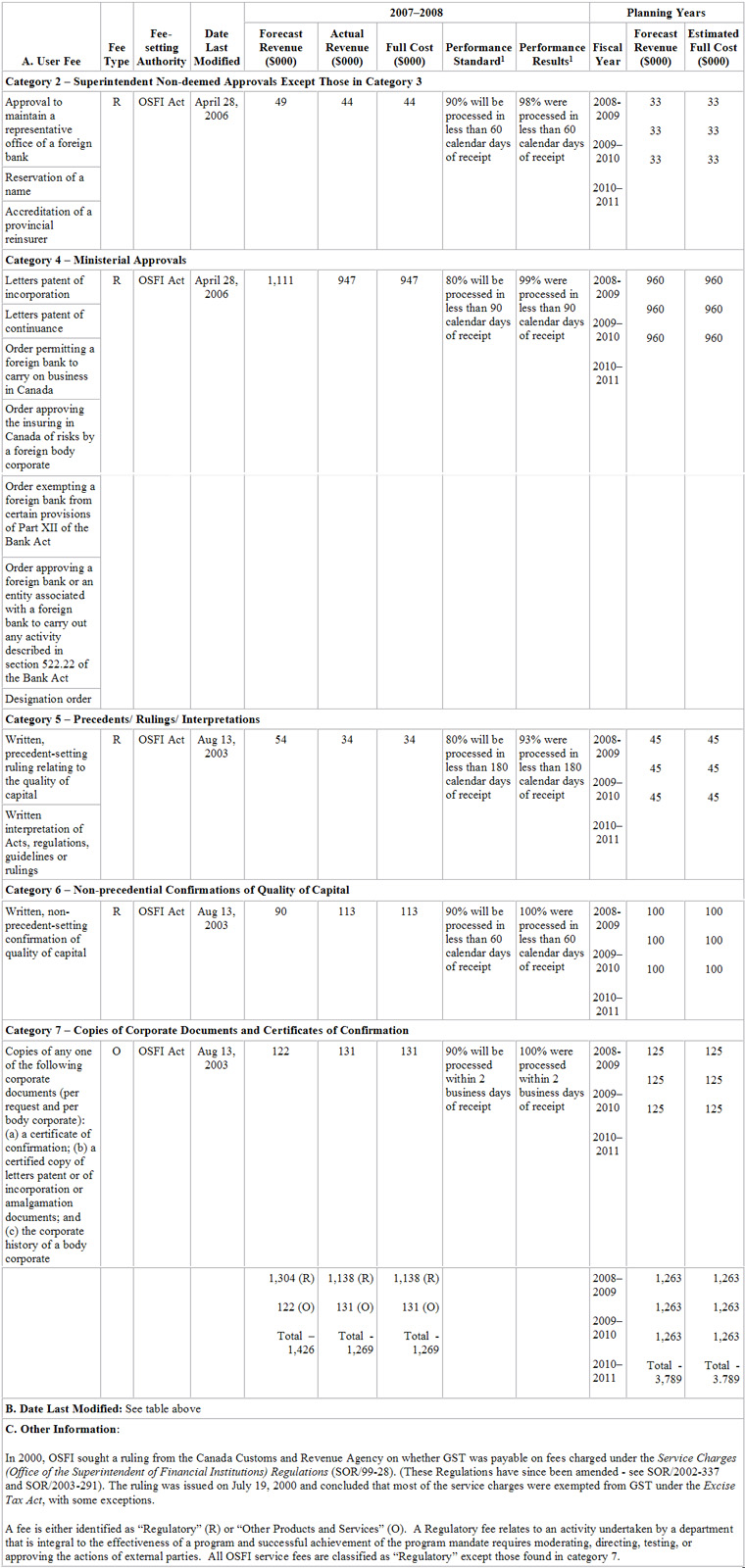
Access to Information User Fees
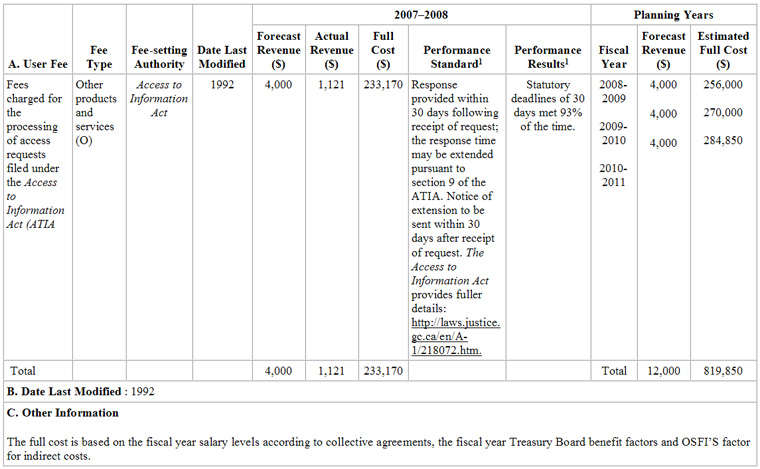
1 According to prevailing legal opinion, where the corresponding fee introduction or most recent modification occurred prior to March 31, 2004:
- the performance standard, if provided, may not have received parliamentary review; and
- the performance standard, if provided, may not respect all establishment requirements under the User Fee Act (e.g. international comparison; independent complaint address).
- the performance result, if provided, is not legally subject to section 5.1 of the User Fee Act regarding fee reductions for unachieved performance.
Table 4–B: Policy on Service Standards for External Fees
Table 4-B is a standard reporting form developed to meet the reporting requirements of the Policy. As the requirements of the User Fee Act and the Policy are very similar, much of the information contained in this table is also found in table 4-A.
| A. External Fee | Service Standard2 | Performance Results3 | Stakeholder Consultation |
| Category 2 – Superintendent Non-deemed Approvals Except Those in Category 3 |
In March 2005, paying and non-paying stakeholders were asked to review and comment on the proposed service standards that were developed based on the analysis and research. Comments were received over a three month period and feedback on the comments was provided to each stakeholder who took the opportunity to provide input. Stakeholders were generally supportive of the initiative, especially with regard to OSFI’s early implementation of the government’s policy. OSFI received some queries with regard to the increased administrative costs associated with monitoring compliance with these new standards. We noted that, as OSFI has monitored application processing time for a number of years, OSFI does not expect to incur additional costs associated with monitoring compliance with these service standards. This expectation has proven to be the case. OSFI continues to review the standards on an ongoing basis and, once experience with the application of the standards has developed, some modifications may be made. |
||
| Approval to maintain a representative office of a foreign bank | 90% will be processed in less than 60 calendar days of receipt | 98% were processed in less than 60 calendar days of receipt | |
| Reservation of a name | |||
| Accreditation of a provincial reinsurer | |||
| Category 4 – Ministerial Approvals | |||
| Letters patent of incorporation | 80% will be processed in less than 90 calendar days of receipt | 99% were processed in less than 90 calendar days of receipt | |
| Letters patent of continuance | |||
| Order permitting a foreign bank to carry on business in Canada | |||
| Order approving the insuring in Canada of risks by a foreign body corporate | |||
| Order exempting a foreign bank from certain provisions of Part XII of the Bank Act | |||
| Order approving a foreign bank or an entity associated with a foreign bank to carry out any activity described in section 522.22 of the Bank Act | |||
| Designation order | |||
| Category 5 – Precedents/ Rulings/ Interpretations | |||
| Written, precedent-setting ruling relating to the quality of capital | 80% will be processed in less than 180 calendar days of receipt | 93% were processed in less than 180 calendar days of receipt | |
| Written interpretation of Acts, regulations, guidelines or rulings | |||
| Category 6 – Non-precedential Confirmations of Quality of Capital | |||
| Written, non-precedent-setting confirmation of quality of capital | 90% will be processed in less than 60 calendar days of receipt | 100% were processed in less than 60 calendar days of receipt | |
| Category 7 – Copies of Corporate Documents and Certificates of Confirmation | |||
| Copies of any one of the following corporate documents (per request and per body corporate): (a) a certificate of confirmation; (b) a certified copy of letters patent or of incorporation or amalgamation documents; and (c) the corporate history of a body corporate | 90% will be processed within 2 business days of receipt | 100% were processed within 2 business days of receipt | |
| B. Other Information: | |||
Access to Information Requests Policy on Service Standards for External Fees
| A. External Fee | Service Standard2 | Performance Results3 | Stakeholder Consultation |
| Fees charged for the processing of access requests filed under the Access to Information Act (ATIA). |
Response provided within 30 days following receipt of request; the response time may be extended pursuant to section 9 of the ATIA. Notice of extension to be sent within 30 days after receipt of request. The Access to Information Act provides fuller details: http://laws.justice.gc.ca/en/A-1/index.html
|
Statutory deadlines met 93% of the time | The service standard is established by the Access to Information Act and the Access to Information Regulations. Consultations with stakeholders were undertaken by the Department of Justice and the Treasury Board Secretariat for amendments done in 1986 and 1992. |
|
B. Other Information
None |
|||
2 As established pursuant to the Policy on Service Standards for External Fees:
- service standards may not have received parliamentary review; and
- service standards may not respect all performance standard establishment requirements under the User Fee Act (e.g. international comparison; independent complaint address).
3 Performance results are not legally subject to section 5.1 of the UFA regarding fee reductions for unachieved performance.
Parks Canada
2007-2008 User Fee Reporting Table 6-A: User Fees Act
| A. User Fee | Fee Type | Fee- setting Authority | Date Last Modified | 2007-2008 | Planning Years | ||||||
| Forecast Revenue ($000) | Actual Revenue ($000) | Estimated Full Cost ($000) | Performance Standard | Performance Result | Fiscal Year | Forecast Revenue ($000) | Estimated Full Cost ($000) | ||||
| Entry Fees | Service | Parks Canada Agency Act | Increased in 2006 | $48,500 | $50,199 | $166,689 | 85% of visitors are satisfied | 100% of sampled locations exceed the standard | 2008-2009 | $54,761 | $158,297 |
| 2009-2010 | $54,761 | $161,229 | |||||||||
| 2010-2011 | $54,761 | $161,249 | |||||||||
| Camping Fees | Service | Parks Canada Agency Act | Increased in 2007 | $14,811 | $16,713 | $24,277 | 85% of visitors are satisfied | 100% of sampled locations exceed the standard | 2008-2009 | $15,750 | $23,055 |
| 2009-2010 | $15,750 | $23,482 | |||||||||
| 2010-2011 | $15,750 | $23,485 | |||||||||
| Lockage and Mooring fees | Service | Parks Canada Agency Act | Lockage increased in 2006 Mooring increased in 2007 |
$2,728 | $2,688 | $25,538 | 85% of visitors are satisfied | 100% of sampled locations exceed the standard | 2008-2009 | $3,048 | $24,252 |
| 2009-2010 | $3,048 | $24,702 | |||||||||
| 2010-2011 | $3,048 | $24,705 | |||||||||
| Pools | Service | Parks Canada Agency Act | Increased in 2003 | $3,603 | $4,099 | $5,101 | 85% of visitors are satisfied | 100% of sampled locations exceed the standard | 2008-2009 | $3,603 | $4,844 |
| 2009-2010 | $3,603 | $4,934 | |||||||||
| 2010-2011 | $3,603 | $4,935 | |||||||||
| Real Property and Business Fees | Rights and Privileges | Parks Canada Agency Act | Increased in 2003-2004 where terms of leases and licenses expired and where rent review provisions exist. | $17,614 | $17,484 | $10,098 | Not Applicable | Not Applicable | 2008-2009 | $17,614 | $8,100 |
| 2009-2010 | $17,614 | $8,163 | |||||||||
| 2010-2011 | $17,614 | $8,095 | |||||||||
| Municipal Services | Services | Canada National Parks Act | Water and sewer fees increased in 2001; remainder in 2003. Garbage fees increased in 1996. | $2,676 | $2,890 | $17,189 | For water, the Guidelines for Canadian Drinking Water Quality (2002) is the current standard. For wastewater, PCA will meet Federal Guidelines (1976) for effluent quality and work towards setting and meeting PCA leadership standards that are based on the receiving waters of each community. Garbage collection frequencies will be established in consultation with Community Councils and Business Community. | Water quality Guidelines are met or exceeded; wastewater effluent quality meets or exceeds Federal Guidelines. Progress on leadership targets are reported in Annual Report. | 2008-2009 | $2,676 | $12,783 |
| 2009-2010 | $2,676 | $12,990 | |||||||||
| 2010-2011 | $2,676 | $12,992 | |||||||||
| Other Revenues | Other goods and services | Parks Canada Agency Act | Business licences increased in 1994; Other fees increased in 2006 | $14,068 | $7,078 | $45,157 | 85% of visitors are satisfied | 100% of sampled locations exceed the standard | 2008-2009 | $13,548 | $42,746 |
| 2009-2010 | $13,548 | $43,530 | |||||||||
| 2010-2011 | $13,548 | $43,528 | |||||||||
| Total | $104,000 | $101,151 | $294,051 | 2008-2009 | $111,000 | $274,077 | |||||
| 2009-2010 | $111,000 | $279,030 | |||||||||
| 2010-2011 | $111,000 | $278,990 | |||||||||
B. Date Last Modified
Multi-year fees for entry, camping, lockage and mooring and other revenues (excluding business licences) were approved in June 2005 for the years 2005-2006 to 2008-2009. New revenues are to be directed to maintain and improve associated services and facilities.
National Consultations were held prior to the User Fees Act in 2003-2004. Parks Canada consulted locally with the public and stakeholders through meetings with advisory and client groups and through direct mailings. On a corporate level, Parks Canada consulted with national stakeholders and interest groups and conducted a national public opinion poll and focus group sessions. Notice was also provided on the Parks Canada website on proposals for fee increases.
There was widespread acceptance of the fee proposal on the condition that Parks Canada honours its commitment to invest the related revenue growth to rebuild deteriorated visitor facilities. To address concerns raised by users during consultations, Parks Canada made three major adjustments to its multi-year fee strategy prior to approval:
- The phase-in period for implementation was extended from 3 to 4 years for all visitor services in order to stagger price increases and reduce the cumulative impact of increasing all fees at the same time.
- To respect our commitment to provide 18 months advance notice, implementation of proposed new commercial group fees was deferred until April 1, 2007 and the phase-in period extended from two to three years (2007, 2008 and 2009).
- The business licence fee proposal was withdrawn from the fee submission. A revised business licence proposal will reflect further research of municipal charging practices across Canada.
Following consultations, a comparison of Parks Canada's proposed fees with those charged by parks organizations in other countries was conducted. This research was carried out in the summer of 2004 and was incorporated into the submission. The Parks Canada's multi-year fee strategy was tabled in Parliament in March 2005 pursuant to the User Fees Act.
On July 1, 2006 and again on January 1, 2008, the Government of Canada implemented a 1% reduction to the GST. This affected all fees seeing that the GST is included in all of Parks Canada approved fees. These reductions are not reflected in the date last modified column.
2007-2008 External Fee Reporting Table 6-B: Policy on Service Standards for External Fees
|
A. External Fee |
Service Standard |
Performance result |
Stakeholder Consultation |
|
Entry Fees |
85% of visitors are satisfied |
100% of sampled locations exceed the standard1 |
Standard is based on a long standing measure2 |
|
Camping Fees |
85% of visitors are satisfied |
100% of sampled locations exceed the standard1 |
Standard is based on a long standing measure2 |
|
Lockage and Mooring Fees |
85% of visitors are satisfied |
100% of sampled locations exceed the standard1 |
Standard is based on a long standing measure2 |
|
Pools |
85% of visitors are satisfied |
For the 2006 cycle, no locations with this service were surveyed. |
Standard is based on a long standing measure2 |
|
Municipal Services |
For water, the Guidelines for Canadian Drinking Water Quality is the standard. Asset Management section has promulgated the potable water directive last year. The new
standard for Potable water is higher than the 2002 standard and is recognized as one of the best in the federal government. |
Canadian Drinking water Guidelines and sewage effluent quality guidelines were met 100% of the time in 7 park communities. |
Canadian Drinking Water Guidelines were established in 2002. |
|
Other revenues |
85% of visitors are satisfied |
100% of sampled locations exceed the standard1 |
Standard is based on a long standing measure2 |
Notes
- For further details please see Program Activity 4: Enhance Visitor Experience.
- Parks Canada has been using visitor satisfaction at surveyed sites as a measure of performance since 1996. The 85% satisfaction standard has been well established and communicated through the Agency’s corporate planning and reporting documents since 1999. In 1998, Parks also introduced a Quality Service Guarantee that applies to all visitor services for which fees are paid. This initiative ensures that visitors have an immediate recourse if they are not satisfied with the quality of service provided or do not believe that they received value for fees. Through the Guarantee, the concern is immediately addressed up to and including a refund of a portion or entire fee paid. This achieves the spirit of accountability for performance as contemplated by the User Fee Act, and exceeds the Act’s requirements by refunding the user-fee immediately to a dissatisfied client.
Privy Council Office
Table 5–A: User Fees Act
| A. User Fee | Fee Type | Fee-setting Authority | Date Last Modified | 2007-2008 | Planning Years | ||||||
| Forecast Revenue ($000) |
Actual Revenue ($000) |
Full Cost ($000) |
Performance Standard | Performance Results | Fiscal Year | Forecast Revenue ($000) |
Estimated Full Cost ($000) |
||||
|
Fees charged for inspection and obtaining of copies of Statutory Instruments in accordance with the Statutory Instruments Act Fees charged for the processing of access requests filed under the Access to Information Act |
O
O |
Statutory Instruments Regulatory Access to Information Act |
1993 SOR/9 3-245
1992 |
1.0
4.0 |
1.4
3.0 |
8.4
2,872.2 |
|
|
2008-2009 2009-2010 2010-2011
2008-2009 |
1.0 1.0 1.0
4.0 |
8.4 8.4 8.4 Note 3 2,889.3 |
| Total |
5.0 |
4.4 |
2,880.6 |
2008-2009 2009-2010 2010-2011 |
5.0 5.0 5.0 |
2,897.7 2,916.4 2,937.0 |
|||||
Note 1: 90% of requests will be completed within 5 business days. This standard became effective as of September 2006.
Note 2: 100% of requests received were completed within 5 business days, with most requests completed within 1 day of receipt.
Note 3: Full cost for the sale of Statutory Instruments includes the direct cost to operate the section (0.07 FTE) including the Employee Benefit Plan. It also includes indirect costs related to Corporate Services to support the division.
Note 4: Response provided within 30 days following receipt of request; the response time may be extended pursuant to section 9 of the ATIA. Notice to extension to be sent within 30 days after receipt of request.
Note 5: 84.2% of requests were completed on time.
Note 6: Full cost for the processing of Access to Information requests filed under the Access to Information Act includes the direct cost to operate the Access to Information and Privacy division including the Employee Benefit Plan. It also includes indirect costs related to the initial 5-hour search, and an allocation of Corporate Services to
support the division
Table 5-B: Policy on Service Standards for External Fees
| A. External Fee | Service Standard | Performance Results | Stakeholder Consultation |
| Fees charged for inspection and obtaining of copies of Statutory Instruments in accordance with the Statutory Instruments Act | 90% of requests will be completed within 5 business days. This standard became effective as of September 2006. | 100% of requests received were completed within 5 business days, with most requests completed within 1 day of receipt. | |
| Fees charged for the processing of access requests filed under the Access to Information Act (ATIA) | Response provided within 30 days following receipt of request; the response time may be extended pursuant to section 9 of the ATIA. Notice to extension to be sent within 30 days after receipt of request. | 84.2% of requests were completed on time. |
Public Health Agency of Canada
Table 4–A: User Fees Act
| 2007–08 | Planning Years | ||||||||||
| A. User Fee | Fee Type | Fee-setting Authority |
Date Last Modified |
Forecast Revenue ($000) |
Actual Revenue ($000) |
Full Cost ($000) |
Performance Standard |
Performance Results | Fiscal Year | Forecast Revenue ($000) |
Estimated Full Cost ($000) |
| Fees Charges for the processing of access requests filed under the Access to Information Act (ATIA) | Other Products and Services | Access to Information Act | 1992 | 0.7 | 1.2 | 312 | Response provided within 30 days following receipt of request: response time may be extended pursuant to section 9 of the ATIA. Notice of extension to be sent within 30 days of receipt request | Statutory deadlines met 95% of the time | 2008–09 2009–10 2010–11 |
1.5 1.5 1.5 |
658 658 658 |
Table 4–B: Policy on Service Standards for External Fees
| A. External Fee | Service Standard1 | Performance Results | Stakeholder Consultation |
| Fees charged for the processing of access requests filed under the Access to Information Act (ATIA) | Response provided within 30 days following receipt of request: response time may be extended pursuant to section 9 of the ATIA. Notice of extension to be sent within 30 days of receipt request | Statutory deadlines met 95% of the time | The service standard is established by the ATIA and the Access to Information Regulations. Consultations with stakeholders were undertaken by the Department of Justice and the Treasury Board Secretariat for amendments done in 1986 and 1992 |
| B. Other Information | |||
1 As established pursuant to the Policy on Service Standards for External Fees:
- service standards may not have received parliamentary review; and
- service standards may not respect all performance standard establishment requirements under the UFA (e.g., international comparison; independent complaint address).
Public Safety Canada
Table 5: User Fees/External Fees
| 2007-2008 | Planning Years | ||||||||||
|---|---|---|---|---|---|---|---|---|---|---|---|
| A. User Fee | Fee Type | Fee-setting Authority | Date Last Modified | Forecast Revenue ($000) |
Actual Revenue ($000) |
Full Cost ($000) |
Performance Standards | Performance Results |
Fiscal Year |
Forecast Revenue ($000) |
Estimated Full Cost ($000) |
| Fees charged for the processing of requests submitted pursuant to the Access to Information Act | Other products and services (O) | Access to Information Act | 1992 | $1.8 | $4 | $538 | The Access to Information Act requires institutions to respond to requests within 30 days of receipt. The Act allows institutions to extend this timeframe in order to search for records and to undertake external consultations | The Department responded to 90% of requests within the legislated timeframes established by the ATI Act. | 2008-2009 | $2 | $700 |
| 2009-2010 | $2.5 | $700 | |||||||||
| 2010-2011 | $3 | $800 | |||||||||
B. Date last modified |
|||||||||||
Public Service Commission of Canada
User Fees
A- User Fees Act
| A- User Fee Description | 2007-2008 | Planning Years - Fiscal Year |
Planning Years - Forecast Revenue $ | Planning Years - Estimated Full Cost $ |
|---|---|---|---|---|
| Fees charged for the processing of access requests under the Access to Information Act (ATIA) Fee Type: Other products and services Fee-setting authority: ATAI Date last modified: 1992 |
Forecast revenue: N/A Actual revenue: $267.40 Full cost: $74,425.50 (salary and O&M) Performance standard: Response provided within 30 days following receipt of request; the response time may be extended pursuant to section 9 of the ATIA. Notice of extension to be sent within 30 days after receipt of request. The ATIA provides more details: http://laws.justice.qc.ca/en/A-1/218072.html Performance results: Statutory deadlines have been met for 95% of requests. Extension notices were sent within 30 days following the receipt of the request in 14% of cases. |
2008–2009 | 400 | 215,000 |
| 2009–2010 | 400 | 215,000 | ||
| 2010–2011 | 400 | 215,000 |
B. Date last modified: May 5, 2006
C. Other information:
It is the practice of the PSC's Access to Information and Privacy Office to waive fees where (a) the total reproduction costs that could be assessed amount to less than $25; (b) the information being requested is publicly available; or (c) no response or notice of extension is forwarded within 30 days following receipt of the request. Fees amounting to more than $25 were waived for 53
requests in 2007-2008.
Public Works and Government Services Canada
Table 7a: User Fees
Access to Information and Privacy
| 2007-2008 | Planning Years | ||||||||||
|---|---|---|---|---|---|---|---|---|---|---|---|
| User Fee | Fee Type |
Fee-setting Authority |
Date Last Modified |
Forecast Revenue ($000) |
Actual Revenue ($000) |
Full Cost ($000) |
Performance Standard |
Performance Results | Fiscal Year |
Forecast Revenue ($000) |
Estimated Full Cost ($000) |
| Fees charged for the processing of access requests filled under the Access to Information Act (ATIA) | Other Products and Services (O) | ATIA | 1992 | 12.34 | 6.58 | 2,260 | Response provided within 30 days following receipt of request; the response time may be extended pursuant to section 9 of the ATIA. Notice of extension to be sent within 30 days after receipt of request. | 71.1% | 2008-2009 | 6.25 | 5,150 |
| 2009-2010 | 5.94 | 3,350 | |||||||||
| 2010-2011 | 5.64 | 3,520 | |||||||||
|
Total 12.34 |
Total 6.58 |
Total 2,260 |
Total 17.83 |
Total 12,020 |
|||||||
|
B) Date Last Modified: N/A |
|||||||||||
|
C) Other Information: It is the department’s practice to waive fees where (a) the total reproduction costs that could be assessed amounts to less than $25; and (b) the legislative time limits have been exceeded by more than 6 months and the request contains a voluminous number of records. In 2007-2008, fees were waived in 63% of ATI requests
completed, amounting to $7,300 waived. In an effort to reduce the amount of paper copied, applicants can request that certain information be provided to them by electronic means, such as by diskette, CD or email, in order to reduce the amount of fees to be paid. In 2007-2008, 19% of responses to ATI were made by electronic means; an increase of 6% compared to previous fiscal year. |
|||||||||||
Canada Gazette
| 2007-2008 | Planning Years | ||||||||||
| User Fee | Fee Type |
Fee-setting Authority |
Date Last Modified |
Forecast Revenue ($000) |
Actual Revenue ($000) |
Full Cost ($000) |
Performance Standard |
Performance Results | Fiscal Year |
Forecast Revenue ($000) |
Estimated Full Cost ($000) |
| Subscription rates charged to external/private sector clients for printing and distributing the hardcopy version of the Canada Gazette | Regulatory (R) | Subscription fees are set in the Statutory Instruments Act assented to in 1971 | Subscription fees last revised in 1985 | 38.0 | 97.7 | 310.0 |
Meet all the legislated publication deadlines for the Canada Gazette and meet the publication deadlines for each of our clients.
Achieve less than 1% error count in all editions of the Canada Gazette. |
100%: All notices were published within the legislated deadlines. 100%: The Canada Gazette Directorate met all of its publication dates for all formats of the Canada Gazette. 100%: The error count was 0.16%, which represents only 7 errors in 4,311 pages published. |
2008-2009 Subscriptions 2009-2010 Subscriptions 2010-2011 Subscriptions |
97.7
97.7
|
310.0
|
|
Total 38.0 |
Total 97.72 |
Total 310.03 |
Total 293.1 |
Total 930.0 |
|||||||
|
B) Date Last Modified: July 2, 2008. |
|||||||||||
|
C) Other Information: 1. Subject to a departmental legal assessment the Canada Gazette Directorate is reporting annually on the Subscription Fees charged to external/private sector clients as the User Fees Act does not apply to internal clients, i.e. other government departments or agencies. Information on insertions fees is no longer included in this table as these fees fall under the contracting authority of the Minister of PWGSC. 2. These figures are only the direct costs of producing the documents. 3. These figures forecast only the direct costs of producing the documents. |
|||||||||||
Public Ports and Harbours – Esquimalt Graving Dock (EGD)
| 2007-2008 | Planning Years | ||||||||||
| User Fee | Fee Type |
Fee -setting Authority |
Date Last Modified | Forecast Revenue ($000) | Actual Revenue ($000) | Full Cost ($000) | Performance Standard | Performance Results | Fiscal Year | Forecast Revenue ($000) | Estimated Full Cost ($000) |
| Booking | Regulatory (R) as per Esquimalt Graving Dock Regulations, 1989 (SOR/89-332 and SOR/95-462). | Order-in-Council | 1995 | See Note 2 | 231.0 |
See Note 2 No costs were incurred by other departments in support of the fee activity. |
EGD meets on a regular and on-going basis with its tenant clients to ensure customer service and client needs are met. | Last fiscal EGD met on a formal basis every other month (6 times/year) with all tenant clients. Additionally, all major vessels were met prior to departure to ensure needs were met. |
2008-2009 2009-2010 2010-2011 |
See Note 2 |
See Note 2 No costs were incurred by other departments in support of the fee activity. |
| Draining | 195.5 | ||||||||||
| Dockage for a vessel per unit of gross tonnage (minimum 2500 tons), per day | 1,555.1 | ||||||||||
| Dockage for cargo on board per tonne of cargo, per day | - | ||||||||||
| Berthage at North Landing Wharf, per metre, per day (a) working vessels | 112.5 | ||||||||||
| Berthage at North Landing Wharf, per metre, per day (b) non-working vessels | 1.6 | ||||||||||
| Berthage at South Jetty, per metre, per day | 120.3 | ||||||||||
| Storage of cargo, building materials, equipment or machinery, per tonne, per day | - | ||||||||||
| Top wharfage, per tonne (minimum 50 tonnes) (one-time charge) | 5.4 | ||||||||||
| Crane per hour (a) with light hook | 791.3 | ||||||||||
| Crane per hour (b) with main hook, up to 50 tonne lift | 76.4 | ||||||||||
| Crane per hour (c) with main hook, over 50 tonne lift | 31.1 | ||||||||||
| Mobile Crane, per hour (a) 9-tonne crane | 19.3 | ||||||||||
| Mobile Crane, per hour (b) 20-tonne crane | 0.4 | ||||||||||
| Forklift per hour | 0.2 | ||||||||||
| Air Compressor, per manifold hour | 508.6 | ||||||||||
| Motor work boat, per hour | 2.2 | ||||||||||
| Fresh water, per cubic metre | 47.8 | ||||||||||
| Electric power, per kilowatt hour | 755.0 | ||||||||||
| Parking, per section, per shift | 114.2 | ||||||||||
| Tie-up and letting go | 7.5 | ||||||||||
| Flood-lights (a) per standard (high mast), per hour | - | ||||||||||
| Flood-lights (b) per caisson (4 lights), per hour | - | ||||||||||
| Overtime labour of dry-dock employees, per employee, per hour | 339.8 | ||||||||||
| Commissionaire service, per employee, per hour | 196.7 | ||||||||||
| Other User Fees (see Additional Tariff Items below) | Other Products and Services (O) | Order-in-Council | 1995 | See Note 2 | 1,167.9 |
See Note 2 No costs were incurred by other departments in support of the fee activity. |
EGD meets on a regular and on-going basis with its tenant clients to ensure customer service and client needs are met. | Last fiscal EGD met on a formal basis every other month (6 times/year) with all tenant clients. Additionally, all major vessels were met prior to departure to ensure needs were met. |
2007-2008 2008-2009 2009-2010 |
See Note 2 |
See Note 2 No costs were incurred by other departments in support of the fee activity. |
|
Sub-total (R) Sub-total (O) |
Sub-total (R) 5,111.7 Sub-total (O) 1,167.9 |
Sub-total (R) Sub-total (O) |
Sub-total Sub-total Sub-total |
2008-2009 5,600.0 2009-2010 2010-2011 |
2008-2009 11,423.5 2009-2010 2010-2011 |
||||||
| Total |
Total 6,279.6 |
Total 11,423.6 |
Total 17,200.0 |
Total 39,165.7 |
|||||||
| B) Date Last Modified: No substantial modification has been made since March 31, 2004. | |||||||||||
|
C) Other Information: Note 1: Revenue forecast assumes no rate increase during planning horizon. Submission to change rates currently under way. Note 2: Since revenues are not forecasted and costs are not calculated based on individual fee items, only the total figures are provided for all user fees at the EGD. |
|||||||||||
Public Ports and Harbours – Esquimalt Graving Dock Additional Tariff Items
| TARIFF ITEMS | UNIT RATE |
| 1" Rope | $240.00 / ea |
| 16 Grit Abrasive | $0.60 / lb |
| 16 Grit Abrasive | $0.60 / lb |
| 18 Grit Abrasive | $0.60 / lb |
| 24/25 Grit Abrasive | $0.60 / lb |
| Administration | $100.00 / hr |
| Air compressor(secondary) | $25.00 / hr |
| Air compressor(portable) | $8.00 / hr |
| Aluminum Oxide | $0.80 / lb |
| Aluminum Oxide,"A" Grade | $0.80 / lb |
| AVAC | $40.00 / hr |
| Berthage at Jenkins Footprint | $0.00 / m-d |
| Berthage at S. Jetty (working vessel) | $2.75 / m-d |
| Berthage at Tug Wharf | $2.50 / m-d |
| Boat Rental | $55.00 / hr |
| Bond | $10,000.00 / ea |
| Brown Aluminum Oxide (All Grades) | $0.80 / lb |
| Clean up | $1,000.00 / ea |
| Commissionaire service (new rate) | $317.21 / d |
| Damages | $1,000.00 / ea |
| EBE 250V - SP10 | $1.20 / ft2 |
| EBE 250V - SP5 | $1.30 / ft2 |
| EBE 250V - SP6 | $1.10 / ft2 |
| EBE 250V - SP7 | $1.00 / ft2 |
| EBE 350 DECK | $0.70 / ft2 |
| EBE 350 (Deck) - SP10 | $0.91 / ft2 |
| EBE 350H - SP10 | $0.91 / ft2 |
| EBE 350H - SP5 | $1.58 / ft2 |
| EBE 350H - SP6 | $0.70 / ft2 |
| EBE 350H - SP7 | $0.53 / ft2 |
| EBE 350V - SP10 | $1.75 / ft2 |
| EBE 350V - SP5 | $2.10 / ft2 |
| EBE 350V - SP6 | $1.30 / ft2 |
| EBE 350V – SP7 | $0.60 / ft2 |
| EBE 500 DECK | $1.00 / ft2 |
| EBE 500H - SP10 | $1.30 / ft2 |
| EBE 500H - SP5 | $2.25 / ft2 |
| EBE 500H - SP6 | $1.00 / ft2 |
| EBE 500H - SP7 | $0.75 / ft2 |
| ENVIROBLAST 500VH | $150.00 / hr |
| EBE 500V - SP10 | $2.00 / ft2 |
| EBE 500V - SP5 | $2.25 / ft2 |
| EBE 500V - SP6 | $1.50 / ft2 |
| EBE 500V - SP7 | $0.75 / ft2 |
| EBE A-Vac | $40.00 / ft2 |
| EBE Operator | $0.15 / ft2 |
| Fine | $100.00 / ea |
| Freight | $155.48 / ea |
| Lease | $398.00 / m2 |
| Miscellaneous | $7,500.00 / ea |
| Miscellaneous Parts | $7,500.00 / ea |
| Road Sweeper | $55.00 / hr |
| Property lease | $2,916.68 / ea |
| S360 Steel shot | $0.60 / lb |
| S390 Steel shot | $0.60 / lb |
| S460 Steel shot | $0.60 / lb |
| Service Charge | $55.00 / hr |
| Shackles | $29.45 / ea |
| Short term lease | $3.33 / m2 |
| Storage by Area | $3.33 / m2 |
| Storage by Weight | $1.00 / t/day |
| Supplementary Charge | $0.67 / ft2 |
| Thimbles | $3.28 / ea |
| Vessel on EDC Floating Drydock | $0.00 / month |
| 350 VH | $2,500.00 / day |
Public Ports and Harbours – Selkirk Marine Railway Dry Dock
| 2007-2008 | Planning Years | ||||||||||
|---|---|---|---|---|---|---|---|---|---|---|---|
| User Fee | Fee Type |
Fee -setting Authority |
Date Last Modified | Forecast Revenue ($000) | Actual Revenue ($000) | Full Cost ($000) | Performance Standard |
Performance Results |
Fiscal Year | Forecast Revenue ($000) | Estimated Full Cost ($000) |
| See Tariff Items below | Regulatory (R) as per Selkirk Marine Railway Dry Dock Regulations, 1989 (SOR/89-331) | Department of Public Works and Government Services Act (1996, c.16) |
1989 PC 1989-1198 |
17.7 See Note 1 |
18.8 See Note 1 |
207.7 See Note 1 No costs were incurred by other departments in support of the fee activity. |
The user fees were introduced prior to March 31, 2004. Performance standards have not yet been established as contracts are established on an individual custom basis. | Selkirk Marine Railway Dry-dock services are responsive to, and satisfy the specific needs of each external user, in accordance with the Selkirk Marine Railway Dry-dock regulations. |
2008-2009 2009-2010 2010-2011 |
22.7 22.7 n/a see note 2
|
198.0 52.7 n/a see note 2 |
|
Sub-total (R) 17.7 |
Sub-total (R) 18.8 |
Sub-total (R) 207.7 |
Sub-total Sub-total Sub-total |
2008-2009 22.7 2009-2010 2010-2011 |
2008-2009 198.0 2009-2010 2010-2011 |
||||||
|
Total 17.7 |
Total 18.8 |
Total 207.7 |
Total 45.4 |
Total 250.7 |
|||||||
| B) Date Last Modified: No substantial modification has been made since March 31, 2004. | |||||||||||
|
C) Other Information: Note 1: Since revenues are not forecasted and costs are not calculated based on individual fee items, only the total figures are provided for all user fees. Note 2: This facility is slated for disposal by 2010. |
|||||||||||
Public Ports and Harbours – Selkirk Marine Railway Dry Dock Tariff Items
| TARIFF OF DOCK CHARGES | |
|---|---|
| ITEM SERVICES AND FACILITIES | DOCK CHARGES ($) |
| Entry fee | 655.00 |
| Setting up keel and bilge blocks | 655.00 |
| Hauling out vessel | 515.00 |
| Launching vessel | 515.00 |
| Accommodation of vessel in the dry dock per day, per unit of gross tonnage | 1.05 |
| Fee for the winter term, one vessel | 6,000.00 |
| Fee for the winter term, tow vessels, per vessel | 3,000.00 |
| Additional charge pursuant to subsection 36(1) up to a maximum of $1000.00 per day, per unit of gross tonnage | 1.80 |
Table 7b: Policy on Service Standards for External Fees
Canada Gazette
| A. External Fee | Service Standard | Performance Result | Stakeholder Consultation |
|---|---|---|---|
|
Subscription rates are charged for the printing and distribution of the Canada Gazette.
|
100% compliance with the legislated publication deadlines for the Canada Gazette and the legislated publication deadlines for each of its clients. Error rate of less than 1%. |
100%: All notices were published within the legislated deadlines. The Canada Gazette Directorate met all its publication dates for all formats of the Canada Gazette. The error count was 0.16 % which represents only 7 errors in 4,311 pages.
|
The subscription rates have not been modified since 1985. The establishment of the current fee structure pre-dates the November 2004 Policy On Service Standards for External Fees.
|
| B. Other Information N/A | |||
RCMP External Review Committee
Table - User Fees Act
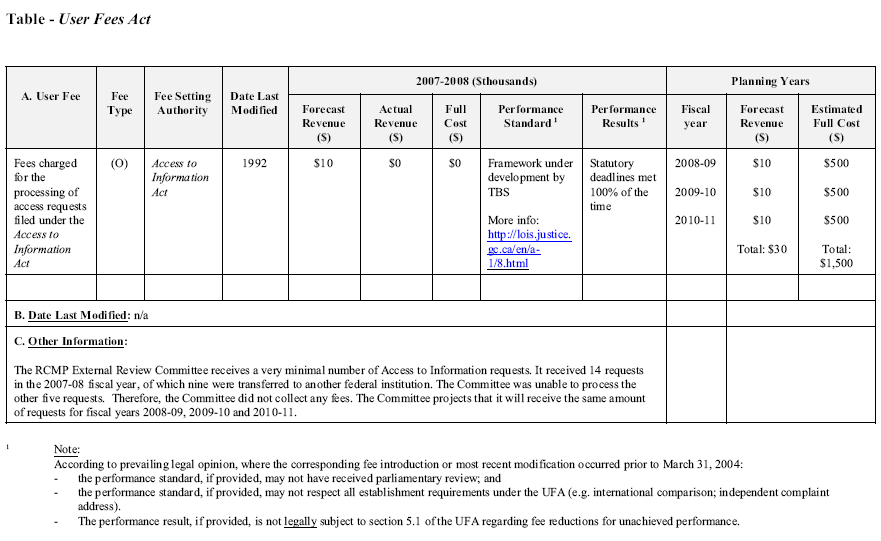
Click on image to enlarge.
Table - Policy on Service Standards for External Fees
| A. External Fee | Service Standard1 | Performance Result2 | Stakeholder Consultation |
|---|---|---|---|
| Fees charged for the processing of access requests filed under the Access to Information Act |
Framework under development by TBS More info: http://lois.justice.gc.ca/en/a-1/8.html |
Statutory deadlines met 100% of the time | The service standard is established by the Access to Information Act and the Access to Information Regulations. Consultations with stakeholders were undertaken for amendments done in 1986 and 1992. |
| B. Other Information: n/a | |||
1. As established pursuant to the Policy on Service Standards for External Fees:
- service standards may not have received parliamentary review; and
- service standards may not respect all performance standard establishment requirements under the UFA (e.g. international comparison; independent complaint address).
2. Performance results are not legally subject to section 5.1 of the User Fees Act regarding fee reductions for unachieved performance.
Royal Canadian Mounted Police
Canada Firearms Centre
Table 4-A: User Fees
|
A. User Fee
|
Fee Type
|
Fee Setting
Authority |
Date Last
Modified |
2007-2008
|
Planning Years
|
||||||
|
Forecast Revenue
($ millions) |
Actual Revenue ($ millions)
|
Full Cost
($ millions) |
Performance Standard
|
Performance Results
|
Fiscal Year
|
Forecast Revenue
($ millions) |
Estimated Full Cost
($ millions) |
||||
| Business Licences | Regulatory | Firearms Fees Regulations | April 10th, 2005 |
0.1
|
0.1
|
Section C Other information See note (1) |
Section C Other information See note (2) |
Section C Other information See note (3) |
2008-09 2009-10 2010-11 |
0.6
0.6 0.6 |
Section C Other information See note (1) |
| Individual Licences | Regulatory | Firearms Fees Regulations | December 1st, 1998 |
1.9
|
5.7
|
Section C Other information See note (1) |
45 days | 76% of properly completed individual licence applications were completed within 45 days |
2008-09 2009-10 2010-11 |
1.9 |
Section C Other information See note (1) |
| Registration Certificates | Regulatory | Firearms Fees Regulations | Registration fees repealed as of May 20th, 2004 |
0.0
|
0.0
|
Section C Other information See note (1) |
30 days | 63% of properly completed registration applications were completed within 30 days | 2008-09 2009-10 2010-11 |
0.0 |
Section C Other information See note (1) |
| Authorizations | Regulatory | Firearms Fees Regulations | December 1st, 1998 |
0.3
|
0.0
|
Section C Other information See note (1) |
Section C Other information See note (2) |
Section C Other information See note (3) |
2008-09 2009-10 2010-11 |
0.3 |
Section C Other information See note (1) |
| Non-resident permits | Regulatory | Firearms Fees Regulations | April 10th, 2005 |
1.9
|
1.9
|
Section C Other information See note (1) |
Section C Other information See note (2) |
Section C Other information See note (3) |
2008-09 2009-10 2010-11 |
1.9 |
Section C Other information See note (1) |
| Services for replacement of documents | Regulatory | Firearms Fees Regulations | April 10th, 2005 |
0.1
|
0.0
|
Section C Other information See note (1) |
Section C Other information See note (2) |
Section C Other information See note (3) |
2008-09 2009-10 2010-11 |
0.1
0.1 0.1 |
Section C Other information See note (1) |
| Fees charged for the processing of access requests filed under the Access to Information Act | Other Products and Services | Access to Information Act | 1992 |
0.0
|
0.0
|
0.2
|
Framework developed by TBS. See: http://www.tbs-sct.gc.ca/gos-sog/atip-aiprp/in-ai/in-ai2006/2006-06_e.asp |
83% of requests under the Access to Information Act were completed within 60 days; 97% of requests under the Privacy Act were completed within 60 days |
2008-09 2009-10 2010-11 |
0.0
0.0 0.0 |
0.2 0.2 |
| Total: 4.3 |
Total: 7.1
|
Total: 0.2
|
2008-09 2009-10 2010-11 |
Total: 4.8 Total: 24.6 Total: 24.6 |
|||||||
|
B. Date Last Modified: Forecast Revenues:
|
|||||||||||
C. Other Information:
|
|||||||||||
Table 4-B: Policy on Service Standards for External Fees
| A. External Fee |
Service Standard | Performance Result | Stakeholder Consultation |
| Business Licences |
Section B Other information See note (1) |
Section B Other information See note (2) | Section B Other information See note (2) |
| Individual Licences | 45 days | 96% of properly completed individual licence applications were process within the 45 day period | Section B Other information See note (2) |
| Registration Certificates* | 30 days | 90% of properly completed registration applications were processed within 30 days | Section B Other information See note (2) |
| Authorizations | Section B Other information See note (1) | Section B Other information See note (2) | Section B Other information See note (2) |
| Non-resident permits | Section B Other information See note (1) | Section B Other information See note (2) | Section B Other information See note (2) |
| Services for replacement of documents | Section B Other information See note (1) | Section B Other information See note (2) | Section B Other information See note (2) |
| Fees charged for the processing of access requests filed under the Access to Information Act. (see note 3) | Framework developed by TBS. See: http://www.tbs-sct.gc.ca/gos-sog/atip-aiprp/in-ai/in-ai2006/2006-06_e.asp |
|
The service standard is established by the Access to Information Act and the Access to Information Regulations. Consultations with stakeholders were undertaken for amendments done in 1986 and 1992. |
B. Other Information:
|
|||
| * Fees for registration certificates repealed as of May 20th, 2004 | |||
Statistics Canada
| User fee | Fee type | Fee-setting authority | Date last modified | 2007/2008 | Planning years | ||||||
|---|---|---|---|---|---|---|---|---|---|---|---|
| Forecast revenue ($ thousands) | Actual revenue ($ thousands) | Full cost ($ thousands) | Performance standard | Performance results | Fiscal year | Forecast revenue ($ thousands) | Estimated full cost ($ thousands) | ||||
| Statistics Canada publications | Other goods and services – Fee for post-manuscript product | Ministerial authority to enter into contract | April 1996 | 855.0 | 763.0 | 763.0 | (See Table 3.6, item 1, Service standard) | (See Table 3.6, item 1 Performance results) | 2008/2009 | 700.0 | 700.0 |
| 2009/2010 | 690.0 | 690.0 | |||||||||
| 2010/2011 | 680.0 | 680.0 | |||||||||
| Online database | Other goods and services – Fee for access | Ministerial authority to enter into contract | September 2001 | 575.0 | 559.0 | 559.0 | (See Table 3.6, item 2, Service standard) | (See Table 3.6, item 2, Performance results) | 2008/2009 | 560.0 | 560.0 |
| 2009/2010 | 540.0 | 540.0 | |||||||||
| 2010/2011 | 525.0 | 525.0 | |||||||||
| Access to Information Act requests1 | Other goods and services – Application fee | Section 11 of the Access to Information Act | 1992 | 0.2 | 0.5 | 75.7 | (See Table 3.6, item 3, Service standard) | (See Table 3.6 item 3, Performance results) | 2008/2009 | 0.4 | 100.0 |
| 2009/2010 | 0.3 | 96.8 | |||||||||
| 2010/2011 | 0.3 | 96.8 | |||||||||
| Total | … | … | … | 1,430.2 | 1,322.5 | 1,397.7 | … | … | … | … | … |
| … not applicable 1. Access to Information Act fees charged for the processing of requests filed under the Access to Information Act. Requests made under this Act are presented as a separate fee type. It is Statistics Canada's practice to waive fees where the total owing per request amounts to less than $25. Note: Statistics Canada is committed to serving its clients in a prompt, reliable and courteous manner. To this end, it has developed standards of service that its employees observe in serving clients. These standards, which are published on the website and in paper form, make commitments in the following five categories: availability, promptness, fees, meeting clients' needs and redress mechanism. See http://www.statcan.gc.ca/about-apercu/standards-normes-eng.htm. |
|||||||||||
| A. External fee | Service standard | Performance results | Stakeholder consultation |
|---|---|---|---|
| 1. Statistics Canada publications | Release dates for the next year for all 29 major economic indicators are announced at the beginning of December of each year. They range from 20 to 60 days from the end of the reference month or quarter. Release dates for the next month for all data output are announced at the end of each month. Release dates for annual and occasional data output normally range from 6 to 18 months, depending on the nature of the data collection process. |
For the 29 major economic indicators, Statistics Canada published a total of 243 releases. It also published 5 census releases. All were published as scheduled. Over 95% of the other data output were released as per the dates announced at the end of each month. |
Client satisfaction measurement surveys with clients for a number of data products were conducted on a yearly basis, with all products covered over a four-year cycle. Declared level of satisfaction with products and associated delivery services was very high. |
| 2. Online databases | New data are to be made available in the CANSIM database every working day at predetermined, pre-announced times. New data are to be made available in the Trade database on a monthly basis at predetermined, pre-announced times. |
New data releases took place as per the announced schedule every working day. | Usability and client satisfaction survey were conducted with a sample of clients in early 2005. Declared level of satisfaction with service was very high. |
| 3. Access to Information Act Fees charged for the processing of access requests filed under this Act | Response provided within 30 days following receipt of request; the response time may be extended pursuant to section 9 of the Access to Information Act. Notice of extension to be sent within 30 days after receipt of request. The Access to Information Act provides fuller details. |
Continue to meet statutory requirements under Access to Information Act legislation. | The service standard is established by the Access to Information Act and the Access to Information Regulations. Consultations with stakeholders were undertaken by the Department of Justice and the Treasury Board Secretariat for amendments made in 1986 and 1992. |
| B. Other information Standards of service to the public for all Statistics Canada services were announced in early 2006. Consultations on satisfaction with all major central services were conducted in June 2006. Declared levels of satisfaction with all services were very high. |
|||
Status of Women Canada
Table 3: User Fees
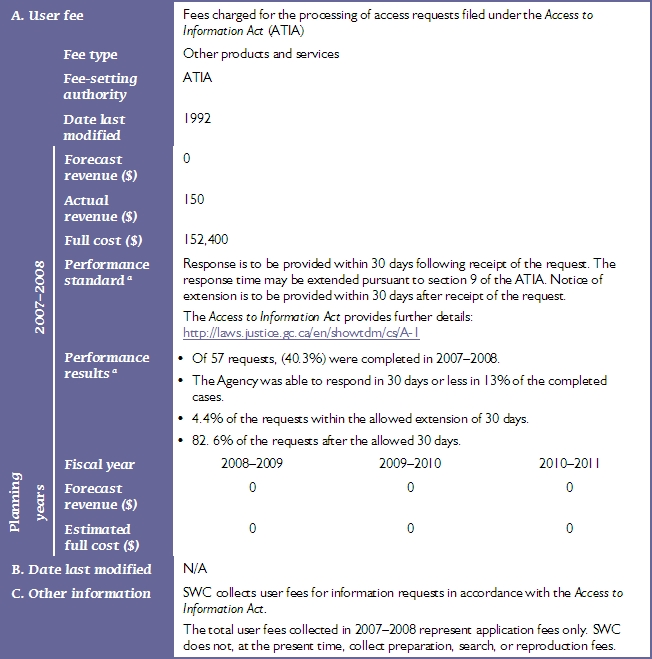
a According to prevailing legal opinion, where the corresponding fee introduction or most recent modification occurred prior to March 31, 2004:
- the performance standard, if provided, may not have received parliamentary review;
- the performance standard, if provided, may not respect all establishment requirements under the User Fee Act (e.g., international comparison, independent complaint address); and
- the performance result, if provided, is not legally subject to section 5.1 of the User Fee Act regarding fee reductions for unachieved performance.
Table 4: Policy on Service Standards for External Fees
The Policy on Service Standards for External Fees requires departments to report on the establishment of service standards for all external fees charged on a non-contractual basis. This policy covers fees charged for processing requests made under the Access to Information Act.
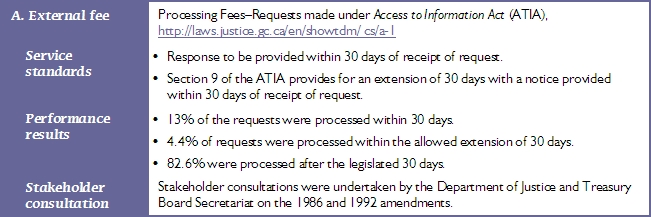
As established pursuant to the Policy on Service Standards for External Fees:
- service standards may not have received parliamentary review;
- service standards may not respect all performance standard establishment requirements under the UFA (e.g., international comparison, independent complaint address); and
- performance results are not legally subject to Section 5.1. of the UFA regarding fee reductions for unachieved performance.
Supreme Court of Canada
Details on Project Spending
|
|
Current
Estimated Total Cost |
Actual 2005-06
|
Actual
2006-07 |
| Program Activity | |||
| Process hearings and decisions |
|
|
|
| Courtroom Audio-Visual / Information Technology / Information Management |
6.2
|
0.4
|
1.9
|
2007-2008
|
|
Main Estimates
|
Planned Spending
|
| Program Activity | ||
| Process hearings and decisions |
|
|
| Courtroom Audio-Visual / Information Technology / Information Management |
-
|
3.7
|
2007-2008
|
|
Total Authorities
|
Actual
|
| Program Activity | ||
| Process hearings and decisions |
|
|
| Courtroom Audio-Visual / Information Technology / Information Management |
-
|
3.1
|
The majority of the Courtroom Audio-Visual / Information Technology / Information Management project was completed in 2007-08. Significant achievements included the replacement of all audio-visual equipment with state-of-the-art equipment, including a full back-up system, introduction of computer equipment and access to electronic case information to the courtroom, modicfication of furniture to accomodate computer equipment, and the construction of an adjustable lectern, to allow for more effective use by counsel of different heights, or counsel in wheelchairs.
The Correctional Investigator Canada
Table - User Fees Act
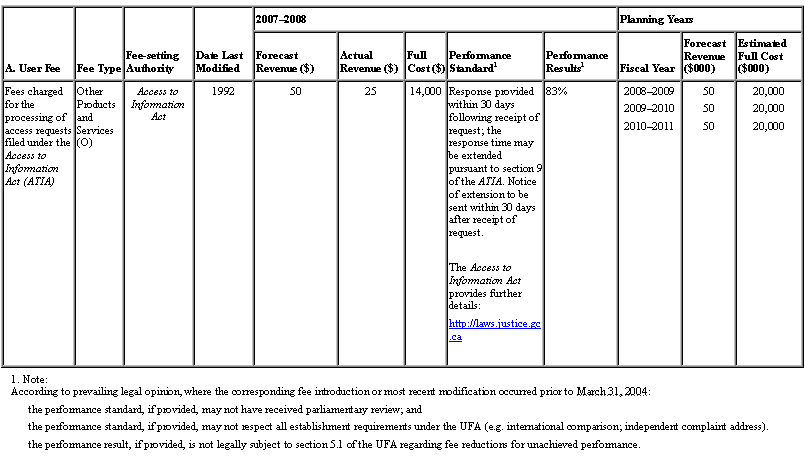
Click on image to enlarge.
The National Battlefields Commission
Table 3: For 2007-2008 User Fees Reporting Purposes: The User Fees Act (in thousands of dollars)
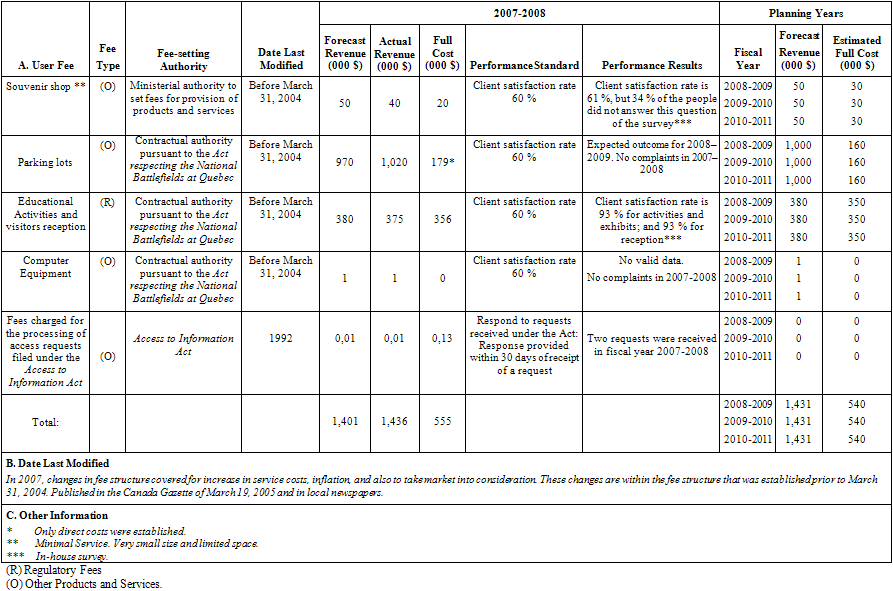
Table 3-B: Policy on Service Standard for External Fees
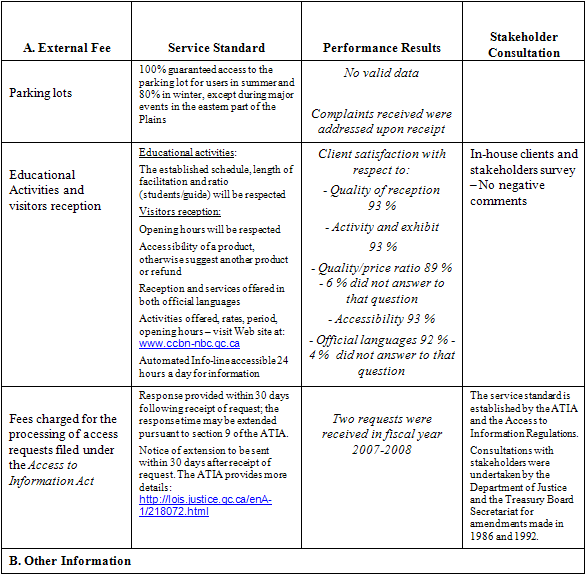
Transport Canada
Table 6-A: 2007-08 User Fee Reporting – User Fees Act
| A. User Fee | Fee Type1 |
Fee Setting
Authority |
Date Last |
2007-08 |
Planning Years |
||||||
|---|---|---|---|---|---|---|---|---|---|---|---|
|
Forecast Revenue 3 |
Actual Revenue3 |
Full Cost 2 |
Performance |
Performance |
Fiscal |
Forecast Revenue 3 |
Estimated Full Cost2 |
||||
|
Aviation Safety - Regulatory Fees (Note 5) |
R |
Aeronautics Act (http://laws. justice.gc.ca/en/A-2/ index.htm ), Canadian Aviation Regulations and fees in Part I subpart 4 |
July 15, 2000 |
8,375 |
8,218 respendable |
239,341 |
http://www.tc.gc.ca/CivilAviation/ servicestandards.htm |
1) Service Charter: http://www.tc.gc.ca/CivilAviation/ publications/tp14790/menu.htm 2) Aircraft Registration and Leasing Service Levels : 3) Pilot project - Ontario Region: results for Services with Fees: 4) Other performance results under development |
FY 08/09 FY 09/10 FY 10/11 |
8,540 8,553 8,566 |
237,175 233,582 233,579 |
|
Marine Safety - Regulatory Fees for inspections, surveys, services, etc. (Note 6) |
R |
Various regulations under the Canada Shipping Act, 2001 (http://laws.justice.gc.ca/en/showtdm/ cs/C-10.15 ) incl. the Board of Steamship Inspection Scale of Fees;(http://laws.justice.gc.ca/en/C.R.C.-c.1405/) and Ships Registry and Licensing Fees Tariff; |
6 June, 1995 (Overall Fee Increase) May 1, 2002 (Specific Fees) |
7,412 |
7,858 respendable |
100,601 |
http://www.tc.gc.ca/marinesafety/ service-standards/menu.htm |
Progress was made in 2007/08 to electronically track performance. Some performance results will be available for 2008/09 DPR. |
FY 08/09 FY 09/10 FY 10/11 |
7,389 7,389 7,389 |
96,594 95,491 95,464 |
|
Marine Safety - Office of Boating Safety - Construction Standard Compliance Labels (Note 7) |
R |
Canada Shipping Act /Small Vessel Regulations / TP 1332 incorporated by reference http://laws.justice.gc.ca/en/C.R.C.-c.1487/ TP 1332: |
1995 |
210 |
202 respendable |
775 |
http://www.tc.gc.ca/marinesafety/ service-standards/fees.htm#OBS _Compliance_Labels |
Performance results updated annually. 9 months of performance was tracked during 2007-08. On average, performance against these standards were achieved in 85% of cases. |
FY 08/09 FY 09/10 FY 10/11 |
210 0 0 |
638 0 0 |
|
Marine Safety - Ship Radio Inspection Program (Note 8) |
R |
Canada Shipping Act /Ship Radio Inspection Fees Regulations http://laws.justice.gc.ca/en/C.R.C.-c.1472/ |
1978 |
48 |
39 respendable |
1,073 Department of Fisheries and Oceans (DFO) full cost share included above: 343 |
http://www.tc.gc.ca/marinesafety/ service-standards/menu.htm |
Progress was made in 2007/08 to electronically track performance. Some performance results will be available for 2008/09 DPR. |
FY 08/09 FY 09/10 FY 10/11 |
48 48 48 |
1,073 1,073 1,073 Department of Fisheries and Oceans (DFO) full cost share included above: 343 |
|
Airports – Air Services Charges Regulations (ASCR) fees: General Terminal Fees, Landing Fees, Aircraft Parking Charges, Emergency response services charges. (Note 9) |
O |
Section 4.4 (2) of the Aeronautics Act (http://laws.justice.gc.ca/en/A-2/index.html ), and Section 2 of the Ministerial Regulations Authorization Order - Air Services Charges Regulations |
January 1, 2003 |
4,937 |
4,936 respendable |
13,056 |
www.tc.gc.ca/programs/airports/ standards.htm |
www.tc.gc.ca/programs/airports/ standards.htm |
FY 08/09 FY 09/10 FY 10/11 |
4,913 4,913 4,913 |
11,638 11,836 11,836 |
|
Airports - Annual Registration of Mobile Equipment used at Airports (Note 9) |
O |
Government Property Traffic Act and Airport Traffic Regulations - Part III Section 57 to 60 http://laws.justice.gc.ca/en/C.R.C.-c.886/ |
February 24, 2004 |
1.0 |
0.2 respendable |
0.5 |
www.tc.gc.ca/programs/airports/ standards.htm |
www.tc.gc.ca/programs/airports/ standards.htm |
FY 08/09 FY 09/10 FY 10/11 |
<1 <1 <1 |
<1 <1 <1 |
|
Airports - Vehicle Parking Charges (Note 9) |
O |
Section 4.4(2) of the Aeronautics Act (http://laws.justice.gc.ca/en/A-2/index.html ) and Section 2 of the Ministerial Regulations Authorization Order, Airport Vehicle Parking Charges Regulations |
November 19,1998 |
209 |
270 respendable |
1,339 |
www.tc.gc.ca/programs/airports/ standards.htm |
http://www.tc.gc.ca/programs/airports/ standards.htm |
FY 08/09 FY 09/10 FY 10/11 |
213 213 213 |
1,194 1,214 1,214 |
| Ports - Public Port Revenues: Utility Charges, Wharfage, Berthage, Storage and Harbour Dues |
O |
Canada Marine Act http://laws.justice.gc.ca/en/C-6.7/index.html Fees at: |
Jan 1, 2004 |
8,525 |
8,289 respendable |
31,687 |
http://www.tc.gc.ca/programs/ ports/standards.htm |
http://www.tc.gc.ca/programs/ports/ standards.htm |
FY 08/09 FY 09/10 FY 10/11 |
8,165 8,032 8,096 |
30,477 28,527 28,154 |
|
Permits for Vehicles used for the Transport-ation of Explosives (Note 10) |
R |
Explosives Act Section 7 : http://laws.justice.gc.ca/en/e-17/56595.html#rid-56631 and Explosives Regulations Part III Section 31. (1) i http://laws.justice.gc.ca/en/e-17/ |
1993 |
30 |
28 non respendable (CRF) |
38 |
95% of the time, will deliver: a) a decision accepting or rejecting a complete new factory application within 60 days after receipt, and b) a decision accepting or rejecting any other type of complete application within 30 days after receipt. |
service standard met 100% of time service standard met 100% of time |
FY 08/09 FY 09/10 FY 10/11 |
0 0 0 |
0 0 0 |
|
Access to Information Requests - Fees (Note 11) |
O | Access to Information Act and Regulations : http://laws.justice.gc.ca/en/A-1/index.html |
1992 |
6 |
5 non respendable (CRF) |
2,158 |
Service Standards are included in the Access to information Act, Section 7: http://laws.justice.gc.ca/en/A-1/ 218072.html#rid-218084 |
Statutory deadlines have been met for 80% of requests. 100% of extension notices were sent within 30 days following the receipt of the request . 100% of transfer notices were sent within 15 days. |
FY 08/09 FY 09/10 FY 10/11 |
6 6 6 |
1,500 1,500 1,500 |
| Total Regulatory Services (R) |
Sub-Total (R) |
16, 075.0 |
16,345.0 |
341,828.0 |
Sub-total R: Sub-total R: Sub-total R: |
FY 08/09 FY 09/10 FY 10/11 |
16,187.0 15,990.0 16,003.0 |
335,480.0 330,146.0 330,116,0 |
|||
| Total Other Goods and Services (O) | Sub-Total (O) |
13,678.0 |
13, 500.2 |
48,240.5 |
Sub-total O: Sub-total O: Sub-total O: |
FY 08/09 FY 09/10 FY 10/11 |
13,297.0 13,164.0 13,228.0 |
44,809.0 43,077.0 42,704.0 |
|||
| Report Total | Total |
29,753.0 |
29,845.2 |
390,068.5 |
Total Total Total |
FY 08/09 FY 09/10 FY 10/11 |
29,484.0 29,154.0 29,231.0 |
380,289.0 373,223.0 372,820.0 |
|||
|
B. Date Last Modified: Subsequent amendments to regulations and/or fee reductions did not trigger the User Fee Act. |
|||||||||||
|
C. Other Information 12 In addition to complaint mechanism included in various Acts and Regulations (eg ATIP http://laws.justice.gc.ca/en/A-1/218072.html#rid-218118 ), several complaint mechanisms have been developed and implemented for service standards related to user fees at public ports: http://www.tc.gc.ca/Programs/Ports/standards.htm and TC operated airports http://www.tc.gc.ca/programs/airports/standards.htm for the Canadian Aviation Regulations (Civil Aviation Issues Reporting System (CAIRS)
http://www.tc.gc.ca/CivilAviation/ManagementServices/QA/cairs.htm ). A complaint mechanism policy "Handling of Complaints Related to Marine Safety User Fees and Applicable Service Standards" is now available on the web at:http://www.tc.gc.ca/marinesafety/service-standards/handling-complaints.htm Due to rounding, columns may not add to totals shown. The Internet links in this report may change following publication, since the various websites are updated regularly. Notes:
|
|||||||||||
Table 6-B: 2007-08 External Fee Reporting: Policy on Service Standards for External Fees
| A. External Fee |
Service Standard 1 |
Performance Result 1 |
Stakeholder Consultation |
|---|---|---|---|
| Aviation Safety – Regulatory Fees |
http://www.tc.gc.ca/ CivilAviation/ servicestandards.htm |
1) Service Charter: http://tcwwwdev/ 2) Aircraft Registration and Leasing Service Levels : http://www.tc.gc.ca/ |
Consultations with stakeholders were last undertaken in 1997 for all fees and in 2000 and 2004 for specific fees. Fees published in Canada Gazette, in Dec. 1997, June 2000, and Sept. 2004 respectively. The June 2000 and September 2004 Amendments did not trigger the User Fee Act. |
|
3) Pilot project - Ontario Region: results for Services with Fees: http://tcwwwdev/ CivilAviation/ levelOfService WithtFees.htm |
The Canadian Aviation Regulation Advisory Committee (CARAC) was consulted in December 2006 to seek agreement on the consultation methodology in the future which was agreed to. Stakeholders’ feedback now sought through the Civil Aviation Issues Reporting System (CAIRS). | ||
| 4) Other performance results under development | In 2008, during the CARAC Plenary Meeting, a progress report was made on the development of the New Service Charter and the intent of TCCA to reaffirm their committment on service delivery. | ||
| Marine Safety - Regulatory Fees for inspections, surveys, services, etc. |
http://www.tc.gc.ca/ marinesafety/ service-standards/ menu.htm |
Progress was made in 2007/08 to electronically track performance. Some performance results will be available for 2008/09 DPR. |
Consultation process completed in May 2006; comments received were favourable; no written comments received. Ongoing feedback via TC Website. All proposals for changes are subject to public consultations via TC Website, Canada Gazette and CMAC meetings. |
| Marine Safety - Office of Boating Safety - Construction Standard Compliance Labels |
http://www.tc.gc.ca/ marinesafety/ servicestandards/ fees.htm#OBS_ Compliance_Labels |
Performance results updated annually. 9 months of performance was tracked during 2007-08. On average, performance against these standards was achieved in 85% of cases. |
Consultation process completed in May 2006; comments received were favourable; no written comments received. Ongoing feedback via TC Website. All proposals for changes are subject to public consultations via TC Website, Canada Gazette and CMAC meetings. |
| Marine Safety - Ship Radio Inspection program |
http://www.tc.gc.ca/ marinesafety/ service-standards/ menu.htm |
Progress was made in 2007-08 to electronically track performance. Some performance results will be available for 2008-09 DPR. |
Consultation process completed in May 2006; comments received were favourable; no written comments received. Ongoing feedback via TC Website. All proposals for changes are subject to public consultations via TC Website, Canada Gazette and CMAC meetings. |
| Airports – Air Services Charges Regulations (ASCR) fees: General Terminal Fees, Landing Fees, Aircraft Parking Charges, Emergency response services charges. |
www.tc.gc.ca/programs/ airports/standards.htm |
www.tc.gc.ca/programs/ airports/standards.htm |
Stakeholder feedback was managed through existing channels at the various sites during Jan/Feb 2006. Stakeholder relationships are important and valued. Stakeholders were also consulted through TC websites. There are no outstanding issues for stakeholders. |
| Airports - Annual Registration of Mobile Equipment used at Airports |
www.tc.gc.ca/programs/ airports/standards.htm |
www.tc.gc.ca/programs/ airports/standards.htm |
Stakeholder feedback was managed through existing channels at the various sites during Jan/Feb 2006. Stakeholder relationships are important and valued. Stakeholders were also consulted through TC websites. There are no outstanding issues for stakeholders. |
| Airports - Vehicle Parking Charges |
www.tc.gc.ca/programs/ airports/standards.htm |
www.tc.gc.ca/programs/ airports/standards.htm |
Stakeholder feedback was managed through existing channels at the various sites during Jan/Feb 2006. Stakeholder relationships are important and valued. Stakeholders were also consulted through TC websites. There are no outstanding issues for stakeholders. |
| Ports - Public Port Revenues: Utility Charges, Wharfage, Berthage, Storage and Harbour Dues |
http://www.tc.gc.ca/ programs/ports/ standards.htm |
http://www.tc.gc.ca/ programs/ports/ standards.htm |
Last official consultations were completed by letters to the industry in January 2006. Ongoing feedback is possible through TC website. Stakeholder relationships are important and valued. There are no outstanding issues for stakeholders |
| Permits for Vehicles used for the Transportation of Explosives |
95% of the time, will deliver: a) a decision accepting or rejecting a complete new factory application within 60 days after receipt, and b) a decision accepting or rejecting any other type of complete application within 30 days after receipt. |
-service standard met 100% of time
|
Consultations with stakeholders were successfully undertaken by Natural Resources Canada (NRCan) in 1993 |
| Access to Information Requests - Fees |
Service standards are in the Access to information Act, Section 7: http://laws.justice.gc.ca/ en/A-1/218072.html#rid-218084 |
Statutory deadlines have been met for 80% of requests. 100% of extension notices were sent within 30 days following the receipt of the request. 100% of transfer notices were sent within 15 days. | The service standard is established by the Access to Information Act and the Access to Information Regulations. Consultations with stakeholders were undertaken for amendments done in 1986 and 1992. |
B. Other Information 5:
In addition to complaint mechanism included in various Acts and Regulations (eg ATIP http://laws.justice.gc.ca/en/A-1/218072.html#rid-218118 ), several complaint mechanisms have been developed and implemented for service standards related to user fees at public ports http://www.tc.gc.ca/Programs/Ports/standards.htm and TC operated airports www.tc.gc.ca/programs/airports/standards.htm for the Canadian aviation regulations (Civil Aviation Issues Reporting System (CAIRS) http://www.tc.gc.ca/CivilAviation/ManagementServices/QA/cairs.htm ). A complaint mechanism policy "Handling of Complaints Related to Marine Safety User Fees and Applicable Service Standards" is now available on the web at: http://www.tc.gc.ca/marinesafety/service-standards/handling-complaints.htm
The Internet links in this report may change following publication, since the various websites are updated regularly
Notes:
-
As established pursuant to the Policy on Service Standards for External Fees:
- service standards may not have received parliamentary review; and
- service standards may not respect all performance standard establishment requirements under the User Fee Act (e.g. international comparison; independent complaint address).
- Performance results are not legally subject to section 5.1 of the User Fee Act regarding fee reductions for unachieved performance.
- Aviation Safety - Regulatory Fees: Revision to standards, performance measurement is ongoing with the National Working Group on Services Standards
-
Marine Safety - Construction Standard Compliance Labels - Following consultations held as part of the Canada Shipping Act, 2001 regulatory reform process, Marine Safety has concluded that the Single Vessel Label Program should be discontinued.
The single vessel label program deals with one-of-a-kind vessels, most often home-built. In order to minimize any inconvenience to pleasure craft owners, the single vessel label program will be discontinued in advance of the upcoming update (2009) to the Small Vessel Regulations. The nature of business will change once the Small Vessel regulations come into force (early 2009). At that point, the fees charged for all compliance notices will be discontinued. See http://www.tc.gc.ca/marinesafety/debs/obs/news/discontinuation/menu.htm for more information.
- Permits for vehicles used for the Transportation of Explosives: Natural Resources Canada entered into an agreement with Transport Canada for the issuance of these permits. The Transportation of Dangerous Goods Regulations were amended in Feb 20, 2008 (SOR/2008-34). As a result, the vehicle permit process used for the transportation of explosives has subsequently
returned to Natural Resources Canada.
-
Main achievement in improving service - The Treasury Board Secretariat Policy on Service Standards for External Fees does not include any specific requirement for measuring client satisfaction other than the need for service standards to be developed in consultation with paying and non-paying stakeholders.
However, Transport Canada, in its commitment to provide quality services and client satisfaction, has implemented dispute mechanisms that apply to services, use of facilities and provision of goods for which user fees are charged. This initiative ensures that stakeholders’ concerns & complaints are handled immediately by the various Groups and redress mechanisms undertaken as appropriate. Internet web site links to various Groups dispute mechanisms are identified under "Other Information" in the two Tables for User fee (Table 6-A) and External Fee reporting (Table 6-B).
Transportation Safety Board of Canada
Financial Table 3: User Fees
| User Fees | Fee Type | Fee-setting Authority | Date Last Modified | 2007-2008 Actual Revenue |
| Fees charged for the processing of access request files under the Access to Information Act (ATIA) | Other products and services (O) | Access to Information Act | 1992 | $310.00 |
Service Standards for User Fees
| Performance Standard | Performance Results | Stakeholder Consultation |
| Response provided within 30 days following receipt of request; the response time may be extended pursuant to section 9 of the ATIA. Notice of extension to be sent within 30 days after receipt of request. | For results, see the 2007-2008 Annual Report to Parliament on the Management of the Access to Information Act on this site. | The service standard is established by the Access to Information Act and the Access to Information Regulations. Consultations with stakeholders were undertaken by the Department of Justice and the Treasury Board Secretariat for amendments done in 1986 and 1992. |
Treasury Board of Canada Secretariat
Table 2: User Fees―User Fees Act (Access to Information and Privacy Office, Treasury Board of Canada Secretariat)
User Fee: Fees charged for the processing of access requests filed under the Access to Information Act (ITIA)
Fee Type: Other products and services (O)
Fee-Setting Authority: Access to Information Act
Date Last Modified: 1992
Performance Standard: Response provided within 30 days following receipt of request; the response time may be extended pursuant to section 9 of the ATIA. Notice of extension to be sent within 30 days after receipt of request.
Performance Results: Statutory deadlines met 96% of the time.
Other Information: It is the Secretariat's practice to waive fees where the total owing per request amounts to less than $25, when the request has not been answered within the legislated time frames and additional costs would normally have been incurred, or there is a public interest in disclosure. There was a significant increase in the number of times fees were waived in 2007-08 due to the informal processing of monthly requests for the reports generated by the Coordination of Access to Information Requests System (CAIRS). It was also due to an electronic disclosure service that we offer. To reduce costs and increase efficiency, documents released are occasionally provided on CD-ROM, which means that no reproduction fees are charged to the applicant.
| 2007-08 | Planning Years | ||||
|---|---|---|---|---|---|
| Forecast Revenue | Actual Revenue | Full Cost | Fiscal Year | Forecast Revenue | Estimated Full Cost |
| 2.0 | 0.867 | 481.4 | 2008-09 | 2.0 | 520.0 |
| 2009-10 | 2.1 | 540.0 | |||
| 2010-11 | 2.2 | 560.0 | |||
| Total | 6.3 | 1620.0 | |||
Table 3: External Fees―Policy on Service Standards for External Fees (Access to Information and Privacy Office, Treasury Board of Canada Secretariat)
| External Fee | Service Standard | Performance Result | Stakeholder Consultation |
|---|---|---|---|
|
Fees charged for the processing of access requests filed under the Access to Information Act (ATIA) |
Response provided within 30 days following receipt of request; the response time may be extended pursuant to section 9 of the ATIA. Notice of extension to be sent within 30 days after receipt of request. |
Statutory deadlines met 96% of the time. |
The service standard is established by the Access to Information Act and the Access to Information Regulations. Consultations with stakeholders were undertaken for amendments done in 1986 and 1992. |
Other Information:
Five complaints were filed with the Office of the Information Commissioner relating to delays or time extensions taken. Two were resolved to the satisfaction of the Information Commissioner; three others have been carried forward to 2008-09.
It is the Secretariat's practice to waive fees where the total owing per request amounts to less than $25, when the request has not been answered within the legislated time frames and additional costs would normally have been incurred, or there is a public interest in disclosure. There was a significant increase in the number of times fees were waived in 2007-08 due to the informal processing of monthly requests for the reports generated by the Coordination of Access to Information Requests System (CAIRS). It was also due to an electronic disclosure service that we offer. To reduce costs and increase efficiency, documents released are occasionally provided on CD-ROM, which means that no reproduction fees are charged to the applicant.
Western Economic Diversification Canada
Table 4A: User Fees Act
|
2007–2008 |
Planning Years |
||||||||||
| A. User Fee | Fee Type |
Fee-setting Authority |
Date Last Modified |
Forecast Revenue |
Actual Revenue* |
Full Cost |
Performance Standard |
Performance Results | Fiscal Year |
Forecast Revenue |
Estimated Full Cost |
| Fees charged for the processing of access requests |
Other products and services (O) |
Access to Information Act |
1992 |
$500.00 |
$446.40 |
$654.80 |
Response provided within 30 days following receipt of request; the response time may be extended pursuant to section 9 of the Access to Information Act. Notice of extension to be sent within 30 days after receipt of request |
-- WD provided a final response on 20 requests within 30 days of receipt. -- Consultation extensions were required on 8 requests; all extension notices were sent within 30 days of receipt of the request. -- Applications fees collected totalled $115; fees waived for 1 request transferred in ($5). -- Search fees collected totalled $160. -- Preparation fees collected totalled $60. -- Reproduction fees collected totalled $314.80; fees waived totalled $203.40 due to lengthy PCO 69 consults. |
2008-09 2009-10 2010-11 |
$500 $500 $500 |
$750 $750 $750 |
|
(R) = $0.0 (O) = $500.00 Total = $500.00 |
(R) = $0.0 (O) = $446.40 Total = $446.40 |
(R) = $0.0 (O) = $654.80 Total = $654.80 |
Sub-Total Sub-Total Sub-Total |
08/09 = $500.00 09/10 = $500.00 10/11 = $500.00 Total = $1,500.00 |
08/09 = $750.00 09/10 = $750.00 10/11 = $750.00 Total = $2,250.00 |
||||||
| B. Date Last Modified - No changes / amendments occurred in fiscal year 2007-2008 | |||||||||||
| C. Other Information – N/A | |||||||||||
Table 4B: Policy on Service Standards for External Fees
| A. External Fee | Service Standard | Performance Result | Stakeholder Consultation |
|---|---|---|---|
| Fees charged for the processing of access requests filed under the Access to Information Act (ATIA). | Response provided within 30 days following receipt of request; the response time may be extended pursuant to section 9 of the ATIA. Notice of extension to be sent within 30 days after receipt of request. |
Application fees = $115.00 Reproduction fees = $111.40 Search Fees = $150.00 Preparation fees = $60.00 Fee Waived = $208.40 Total actual costs = $654.80 WD provided a final response on 20 requests within 30 days of receipt. Extensions for consultations were required on 8 files; extension notices were sent within 30 days of receipt of the request on 100% of the files where consultations were required. Application fees were waived for 1 request -- transferred in ($5); reproduction fees waived totalled $203.40 due primarily to lengthy PCO 69 consultations. |
The service standard is established by the Access to Information Act and the Access to Information Regulations. Consultations with stakeholders were undertaken by the Department of Justice and the Treasury Board Secretariat for amendments done in 1986 and 1992. |
| B. Other Information – N/A | |||
