Rescinded [2016-02-02] - Guide to Costing
This page has been archived on the Web
Information identified as archived is provided for reference, research or recordkeeping purposes. It is not subject to the Government of Canada Web Standards and has not been altered or updated since it was archived. Please contact us to request a format other than those available.
Hierarchy


Financial Management and Analysis Sector - Foreword
This Guide to Costing is one of several tools that the Office of the Comptroller General (OCG) has developed to advance stewardship, accountability, and value for money across the Government of Canada. The use of well-prepared, timely cost information contributes to accountability and transparency as well as good decision making and intelligent risk taking.
This Guide replaces the Treasury Board of Canada Secretariat Guide to the Costing of Outputs in the Government of Canada , which has been the main source of costing guidance since it was issued in 1989.[1] The principles that were contained in that Guide have been retained in this Guide as they remain useful and relevant. This new Guide was developed to focus more broadly on costing in recognition of the fact that it has become a common managerial requirement as opposed to one that was relevant to just a few departments and agencies, primarily those with cost-recoverable operations. The management accounting principles and guidelines issued by the Certified Management Accountants of Canada (CMA Canada) were an important source of reference in the development of, and are supported by, this Guide.
This Guide should be used by financial officers and managers at all levels as the official Treasury Board of Canada Secretariat (the Secretariat) reference on costing. It should be used by financial officers when called upon to perform costing, give costing advice, or attest to the accuracy and relevance of cost information; for example, in Treasury Board and Cabinet submissions.
The roles and responsibilities of the parties involved in costing are described in each of the recommended seven steps.
A costing tool kit has been developed as a supplement to this Guide (see Annex B). It was designed to explain fundamental concepts to those who do not have expertise in costing and to show managers and practitioners at all levels how to take a logical, consistent approach when developing and challenging cost information. The tool kit provides a consistent approach to the calculation of cost information that is necessary for planning, resource acquisition and allocation, decision making, performance measurement, reporting, and accountability.
The concepts of "costing," "pricing," and "funding" are easily confused. Costing, pricing, and funding, however, are separate and distinct functions. Costs should be known regardless of whether a charge is being considered and irrespective of the level of funding. The purpose of pricing is to determine what a charge should be or whether it is appropriate to make a charge. Pricing considers many factors besides costs. A comparison of the costs and the funding will reveal if there is a gap that should be addressed in some way. The focus of this Guide is on costing.
All departments and agencies were consulted during the revision of this Guide, and we thank the many who provided comments.
This Guide will be updated periodically as required. Suggestions are welcome.
Inquiries concerning this guide should be directed to the following:
Financial Management and Analysis SectorOffice of the Comptroller General
Treasury Board of Canada Secretariat
L'Esplanade Laurier
300 Laurier Avenue West
Ottawa ON K1A 0R5
Email: fin-www@tbs-sct-gc.ca
Telephone: 613-957-7233
Fax: 613-952-9613
Executive summary
Costing is a business management function that is key to the sign-off of the financial implications of Memoranda to Cabinet (MC) and Treasury Board submissions as well as the sign-off leading to the release of financial statements and reports to Parliament by the chief financial officer (CFO) or the Chief Financial Officer (CFO). Quality, timely costing information supports decision making and performance monitoring. It also enhances transparency when dealing with internal and external auditors along with other third parties. All financial proposals and decisions are strengthened when there is a clear understanding of their complete resource implications.
This Guide, which is based on generally accepted management accounting principles, presents a logical seven-step approach to be used for all costing exercises.
To produce meaningful costing information that will be used by all levels of management, the Guide puts an emphasis on the consultation that must take place between the Deputy Chief Financial Officer (DCFO) organization, program managers, and all other stakeholders to establish a clear understanding of the information needs to which the costing exercise will respond. This consultation will bring together the costing expertise of the DCFO organization and the detailed knowledge of the business functions held by the program managers and the providers of internal services (IS), also referred to as corporate and administrative services (CAS). Under the direction of the DCFO organization, and with the cooperation of these parties, consultation produces complete, relevant, and well-justified costing information.
Another important benefit of following the logical, seven-step approach to costing is that it requires documentation of the underlying assumptions and methodologies used to produce the information, thereby supporting departments' internal sign-off processes. This will enhance the credibility of the information as well as accountability. Departments are encouraged to add to the checklists and internal sign-off processes described throughout this Guide, making them as detailed as required to meet their internal control and accountability needs.
The Guide's logical, seven-step approach to costing includes the following:
- a tool kit to reinforce the logical, seven-step approach;
- a description of the roles and responsibilities arising at each of the seven steps;
- expanded guidance and examples relating to costing methodologies;
- checklists for each of the seven steps, including the internal sign-off;
- a case study; and
- an improved glossary of terms and list of related references.
The seven steps of the Guide to Costing produce information that supports the actions of managers and decision makers, assists the Secretariat in assessing business cases, and enhances reporting and public disclosure of information. Managers may also use the cost information to develop, for example, cost-benefit analyses, risk assessments, or cost-recovery strategies.
Whether departments use sophisticated costing software or more basic cost-finding methods is not important. The choice of method depends on what is feasible and cost-effective in light of their operations. What is important is an understanding of fundamental costing principles and concepts and how to apply them consistently in decision making, performance comparison, and planning, managing, and reporting results and resources.
Introduction
Costing is a business management function that needs to be understood and used effectively by financial officers and managers at all levels. Consultation between the program managers and the department's DCFO organization is essential to the production of quality costing information. DCFOs and their financial officers provide functional direction, guidance, and support to managers on the most appropriate costing methods and practices to meet their needs. Given their expertise, a department's financial officers, under the ultimate direction of the DCFO, should normally take the lead in most costing exercises. Judgment is a critical element in this business management function because costing is not an exact science.
Costing is needed because questions about costs arise virtually every day, such as the following:
- What is the appropriate budget for Program X?
- What does it cost to deliver this service?
- What did it cost to improve the timeliness of this service?
- What will the department's costs be in a joint undertaking?
- What will the additional cost be if client demand increases by 10 per cent?
- What is the difference in cost between providing this function in-house and outsourcing it?
- What are the relevant costs associated with a proposed cost-recoverable arrangement?
- What are the environmental costs associated with this project?[2]
Cost is the value of the resources consumed for something such as an activity, output, or outcome. A question on costs is answered through effective costing, which involves the production of cost information specifically for the purposes intended.
Costing depends on circumstance, the selection of the relevant variables, and the underlying assumptions, which significantly influence the final figures. A costing exercise requires consultation with all stakeholders who may be affected or potentially affected.
Although costing is not an exact science, a logical costing approach should be followed, regardless of the type of cost information required. The Guide to Costing includes the following seven steps:
- Cost purpose: What is the purpose for which the cost information will be used?
- Cost object: What is being targeted for costing (e.g. an activity, output, service, or immediate outcome)?
- Cost base: Which costs are relevant to the cost purpose and object(s)?
- Cost classification: Which costs can be identified directly with the cost object(s) and purpose, and which costs are less direct (such as the cost of supporting activities)?
- Cost assignment: What are the appropriate methodologies for assigning the costs to the cost object(s)? The methods chosen should be reasonable and cost-effective in light of the purpose of the cost information.
- Calculate, validate, and confirm: Apply the costing methodologies, validate the calculations and assumptions, and confirm that the results respond to the cost purpose defined in Step 1.
- Sign-off: Sign-off by CFO for Treasury Board submissions and MCs or underlying internal sign-off as designed by departments to meet their own needs.
Before starting any costing exercise, it is critical for all parties to have a clear and precise understanding of the purpose for which the information is needed. Understanding exactly what decision the information will support is the essential first step. More details on this and the other steps in costing can be found in the costing tool kit found in Annex B.
Objective of this Guide
A premise of this Guide is that all managers need to understand what causes the consumption of resources; i.e. costs and what it costs to produce their services or products. Whether departments use sophisticated costing software or more basic cost-finding methods is not important; the choice will depend on what is feasible and cost-effective. What is important is an understanding of fundamental costing principles and concepts and how to apply them consistently in decision making, performance comparison, and planning, managing, and reporting results and resources. As such, this Guide elaborates on the fundamental costing principles that remain unchanged from the previous version of the Guide. These principles mirror those used in the private sector.
Simply put, the purpose of this Guide is to help departments perform their costing function. This assistance, in turn, will result in more accurate and better-justified costing information that will benefit decision makers in departments and in the Secretariat. It will also make improved information available to parliamentarians and other stakeholders.
Guiding principles
The following seven principles are the foundation for the guidance provided in this document.
1. Costing requires consultation and judgment
Sound costing cannot be performed in isolation. Effective consultation and sound judgment are always required. Consultation among the stakeholders, which may sometimes be extensive, is a fundamental costing principle since all relevant costs often reside throughout the organization. The relevant costs often include IS, program support services, and the costs of common and central services, such as accommodation and employee benefits. For horizontal initiatives, the costs of services in the same department or other departments may be relevant.
As well as stakeholders whose costs may be relevant, there are other parties who may be affected by the purpose and use of the cost information; for example, the Secretariat analyst who has to understand the cost implications of a new initiative included in a submission.
DCFOs and their financial officers are key stakeholders as it is their responsibility to provide sound judgment, advice, and guidance on costing. They will ensure that relevant and reliable cost information and reasonable assumptions are used for financial planning, resource allocation, performance reporting, and, more generally, decision making that will affect resources. It is also their role to recommend a costing approach that balances the level of investment (e.g. in time and resources) needed to generate the information against the benefits of that investment. An excessively detailed approach may be more costly and time-consuming to maintain than is warranted.
2. Costing is done for the purpose intended
Costing must be tailored to the purpose for which the cost information will be used. Before costs can be determined it is critical that all parties agree and understand exactly what decision the information supports. Once that is understood, the task of identifying what information is needed may commence. Examples of two different purposes could be the following: (a) to determine the cost to establish and deliver a new program; and (b) to determine the cost of expanding an existing service to meet additional demands. Each purpose and its different information needs are described in more detail below.
For the scenario in case (a), the purpose is to determine the costs to all stakeholders of establishing and delivering this new program. It is essential to identify and assign all the resources that will be required to support the program. These resources include not only the one-time and ongoing resources that are needed by the organization directly responsible for the program but also any additional resources needed by other organizations that will provide support to the program.
For the scenario in case (b), the purpose is to develop cost information for the preparation of a business case to secure incremental funding to expand this service. It is necessary to identify and assign the additional resources that are required — in other words, the resources that are incremental to the resources already provided for the existing level of service. It is essential to take into account the ability of the organization (or organizations) to absorb any additional workload required to directly deliver or indirectly support the expanded service.
3. Costs do not always vary in proportion to changes in volume
Costs do not always vary proportionately with demand. Numerous variables will influence how costs vary or not, in relation to a change in a situation. The existing capacity to absorb an increase or decrease in volume before any incremental costs are incurred or before any savings are realized should be one of the first considerations of costing. Understanding the fixed and variable costs and the causal relationships that affect cost behaviour is essential. Equally important is determining the costs associated with the initial start-up, steady state, and windup — including disposition and remediation, as well as other one-time costs — and then costing each of the foregoing for the appropriate time period. This principle is explained further under "Cost behaviour" in the Glossary.
4. Costing is done consistently for the same purposes
Where the same circumstances and purposes exist in an organization or department, costing must be done consistently. Otherwise, comparative information used for performance or other purposes will not be valid. Different circumstances could exist within a department where there is, for instance, more than one kind of funding, such as a revolving fund for one program and regular annual appropriations for the other programs. Normally, revolving fund costs will include non-cash items, such as amortization of major equipment, that are not accounted for in cash-based appropriations.If, however, comparisons are made between these two groups of activities, such as the efficiency of performance, identical costing must be done for both.
5. Costing, pricing, and funding are not the same things
Costing, pricing, and funding are three distinct functions.
Costing is an important business management function that is undertaken for various reasons such as measuring performance, aligning resources to results, evaluating efficiency, and reallocating resources. In some instances, costing is also done to calculate the cost (i.e. the value of the resources consumed) of providing products or services. This information should always be established regardless of whether there will be charges for delivering the products or services.
Pricing is undertaken for broader policy purposes. It takes into account a number of factors such as fairness and equity, economic impact on clients, and competition with private sector suppliers. Specific considerations include but are not limited to the following:
- whether the advantage to the government outweighs the start-up and ongoing costs of administering the charges;
- the degree to which price will affect achievement of broader policy objectives; and
- whether the activity in question is a legitimate function of government that cannot be adequately provided by other sectors.
Funding depends on government priorities, affordability, and, in some cases, fee revenue. Any gap between the cost and the funding sources will require management action. At a minimum, this should include a thorough analysis of the costs. If fees are part of the equation, they too should be thoroughly analyzed in the context of program priorities and the associated costs. The information obtained from a rigorous costing analysis will help management make a well-justified case for its recommended course of action.
6. Data and documentation must be reasonable, consistent, defensible, reconcilable, and current
In most cases, it is up to the department to select, justify, and document the most appropriate data source for a particular costing exercise. For the purpose of this Guide, the data source for "costs" may be actual costs, historical costs, budgets, averages, multi-year averages of costs or budgets (adjusted for annual anomalies), estimates, forecasts, or standard costs (see definition in Annex A). Depending on the purpose of the cost information and the availability of data, the financial officer recommends the most appropriate data source. In all cases the choice must be reasonable, consistent, documented, and defensible. Departments should be able to reconcile their ultimate costing results with their main financial management systems.
Departments should document all assumptions, processes, and calculations used to produce the cost information. These, along with the data sources, should be reviewed at least every two years to ensure continuing validity.
7. There must be a balance between the desired elements and the affordability of the costing function
In designing a costing function, departments must strive to balance the following competing elements: level of precision, timeliness, accuracy, complexity, and affordability. Such a balance ensures that departments develop a sustainable costing capability that both meets their needs and is affordable. Situations should be avoided where the investment made to derive costing information exceeds the benefits of that information.
The Guide and different costing purposes
The purpose of this section is to describe some of the more common costing applications in government.
The logical seven-step approach to costing described in the Introduction and throughout this Guide applies to all costing initiatives.
The cost base and cost assignment methodologies that are used depend on the purpose for which the information is required. All parties involved in costing, including program managers, the DCFO organization, and IS (or CAS) must fully understand the purpose of the costing information required before the appropriate costing method is determined. To be consistent with the Management, Resources, and Results Structure Policy (MRRS) and Program Activity Architecture (PAA) instructions, this Guide uses the term "internal services" (IS) in place of "corporate and administrative services" (CAS).
In all cases, the relevance of non-cash costs such as amortization depends primarily on whether the purpose of the analysis being performed is to determine funding implications or to portray the economic impact of alternatives. Non-cash costs are considered only in the latter case.
Understanding the cost implications of a particular decision or initiative helps departments to internally reallocate resources not only from lower to higher priorities but also from one functional area to another. For instance, after performing the costing in support of an MC, a department may determine that resources need to be shifted from a lower priority to a higher one within the department and, further, that resources have to be reallocated to IS to support the delivery of the new MC initiative.
Below are some of the more common costing applications in government and the relevant costs to be considered in each case.
Cost recovery
Knowing the full costs of a product or service (also referred to as an output) is one of the first steps in supporting cost recovery decisions. Cost recovery refers to setting charges to cover some or all of the costs incurred in providing a product or service, rather than funding the product or service solely out of general tax revenues.
The full costing of outputs to support cost recovery rate-setting decisions does not necessarily mean that all costs will be recovered. The recovery of less than full cost may be justified on the basis of policy, program, or administrative grounds. Nevertheless, it is important to be aware of the gap between the costs of delivering a service and the revenues that will be generated. For guidance in setting fees, refer to the User Fees Act , your department's DCFO organization (costing or financial management group), or your Secretariat program analyst. Depending on the question, your program analyst may consult the Financial Management Strategies, Costing and Charging Division in the OCG. Other sources of guidance are listed in Annex D.
Make-or-buy decisions
A make-or-buy decision determines whether the delivery of a service or a product to users is more efficiently performed by the government or by a third party. For these decisions, relevant costs are limited to those that would change depending on which option is selected. See Annex C for an example.
Level-of-service decisions
These are decisions made by managers regarding the appropriate level of service to provide to users. Relevant costs are those that will change as the level of service is adjusted. For example, a lower level of front-line program delivery may reduce the direct salary and operation and maintenance (O&M) requirements. This may, in turn, have implications on the level and cost of the support functions.
Cost-benefit decisions
Cost-benefit decisions involve assessing alternative courses of action such as whether to acquire an asset or which type of asset to acquire. Relevant costs for these decisions are those that vary depending on the option. Usually non-cash costs such as amortization are not relevant to these decisions.
If the cost of acquiring or disposing of capital assets is relevant to a given cost-benefit decision, a net present value (NPV) methodology should be applied to cash flows to compare alternatives. If the support infrastructure already exists and does not change depending on the alternative, then the associated costs are not relevant. Relevant costs and methodologies are described in depth in the Canadian Cost-Benefit Analysis Guide.
Capital investment decisions
These are decisions concerning the building, creation, betterment, or acquisition of assets; they are a type of cost-benefit decision. They are usually supported by life-cycle costing that captures or predicts all the capital and operating costs of an asset over the four phases of its lifetime: planning, acquisition, operation and maintenance, and disposal. This life-cycle approach is also pertinent to the government's Policy on Green Procurement.
Costing of a new initiative — incremental funding
All the costs of a new initiative for a department must be known, including costs of employee benefits and accommodation. For a new initiative that is incremental to existing programs, it is necessary to know the incremental financial impact; that is, the costs that change as a result of the decision. These normally include the direct and indirect costs that originate in program support and IS. The incremental financial impact may also include the effect on partner departments and on services provided without charge from other government departments (OGD). This same incremental costing approach applies in determining the savings from discontinued initiatives.
Guidance on costing for Treasury Board submissions is provided in the Guide to Preparing Treasury Board Submissions.
Guidance on preparing an MC is available from the Privy Council Office (PCO) and on their website.
Program Activity Architecture (PAA)
The Secretariat's MRRS policy requires that resources be linked to each activity at all levels in the PAA and that each activity be linked to results. This achieves the alignment of resources, activities, and results and the integration of financial and non-financial performance information for decision making as specified in the MRRS. The costing approaches recommended in this Guide should be applied in determining the costs of each level of activity and relevant outputs and outcomes that are specified in a department's PAA.
Reorganizations
Credible, documented cost information is critical to both intra- and interdepartmental reorganizations as well as to the establishment of new governance structures. This information is necessary to ensure that the cost implication of a re-organization is completely understood by all parties. It may also be used by management to negotiate an acceptable amount of resources to transfer within a department or to a new or existing department.
The magnitude of the re-organization is an important factor in determining the relevant costs to analyze. A transfer of two full-time employees (FTE) and their related activities from one unit to another within the same department likely involves only the direct costs (salary and non-salary), with no impact on program support and IS. A government restructuring that sees an entire or significant portion of a function move from one department to another requires a more extensive costing effort. Such a restructuring may involve not only hundreds of FTEs and their direct costs, but it may also require the costing of the associated program support and IS costs that the original host department incurred to support that function.
On the other side of the equation, the receiving department, in addition to the foregoing costs, needs to factor additional elements into its calculation in order to understand the full impact of the transfer on its organization. For instance, the receiving department needs to consider the capacity of its program support and IS areas to absorb the increased demands of supporting the new function, plus any other incremental costs such as relocation, informatics infrastructure capacity, re-training, security, accommodation, and capital requirements. The receiving department may need to identify a source of funds for the incremental costs that will not be provided by the original host department. It also needs to report an increase in services provided without charge from other government departments.
Significant re-organizations, such as the example above, require that communication take place between the parties to ensure that a consistent, apples-to-apples approach is followed in the detailed calculations and that there is mutual agreement as to definitions and what to include and exclude. All parties should use the seven-step approach presented in this Guide.
Cost efficiency decisions
Costing provides information for measuring the cost-efficiency of operations. For example, are the unit costs of outputs going up or down? An input-to-output ratio expressed in dollar terms helps in analyzing efficiency.
Cost information only provides a measure of cost performance; it is not a measure of overall performance. While cost information definitely enhances the assessment of performance when, for example, comparing actual to budget costs, it has to be balanced against non-financial performance information, such as quality (e.g. the accuracy of claims processed) and timeliness (e.g. the speed with which client demands are met).
The seven-step approach to costing
Given the diversity in the nature, size, and complexity of federal government departments, each assesses its own needs and the needs of its stakeholders for cost information. This assessment, in turn, informs the appropriate depth and scope of costing required to respond to those needs.
This Guide is designed to help departmental managers and financial officers reinforce the costing practices that best suit their own information needs. It can be applied globally, at a government-wide or departmental level, or at the sub-subactivity level of a departmental program. No matter what the level or the relative importance of the cost information, the principles of the costing approach are the same and the series of steps it lays out should always be followed.
The steps must be taken in sequence; the extent of effort taken at each level to achieve the required result, however, depends on the purpose of the cost information and how it will be used.
Although costing is not an exact science, the seven steps must be followed regardless of the nature of the costing exercise. The first step is to clearly define the purpose for which the information is needed. Clear definitions are also required for each of the succeeding steps.
A brief description of each of the seven steps is provided below. Each is explained more fully in Annex B — Costing tool kit, along with the responsibilities for performing each step and supporting checklists.
- Determine the cost purpose: What is the purpose for which the cost information will be used?
- Determine the cost object: What is being targeted for costing, e.g. an activity, output, service, or immediate outcome?
- Determine the cost base: Which costs are relevant to the cost purpose and object(s)?
- Determine the cost classification: Which costs can be identified directly with the cost object(s) and purpose, and which costs are less direct, such as the cost of supporting activities?
- Determine the cost assignment methodologies: What are the appropriate methodologies for assigning the costs to the cost object(s)? An overriding principle is that the methods chosen should be reasonable and cost-effective in light of the purpose of the cost information.
- Calculate, validate, and confirm: Apply the costing methodologies, validate the calculations and assumptions, and confirm that the results respond to the cost purpose defined in Step 1.
- Get sign-off: Sign-off by CFO for Treasury Board submissions and MCs, or underlying internal sign-off as designed by departments to meet their own needs.
Annex A — Glossary of key terms and concepts
Introduction
Costing definitions used in the private and public sector were reviewed as part of the research for this Guide. Although it was found that there is no absolute consistency, the general meaning of common terms and concepts is very similar. At the same time, definitions for a few costing terms may vary under certain circumstances.
The definitions in this Annex are intended to be generally applicable to most costing applications in federal government departments.
- Accrual versus expenditure accounting
- There are a number of differences between accrual and modified cash accounting, but the main ones from a costing perspective relate to timing and treatment of assets and liabilities. For more information, please refer to the Financial Information Strategy Accounting Manual.
- Activity
- An activity is the work that is done to achieve an output, such as a product or service. It is a component of a program and may include several levels of activities (i.e. activity, subactivity, and sub-subactivity) at the level of detail needed to manage a program and its services successfully. A departmental activity structure used for costing purposes should be consistent with the department's PAA.
- Allocating costs
- Allocating is the action taken to apportion a cost when it benefits two or more objects. The term "allocating costs" is often used interchangeably with "cost assignment." When a cost cannot be directly identified with a single cost object, it must be allocated to the two or more objects it benefits on a basis that is as fair and accurate as possible based on the relative share that each cost object has consumed. If an engineer is engaged in three different activities, his or her salary cost would need to be "allocated" to each of these activities on some reasonable basis, such as the estimated time spent engaged in each activity. Wherever feasible, costs should be allocated on a causal basis (e.g. time spent). In cases where this is not feasible or practical, another reasonable basis for allocation should be used, such as the number of FTEs or percentage of budget. In choosing a cost allocation method, a balance should be maintained between the level of effort invested in the method and the usefulness of the information produced. In other words, a more precise allocation method may not be worthwhile for a cost that is not material. See also "Cost assignment."
- Amortization
- This is the allocation of the historical cost of an asset (e.g. buildings, motor vehicles, and major equipment) over the course of its useful life.
- Attributing costs
- See "Cost assignment."
- Avoidable costs
- These are costs that can be avoided by not performing an actual or planned activity or service. Not all relevant costs are avoidable; e.g. some program management and some IS costs may not be avoided by discontinuing an activity. See also Annex C — Case study of a make-or-buy decision.
- Business-sustaining costs
- These costs refer to some activities in an organization that do not directly contribute to the end cost objects yet which cannot be eliminated or reduced without harming the organization. Preparing regulatory reports or closing the books at year-end are examples of business-sustaining costs that benefit the organization as a whole but often cannot be logically traced to clients or services. Depending on the defined purpose of the costing exercise, along with any other imposed constraints (e.g. determining full cost under the Common Services Policy ) it may or may not be appropriate or even required to allocate these costs to cost objects. Recovering these costs via cost recovery may eventually be required. "Business-sustaining costs" and IS costs offer views of selected parts of the organization through different lenses. They are informed by the defined purpose and are not necessarily identical. Business-sustaining costs are sometimes referred to as organization-sustaining costs.
- Capital asset
- A capital asset is the cost of an asset with a life of more than one year. These are assets owned by a department, including land, buildings, equipment, furniture and fixtures, and motor vehicles. Capital assets include both real property and movable assets but exclude inventories that are consumed in the delivery of services or the manufacture of products. Guidance on the definition of fixed assets can be found in the Treasury Board Accounting Standards. Direction on valuation and amortization of assets can also be found in the Treasury Board Accounting Standards as well as in the Financial Information Strategy Accounting Manual.
- Corporate and administrative services (CAS)
- See "Internal services."
- Cost assignment
-
Cost assignment is the process that identifies costs with cost objects, such as activities, products, or services. Cost assignment should be performed by the following methods, listed in the recommended order:
- Direct assignment: Costs should be assigned by direct assignment where they can be directly identified with a single cost object, which is the case for the salary cost of an employee who is fully employed in a cost object.
- Assignment of costs on a cause-and-effect basis: Costs should be assigned on a cause-and-effect basis where costs are identified with two or more cost objects, which is the case for the salary cost of a manager who supervises a number of activities. Here the costs are assigned on a causal basis, such as time spent on each activity. Depending on the volume and circumstances, cost pools may be advisable.
- Allocation of costs on a reasonable and consistent basis: Costs should be allocated on an otherwise reasonable and consistent basis in cases where a causal relationship cannot be identified, or where it is not feasible to assign costs based on an identifiable causal relationship. For example, corporate human resource costs may be allocated to activities on the basis of the number of FTEs assigned to each activity. Depending on the volume and circumstances of the costs, cost pools may be advisable.
In all cases, the assumptions, methodologies, and source data used must be credible and documented.
See also "Allocating costs."
- Cost base
-
Cost base is the accumulation of all the costs that are considered relevant to the costing of a cost object, taking into account the purpose of the costing. Depending on the purpose of the cost information, it may not be appropriate to include all of the types of costs listed. The types of costs that should be considered for inclusion in the cost base are as follows:
- direct program costs;
- program support costs;
- IS costs;
- the costs due to the employee benefit plan (EBP) conversion factor in the case of transfers between salary and non-salary;
- accommodation costs where the department is the custodian;
- amortization charge for the capital assets used directly and indirectly by the cost object;
- financing costs on the drawdown (this applies to revolving funds only); and
- costs of services provided at no charge by other departments such as contributions covering the employer's share of employees' insurance premiums paid by the Secretariat; workers' compensation coverage paid by Human Resources and Social Development Canada (HRSDC); accommodation paid by Public Works and Government Services Canada (PWGSC); and legal services paid by the Department of Justice Canada (JUS).
It is always important to consult with the DCFO organization and other affected stakeholders to ensure that all relevant costs are included in a cost base. The source of relevant costs may be the actual or average expenditures, budgets, or standard costs or even multi-year averages of expenditures or budgets. Adjustments may be warranted to remove anomalies, such as the costs associated with one-time events that would otherwise distort the costing results. Depending on the purpose of the costing information and the availability of data, the DCFO organization will recommend the most appropriate approach and data source. For instance, estimated budget data is recommended if costing a new product or service, whereas a multi-year average of actual expenses, adjusted where appropriate to remove one-time costs, lends more credibility to the costing of a significant transfer resulting from an internal reorganization; judgment is necessary in cases like this because an historical average might still need to be adjusted to account for known future costs in order to arrive at a reasonable amount to transfer.
- Cost behaviour
-
Cost behaviour is the way that costs change in response to different variables. Cost behaviour is the key to determining causal relationships. It is based on the premise that costs do not all necessarily change correspondingly to variables. For example, the cost of stamps will vary with the number of mailings, but the cost of the mailroom's staff and their accommodation may be unaffected by this variable.
It is important to examine cost behaviour using historical cost information. Historical cost information helps improve the integrity of cost information that is used for performance measurement and for resource planning purposes. It is equally important, however, to address cost behaviour through consultation with the providers of the services that support the initiative in question, as historical data alone may not be sufficient. For example, through discussions with representatives from communications or legal services, it may become apparent that even though the initiative in question is relatively modest it is very sensitive in nature, and the communications and legal costs may be disproportionately high when compared to another, seemingly similar initiative.
Cost behaviour analysis is also important in the determination of incremental costs.
- Cost driver
- Cost drivers determine how a cost will vary and the rate at which that cost will vary. Cost drivers are the factors that cause changes in the level of resources consumed. Appropriate cost drivers are identified through an analysis of what causes resource requirements. There are many kinds of cost drivers, including clear numerical drivers, such as the number of units produced or the number of transactions which may drive data processing operation costs. More qualitative drivers include the complexity of procedures to the amount of seating in a client waiting room; departmental FTEs may also drive the costs incurred by the human resources (HR) function.
- Cost object
- Cost object is the term used to describe what is being costed. It can be almost anything, such as an activity, program, product, service, client, organization, or outcome.
- Cost of capital
- See "Cost of financing."
- Cost of financing
- The cost of financing is the cost of the interest charged to revolving funds on the amount of the drawdown used. The financing rate to apply for financing costs should be the current Consolidated Revenue Fund lending rate that is published by the Department of Finance Canada.
- Cost pools
-
For the sake of efficiency, costs may be accumulated into cost pools to facilitate different methods of allocation. Generally, the number of pools should be kept to a minimum and each pool should consist of homogeneous or " like" costs. For example, the HR and legal services costs may be accumulated into separate cost pools because each has a different relationship with the cost objects. Another cost pool may be used for all the other costs, which may be allocated on the basis of, for example, the percentage of total expenditures. Cost pools are also an efficient way of allocating numerous, relatively small value amounts to cost objects.
While the costs assembled in pools may come from different sources (e.g. different organizations or activities) and be made up of different types of resources (e.g. office supplies and postage), they are the same with respect to basis of allocation. For example, it may be decided that the IS costs from a number of different branches, such as finance, HR, and information technology (IT), which comprise many different types of costs (e.g. salary and non-salary), should be assembled in a single pool for allocation to direct programs on the basis of the number of FTEs.
Cost pools may also be necessary for subsequent allocations. For example, after costs have been allocated to an activity, it may be appropriate to accumulate the costs in this activity in cost pools for allocation to a number of cost objects (such as different product lines). An example is a building maintenance activity: the costs are accumulated in two cost pools, one for cleaning costs and the other for security services costs. This is useful if it has been decided that an appropriate causal basis for allocating cleaning costs is square metres of office space occupied and an appropriate causal basis for allocating security services costs is the number of employees in each service line. For a fuller discussion of cost pools, please refer to the section on cost pools in Step 5 of this Guide.
- Cost
- Cost is the value of resources (human, physical, or financial) consumed by a cost object. Cost can include both the direct resources consumed and an allocation of support services consumed by the cost object. Judgment is required to determine which costs to include and to what extent to include them.
- Costing versus pricing
- "Costing" and "pricing" are two distinct concepts. The cost of a cost object, such as a product or service, should always be determined regardless of whether there is a charge for the product or service. Pricing a product or service is a policy decision that may take into account a number of other factors besides cost, such as fairness and equity, economic impact on clients, and competition with private sector suppliers.
- Costing
- Costing is the action taken to determine the cost information required for a defined purpose. The information derived from costing will support many types of business management decisions.
- Direct costs
-
Direct costs are incurred as a result of the production of a good or the provision of a service, and they can be attributed directly to the good or service. Direct costs are relatively straightforward to identify and measure. Normally direct costs include direct labour; direct operating (such as matériel , travel, and professional services); and capital acquisitions (to the extent that these capital acquisitions will contribute to an output).
Care needs to be taken in how the terms "direct cost" and "indirect cost" are understood. The term "direct costs" is often used to describe program costs, and "indirect costs" to describe IS costs. This can be misleading in some instances, because although program support costs are "indirect" in relation to subactivities, they are "direct" at the program level. The same relative distinction applies to IS costs: if the cost object is an operational program, IS costs are considered "indirect," whereas IS costs are considered "direct" if the cost object is the department as a whole.
- Employee benefits
- These include employer contributions to employee benefit plans (EBP) such as superannuation, Canada Pension Plan, Québec Pension Plan, severance pay, and unemployment insurance contributions paid by departments. Employee benefits also include costs assumed by the Secretariat, such as the Disability Insurance (DI) Plan and the dental plan as well as costs for workers' compensation. On an annual basis, the Secretariat publishes the percentage to be applied to salary costs for these employee benefits. Consult the detailed instructions for the preparation of the Annual Reference Level Update(ARLU), being careful to select the appropriate year. Just like other costs that are not incurred directly by a department, employee benefit costs are only included when they are relevant.
- Fixed assets
- See "Capital assets."
- Full cost
-
The purpose that is served by the cost information influences what to include in the full cost. In addition, the context in which the full cost is being calculated may also influence the full cost. For instance, different funding mechanisms have an influence, as does the Common Services Policy , which defines full costs for its application. Because "full cost" is a subjective term, judgment is required in all instances to determine the scope of the indirect costs to allocate to the cost object. The indirect costs to be considered for inclusion include program costs at the regional and national headquarters (HQ) levels, program support costs at the regional and HQ levels, IS costs at the regional and HQ levels, EBP, amortization, cost of financing, and services provided without charge by OGDs.
When the full cost is calculated, care must be taken not to obscure the reporting of costs for which managers are held accountable. Any allocations of costs that are made from activities over which the managers have no control should be identified separately. The same holds true for any allocation of services provided without charge by OGDs.
It is essential that the person or persons responsible for conducting a costing exercise document which costs are included and excluded, along with supporting justification
The following are examples of how the definition of full cost can vary in different circumstances.
The type of funding arrangement influences the calculation of full costs. The full cost of a service funded by a revolving fund normally includes financing costs, whereas these costs are not included when costing a service funded by an appropriation.
Full costs can also vary to meet internal as opposed to external reporting requirements. In an external report it may be appropriate (depending on the purpose and the audience) to include in the cost of a program all of the departmental costs it consumed, in addition to the cost of services provided without charge by OGDs. On the other hand, an internal report that is being used for monthly budget variance tracking excludes any costs that are not controlled by the program manager, such as IS costs. The cost of any services that are provided without charge by OGDs are likewise excluded.
- Incremental costs
-
Incremental costs are the increases or decreases in the costs of cost objects that result from new circumstances. Examples of new circumstances include the following:
- a decision to increase or decrease levels of service;
- a decision to add a new service component; and
- any change in operations.
Incremental costing recognizes that some of the costs of an object do not change, or do not change proportionally, when conditions change. For example, existing building and major equipment costs may be unaffected by program changes, and other costs such as IS may be only marginally affected. Where a service unit has excess capacity, even direct service delivery costs may not be affected by a decision to increase service levels. Similarly, a decision to decrease service levels may only produce minor savings because it may not be feasible to reduce many of the costs, such as those related to FTEs.
- Indirect costs
- Indirect costs are costs that have to be allocated because they apply to more than one cost object. Indirect costs most often originate in program support and IS functions.
- Internal services (IS) —
-
Sometimes referred to as corporate and administrative services (CAS), these functions incur costs in support of departmental programs and activities. IS costs are normally incurred outside of program branches for the benefit of the department as a whole. For cost allocation purposes , IS costs are distinct from program support costs, which originate within a program.
Please refer to the profile of internal services for the most current list of IS.
IS costs are sometimes incurred in both headquarters and regional program branches in a decentralized environment, but they should still be accounted for as IS costs forallocation purposes.Also for cost allocation purposes , IS costs are distinct from program support costs, which originate within a program.
Depending on how a department or agency is organized and where it sources the IS that it consumes, the functions that IS would typically include are as follows:
- management and oversight services;
- communications;
- legal;
- human resource management;
- financial management;
- information management;
- information technology;
- travel and other administrative services;
- real property;
- materiel; and
- procurement.
- Marginal cost
- A marginal cost is a change in total costs as a result of a change in volume. The term "marginal cost" is sometimes used in place of "incremental cost." However, most costing and economics glossaries define "marginal cost" as the change in total costs of production when output is varied by a single unit. "Incremental cost" generally has a broader definition because as well as including changes in costs resulting from volume changes it also applies to changes in costs that come from other factors, such as a new task or service, and a change to any portion of an operation.This Guide uses the concept and term "incremental costs."
- Materiality
- Determining whether an item is material depends on the degree to which omitting information about the item makes it probable that the decision of a reasonable person relying on the information would be changed or influenced by the omission.
- Organization-sustaining costs
- See "Business-sustaining costs."
- Output
- Output refers to a product or service provided on behalf of a client, regardless of whether the client is within or external to the department.
- Product
- A product is a tangible output generated by a departmental program. An example is a publication produced by Statistics Canada.
- Program support costs
- These are costs of a program incurred in the performance of functions that are not directly involved with service delivery but that support service delivery activities. Program support includes supervisory, administrative, management, and policy functions within a program branch. These costs may be incurred within the program branches at HQ or in the regions. Program support costs are separate and distinct from IS costs, which are support costs incurred outside the program branches for the benefit of the department as a whole.
- Purpose
- Costing is tailored to the purpose for which the cost information will be used. Before costs can be determined, it is critical that all parties agree and understand the purpose; i.e. exactly what decision the information will be used for. Once the purpose is understood, the task of identifying exactly what information is needed may commence.
- Relevant costs
-
The relevanceof a cost is determined by the purpose that is served by the cost information. For example, relevant costs differ in the following scenarios: (a) the purpose is to determine the increase in costs that result from an increased number of clients; and (b) the purpose is to report the total annual cost of providing a program to the public. In the first scenario the cost of services provided without charge by OGDs are probably not relevant (provided they are fixed over the short term and do not vary as a result of the increase in the number of clients), while in the second scenario the OGDs' costs are relevant because the purpose is to disclose the full cost to the government of delivering the program.
In another example, if the purpose is to compare, among regions, the costs that are "controllable" by the regional managers, departmentally controlled costs such as the costs of program design and transformation are not relevant, even if they could be included in the full costs of regional services.
In all cases, it is important to document the costs that are deemed relevant, the justifications for these decisions, and the sources of the information that supports these decisions.
- Services provided without charge
- These are services provided, free of charge, by a department that significantly benefits one or more other departments. The estimated costs of services provided without charge are reported in the receiving departments' reports on plans and priorities (RPPs) and departmental performance reports (DPRs). The information is obtained directly from the departments providing the services. Examples of these services include the following:
-
- PWGSC — accommodation services;
- HRSDC — workers' compensation claims;
- JUS — legal services; and
- the Secretariat — employer's share of employees' health care premiums.
- Service
- Service is an intangible output generated within a department on behalf of either internal or external clients. It includes IS performed by other internal branches, such as staffing and program services.
- Standard cost
- Standard cost is the predetermined cost of a cost object that is used for costing purposes. Standard costs are generally calculated on a per-unit basis, such as cost per output or cost per person-year (for a specific job classification and level). The seven-step approach presented in this Guide should be used to establish standard costs. Standard costing is useful in circumstances where there is reasonable consistency in operations, e.g. where the type and volume of work is fairly uniform. In this kind of situation, standard costs can be used for budgeting, controlling, MCs and Treasury Board submissions. Standard costs are also useful for performance measurement purposes.It is important to regularly review standard costs against actual costs to ensure that they are still reasonable. This review should take place no less frequently than every two years.
- Unit cost
-
Unit cost is computed by dividing the total cost of a cost object, such as an activity, by its volume of outputs. Unit cost serves as a measure of cost efficiency when comparing unit costs over different periods.
Annex B — Costing tool kit
Introduction
This tool kit provides a handy summary that managers and financial officers at all levels can use to apply the seven-step approach to costing. It is designed to supplement the main body of this Guide by demonstrating how readers can use a logical, consistent approach in developing and challenging the cost information needed for planning, resource acquisition and allocation, decision making, performance measurement and reporting, and accountability.
If applied consistently, this costing approach for DCFOs and their financial officers to follow in consultation with program managers will result in quality costing information for deputy heads and departments, while at the same time recognizing the diversity and complexity of operations across government.
Accountability for the accuracy and quality of cost information rests with departments and managers at all levels in general and the CFO in particular. CFOs need to demonstrate that the cost information they provide and attest to, such as for Treasury Board submissions and MCs, was developed on the basis of the costing approach in this Guide.
Costing should not be performed by one individual in isolation. Consultation is essential between program managers, the DCFO organization, the providers of IS, and other departments affected by the initiative being costed should also be consulted. Depending on the circumstances and the complexity of the costing exercise, the DCFO organization may also need to consult the appropriate Secretariat program analyst; departmental legal services; departmental economists; Secretariat Regulatory Affairs; or the Financial Management Strategies, Costing and Charging Division of the OCG. These types of consultations will ensure that the resulting cost information and its implications are complete, reliable, and understood by all affected stakeholders.
The templates and sign-off checklists presented throughout this Annex should be considered a minimum standard. Departments are encouraged to add to these to meet their particular needs.
Costing
Costing is a business management function used to calculate the cost (dollar value of resources consumed) of something (cost object) relative to the purpose for which the cost information is used.
Costing is purpose-based. For example:
- If the purpose is to know the full cost, such as of an activity, it is necessary to calculate the cost of all the resources consumed (human, physical, and financial); and
- If the purpose is to know the incremental cost, such as of an increase in demand or improvement in the quality of a service, it is only necessary to calculate the cost of additional resources consumed.
Costing uses accepted methodologies for calculating the costs (resources consumed) that are relevant to the intended purpose.
Examples of why costing is needed
Budgeting and resource proposals
Costing is needed to answer questions related to the resource implications of proposals. For example:
- What will it cost to deliver this new program?
- What are the additional costs of this higher-quality service?
- What is an appropriate budget for this program, project, or activity?
- What are the life-cycle costs associated with this major capital expenditure?
- How does this initiative affect the costs of other programs?
- What are the environmental costs of a proposed project?[3]
Internal control and performance measurement
Costing information is needed to assist in controlling costs, manage risks, and answer questions related to performance. For example:
- What is the cost per unit this period compared to the last period for a type of product or service?
- How is the cost per client measured?
- How can one fairly compare the cost of providing a service in one region with other regions?
- Are products and services being delivered cost-efficiently?
- Are outcomes being achieved cost-effectively?
- Why are actual costs higher or lower than budgeted?
Internal and external charging
Costing is needed to answer questions related to new charging initiatives. For example:
- With respect to determining an appropriate fee, what are the full costs of the inspection services provided to a specific industry sector?
- What is the incremental cost of providing a one-time service to another department pursuant to the interdepartmental charging rules?
- How is the unit cost established for publications sold to the public?
Costing is also needed to answer questions related to the regular review of existing fees and charges. For example:
- What are the current costs of producing a product for which the fee was established several years ago?
- What amount of costs would not be recovered if the charge for this service were reduced?
Costing and pricing of products and services are separate functions.
Costing is performed to determine the value of the resources consumed in producing a product or delivering a service. It is performed in every case, regardless of whether there is a charge for the product or service.
Pricing establishes an appropriate charge. Pricing considers factors such as the following:
- the economic impact on stakeholders and the ability of clients to pay; and
- the degree to which a price may affect the achievement of public policy objectives.
Program delivery options
Costing is needed to answer questions related to program delivery options. For example:
- What is the difference in cost between a given outsourcing proposal and doing the work in-house?
- What are the estimated cost savings if this function is transformed into a shared departmental service?
- What is the total cost of a collaborative arrangement with a provincial government, and what is the cost to the federal government?
- What will the one-time and continuing cost savings be if a service is discontinued?
Step 1 — Cost purpose - How is the cost information to be used?
Determining the cost purpose is a prerequisite to costing. Unless one knows beforehand exactly how the resulting cost information will be used and why, it is impossible to determine the scope of the exercise and what costs are relevant to it.
As stated earlier, costing is tailored to the purpose for which the cost information will be used, whether for ad hoc or ongoing information needs. Before costs can be determined it is critical that all parties agree and understand exactly what decision the information will be used for. Once that is understood, the task of identifying exactly what information is needed may commence. A well-structured definition of the information needed will inform the scope of costs that are to be included in the costing and the degree of detail and rigour in cost assignment to be used.
Specifying a clear purpose is aided by determining which of the three general categories it falls into:
- Resources — focus is on resource levels corresponding to new, incremental, discontinuing, or cost-recovery activities;
- Performance measurement — focus is on measuring and evaluating performance;
- Program delivery options — focus is on alternatives and their relative cost impact.
Under each of these categories, there are numerous subcategories. It is therefore useful for departments to add to the purpose checklist, provided at the end of this step, to reflect particular departmental costing purposes.
Responsibility
The responsibility for complying with central agency costing information requirements rests with the DCFO. It is the joint responsibility of the DCFO and departmental management to determine the frequency and detail of departmental costing information requirements. The DCFO organization is responsible for ensuring that it understands the purposes for which the end-user requires cost information and provides advice, expertise, and appropriate support for the costing function. It is the responsibility of managers at all levels to be aware of decisions that affect costs and to assist in the development of methods of costing that provide better cost information to support such decisions.
Tasks
In defining the various costing purposes for a department, it is necessary to ensure a common understanding of the cost information needed to support decisions. The DCFO organization needs to work closely with the departmental stakeholders to develop a clear understanding of the purpose the information will serve.
Results
The result of the first phase of the costing process is a concise "user needs" statement that documents the purpose for which the costing information is needed. The user needs statement provides the following information:
- the specific decision that the costing is intended to support;
- the overarching assumptions used;
- in conceptual terms, the costing information required to support the decision, including the source or sources of the data to be used;
- the time period to be covered; and
- the frequency with which the information will be required.
This user needs statement is presented to the departmental end-user for review and approval prior to proceeding further. In the case of horizontal or other interdepartmental initiatives, the user needs statement should be developed in consultation and agreed to by all parties before proceeding.
Tips
Time and effort spent upfront in defining a clear purpose facilitates completion of the remaining steps.
Any subsequent change in the "purpose" statement requires revisiting each step.
Below is an example of a cost purpose template followed by a cost purpose checklist to which departments should add to meet their own needs.
Step 1 — Cost Purpose Template*
|
|
|
|
|
This template helps to define a "purpose statement" that specifies exactly what cost information is needed, at what level of detail, and for what period of time. The resulting cost information should support the overarching decision, information need, or reporting requirement articulated in the purpose statement.
*This template is not meant to be all-inclusive — it covers only some of the more common costing purposes. Departments should add to this template, making it suitable for their particular circumstances.
Step 1 — Cost Purpose Checklist*
- What management decisions will be supported by the costing information? Please specify these decisions.
- What is the business issue or issues that triggered the need for cost information?
- Are there any central agency, legislative, or policy requirements that may affect the definition of the purpose or determination of the cost base? If yes, please describe these requirements. Did you take them into consideration? If not, please justify this decision.
- Who are the stakeholders in the costing project?
- What is the scope of the costing exercise? Please list the organizations involved (internal and external), the program activities, the program support services, and the specific IS activities involved.
- Are there any OGDs that will be affected by the initiative being costed, and have they been consulted?
- What is the time period to be covered by the costing exercise?
- What assumptions were made while defining the costing purpose? Have all assumptions been documented along with the supporting rationale?
- Does the defined purpose require information on incremental costs, full costs, or both?
- Is the cost information needed on a recurrent basis? If so, please specify the rate of recurrence.
- What are the deliverables? Please list and describe them along with the related timelines and recipients.
- Have all stakeholders been consulted in this step to define the purpose? If not, please explain why not.
- Has the defined purpose been confirmed by the ultimate end-user of the information?
- Have you documented the defined purpose?
Signature:
*Departments are encouraged to add to this checklist to satisfy their own needs.
Step 2 — Cost object
What is to be costed?
Cost objects are anything that needs to be costed, such as organizations, programs, outputs, or outcomes. Products and services are significant outputs because they are often the focus of performance measurement and other management decisions such as the setting of charges.
Cost purpose and cost objects are integral to each other. A cost purpose may include multiple cost objects; for example, the purpose of a costing exercise may be to compare the cost of IS consumed by each of the program branches (the cost objects) of a department. If there are six branches, there are six cost objects that have to be costed.
A checklist of appropriate cost objects is a useful road map for departments. It ensures the collection of all pertinent information at the level of detail required. Some typical categories of cost objects that may be included in checklists are the following:
- organization — such as a department and its units;
- programs — such as business lines, services, client groups, activities, and subactivities;
- processes — such as activities in the PAA;
- horizontal initiatives;
- IS — such as finance and HR;
- locations — such as HQ and other locations where there are departmental operations and services;
- infrastructure — such as buildings and departmental systems; and
- performance measurement units — such as outputs and outcomes.
Responsibility
It is the joint responsibility of program management and the DCFO organization to identify the appropriate cost objects for costing purposes. Program managers have the most knowledge about the nature of their programs and what needs to be costed. The DCFO organization provides advice and expertise to project managers on the most appropriate costing approaches and data sources. The relative involvement of representatives from each of these two groups will differ from department to department, depending on the division of responsibility and other influencing factors.
Tasks
The department's DCFO organization and program managers should clearly and completely define the cost objects to be costed.
In defining the purpose, the DCFO organization also reviews documents that provide key financial information (e.g. chart of accounts and monthly financial reports) and performance information.
Results
The result of this step is a clearly defined cost object consistent with the costing purpose.
There can be one or multiple cost objects for a single costing purpose.
Tips
Having a copy of the departmental PAA, organizational chart, and list of cost objects facilitates the discussions needed to complete Step 2.
Reference to these documents provides an opportunity for staff to gain insights into the structure of the department and components of the financial coding.
Following is an example of a cost object template followed by a cost object checklist that departments should supplement to meet their own needs.
Step 2 — Cost Object Template*
|
|
*This template is not meant to be all-inclusive and recognizes that terminology varies from department to department. Departments are encouraged to add to this template to meet their own needs.
Step 2 — Checklist for Defining the Cost Objects*
- Given the defined purpose, what are the cost objects (such as products, services, regional offices, processes, and program activities) to be costed? Please specify.
- Did you use the cost object template provided in Annex B?
- Did you consult with the various users of the cost information in order to define your cost objects?
- Have you reviewed the appropriate documents related to the defined purpose (such as PAA, RPP, user fee information, audit reports, and public accounts)?
- Does your choice of cost objects fully satisfy the defined purpose?
- Have the relevant stakeholders (internal and external) confirmed the defined cost objects?
- Have you documented your selection of cost objects?
Signature:
*Departments are encouraged to add to this checklist to satisfy their own needs.
Step 3 — Cost base
Which costs are relevant?
This step entails identifying all the costs that are relevant to the cost object or objects and the costing purpose. Determining which costs are relevant to the costing purpose and cost object or objects is necessary for accurate and reliable costing. It is often useful to consider all cost categories before deciding which ones are relevant, unless it is quite clear from the costing purpose that certain categories should be excluded.
Relevant costs are costs such as salaries and supplies that may originate in one's own budget and in the budgets of others, such as IS and OGDs.
Relevant costs commonly include the following:
- direct costs of the cost object;
- a share of the support costs of the program within which the cost object belongs; and
- a share of the IS costs that originate outside of the program.
Management Accounting Standard 2400-4 states that when various cost centres provide a significant level of services to themselves and to each other, the design of the costing system should reflect those interactions. Consequently, each category of IS costs that is allocated to a cost object should include its own direct costs as well as the indirect costs it has consumed. For example, the cost of the finance function would include the portion of HR and IT support costs it consumed.
Other costs that may be relevant, depending on the defined costing purpose and provided they are reasonably material, include the following:
- the costs of OGDs if the initiative is joint or horizontal;
- the costs of services provided at no charge by OGDs — estimates of costs provided by other departments at no charge can be obtained either in Part III of the Estimates or directly from the departments or agencies providing the services (e.g. accommodation provided by PWGSC; contributions covering the employer's share of employees' insurance premiums paid by the Secretariat (this excludes revolving funds); workers' compensation coverage provided by HRSDC; and legal services provided by JUS);
- the costs of centrally managed funds, principally the EBP payments that are made by the Treasury Board on behalf of federal government employees; and
- amortization costs for the capital assets used directly and indirectly in producing the outputs — for guidance on the valuation and amortization of physical assets, please review the Treasury Board Accounting Standards.
Another cost particular to revolving funds is the interest paid on the drawdown. The financing rate to apply should be the current Consolidated Revenue Fund lending rate that is published by the Department of Finance Canada.
It is important to consider all the circumstances before deciding on relevant costs. For example, if the incremental cost of a new service is being considered, the existing departmental infrastructure may have the capacity to support this service without incurring any new capital investment costs. In this case, capital is not a relevant cost.
To ensure that no relevant costs are overlooked it is important to develop a matrix or table that lays out all the possible relevant costs. A template of such a table follows on a subsequent page; it demonstrates the identification of relevant costs for several different purposes. Departments are encouraged to add to the template to meet their own needs.
Consultations should take place between the managers responsible for the cost objects being costed, appropriate members of the DCFO organization, and managers of those areas that generate the categories of costs being considered (i.e. the direct program managers, program support managers, and IS managers).
Depending on the purpose of the costing information, consultations will determine the most appropriate sources of information to be used in the cost base. These sources may include actual costs, historical costs, budgets, multi-year averages of costs, estimates, forecasts, or standard costs (the definition of standard cost is included in Annex A). Ideally, the purpose statement will already specify these sources. The rationale for choosing to use one or the other source (or a combination where warranted) must be objective and documented. When complying with central agency reporting requirements refer to the pertinent instructions for guidance on the source to be used..
In the case of costing a cost object, such as an activity, for the purpose of establishing an amount to transfer as a result of an internal reorganization, the following is recommended:
- Use historical budgets, actuals, or both based on an internal assessment of which are more representative, reliable, and complete in the context of the purpose statement and the period to be covered;
- Remove any anomalies (e.g. unique one-time costs); and
- Establish an appropriate average or standard upon which to base the amount that the parties would agree to transfer.
In complicated situations, the same approach can be used as a basis for subsequent negotiations between the parties involved. The DCFO's financial officers can provide guidance in this area. In cases where people are being transferred (either within a department or between departments), the department's HR experts should also be consulted. In the case of interdepartmental transfers, the IS managers should be consulted on potential impacts.
All assumptions made along the way should be reasonable and documented..
Responsibility
The appropriate members of the DCFO organization, the program, and IS share the responsibility for developing the cost base. Other stakeholders may also need to be consulted, particularly in the case of joint or horizontal initiatives. Program managers and managers of the IS functions can assist in identifying the impact and cost categories that apply to each of the cost objects and in defining the relevance of the costs. Program managers have the most knowledge about the nature of their program costs and cost objects.
Tasks
At the departmental level, the tasks required to determine the cost base and related categories are not all consistently applicable; for example, those tasks related to amortization and financing of revolving funds do not apply in every situation. Further, the precision of the data should be balanced against its importance and the cost of gathering it. The tasks are as follows:
- Determine the department's operating costs (salary and non-salary), capital assets, and transfer payment data by activity for each program at the level of detail required;
- Determine the EBP and health care insurance (if applicable) percentage that is to be applied to the personnel costs — this percentage is available from the detailed instructions for the preparation of the ARLU. Be sure to select the instructions and EBP rate(s) corresponding to the year(s) you are costing;
- Obtain records of the cost and net book value of the department's capital assets, including land, buildings, and movable assets such as equipment, computers, and motor vehicles by program and activity to the same level of detail as the direct program costs (capital assets are defined in Annex A);
- Determine the useful lives of the assets and calculate the amortization — Treasury Board Accounting Standard 3.1 — Capital Assets and Treasury Board Accounting Standard 3.1.1 — Software describe the proper method for this task;
- Determine the average value of any material amount of inventories or supplies held specifically for the cost objects being costed;
- Obtain cost information from partner departments if this is a joint or horizontal initiative;
- Obtain information on costs of services provided without charge by other departments and add to the appropriate category of departmental costs — as a starting point, each department's RPP and DPR lists the OGDs who provide services to them without charge; additional information can be obtained from those OGDs, as required; and
- Document all data sources and assumptions.
Results
This step produces the "raw data" for the relevant costs to be taken into account in the costing exercise and assembles documentation that outlines the data source or sources, the assumptions, and the details of the cost base.
Tips
For an efficient consultation process, consider establishing a standing working group committee, available at the call of the DCFO, with membership representing the various IS areas.
Similarly, it is recommended that pre-established contact points in OGDs be identified.
A sample template and a cost base checklist appear on the following pages. Departments are encouraged to add to them to meet their own needs.
Step 3 — Cost Base Template*
| Cost Purpose | Cost Object | Program Costs | IS | Externally Managed Costs(2) | Other Relevant Costs(3) | Costs of other Government Programs(4) | Assumptions | |||
|---|---|---|---|---|---|---|---|---|---|---|
| Salary | Non-Salary | Capital(1) | Office Space | Employee Benefits | ||||||
|
||||||||||
| In-house versus private sector | New service | No existing in-house govern- ment capacity; capital invest- ment needed |
||||||||
| Cost recovery for one-time service | Research station activity | Extra cost of service to another depart- ment; no impact on IS |
||||||||
| Cost recovery for regular service | IT shared service activity | Financing costs apply to revolving funds. | ||||||||
| Cost efficiency of procure- ment pro- cessing |
Purchase order | Internal perform- ance measure of unit cost |
||||||||
| Cost effective- ness |
Horizon- tal initiative |
Compar- able relevant costs |
||||||||
| Cost reduction | Program | Capital is fixed cost so won't change; other depart- ments not affected |
||||||||
*For any given cost purpose, it is recommended that departments develop supporting spreadsheets to capture and calculate the relevant cost information. Departments are responsible for developing spreadsheets that meet their own needs.
Step 3 — Cost Base Checklist*
- What are the fiscal years to be included in the costing exercise?
- Does your departmental financial structure (chart of accounts) allow you to gather costs that are relevant to the purpose and the cost objects? If not, how will you obtain the necessary information?
- Is the cost base composed of actual, standard, budget, forecasted costs, or a mix of these costs? Have you documented the rationale for choosing the cost base?
- Are any standard costs or rates part of the cost base? How were they developed? Have they been updated within the last two years? If not, please justify.
- Has management approved your standard cost rates?
- For estimated and forecasted costs, describe the technique used and document all assumptions.
- Have senior management and other relevant stakeholders (internal and external) validated your assumptions?
- For actual costs, did you consider using a combination of various fields in the departmental financial coding block to build your cost base? Describe the combination.
- Have you considered the direct program costs, such as salary, O&M, and capital? Please describe.
- Have you considered the support costs of the program to which the cost objects belong? Please describe.
- Have you considered the IS costs that are relevant to the purpose and the cost objects? Please describe.
- Have you considered the centrally managed costs, such as EBP, legal services, and those pertaining to PWGSC? Please specify.
- Is the entity to be costed a revolving fund? Are the financing costs relevant to the defined purpose and cost objects? Please justify.
- Have you considered the amortization costs? Please specify the source of your information.
- Did you consult with your partner department or departments for joint or horizontal initiatives and for shared service delivery?
- Did you consider other departments' costs related to joint or horizontal initiatives?
- Did you consult with the program managers and IS managers (such as for communications, legal, finance, HR, informatics, and material management)?
- Did you use the preceding cost base template to determine the relevant costs?
- Did the users of cost information confirm the final cost base?
- Have you documented your cost base, including such factors as data sources, financial coding fields used, standard costs, forecasting techniques, and assumptions?
Signature:
*Departments are encouraged to add to this checklist to meet their own needs.
Step 4 — Cost Classification
What are the direct and indirect costs in the cost base?
After the relevant costs have been determined, it is necessary to classify them into three main classifications: direct costs, indirect costs composed of program support costs, and indirect costs composed of IS costs.
This classification is for cost assignment purposes because direct costs can be assigned directly, whereas indirect costs have to be allocated on some other reasonably appropriate basis.
The terms "direct" and "indirect" are relative to the cost object in question; costs that are indirect for one cost object can be direct for another.
Costs are identified as direct when there is no doubt that they are used solely for the target cost object. For example, if the target cost object is an activity, the salaries of employees who are engaged full-time in carrying out that activity are classified as direct costs.
Costs are identified as indirect when they are not used solely for the target cost object; for example, the costs of a finance function may support several cost objects, so only the share of the finance function's cost that applies to the target cost object is assigned to it.
It is useful to prepare a spreadsheet table for classifying the relevant costs as direct and indirect. A template of such a spreadsheet is provided at the end of this step.
The figure below illustrates the concept of cost classification:
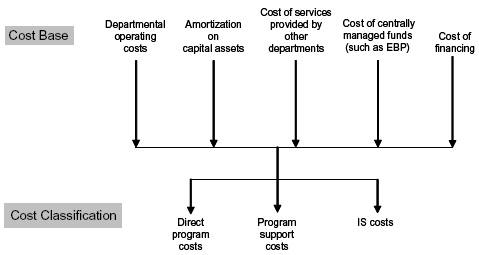
Responsibility
The responsibility for classifying the costs rests primarily with the department's DCFO organization. Program managers and IS managers will be able to assist in identifying which classification is most appropriate for each cost.
The classification of the indirect program support and IS costs may require extensive consultation and good judgment; the complexity created by differing mandates and geographic locations brings additional challenges to the process. Organizations define and categorize program support and IS costs according to their own needs. What one organization categorizes as an IS cost may be considered by another organization as a direct or program support cost. Similarly, some support costs may be considered either IS or program support, depending on how the support function is organized and to where it reports. At a minimum, departments should ensure that the classification of their indirect program support and IS costs is consistent throughout the department.
Sometimes, small parts of IS activities are performed within programs yet the department as a whole benefits. For instance, if some of a department's security services are performed within a program, rather than under the IS umbrella, these must still be identified and treated as IS costs and allocated accordingly.
Tasks
The following are the tasks required to determine the cost classifications:
- Determine whether costs are direct, program support, or IS. Conducting interviews with the appropriate managers is usually necessary to distinguish between direct and program support costs. Departments are free to create as many subcategories of costs as is necessary to assist in the disclosure and analysis of their costing information; for example, a department may create separate subcategories for regional program support and HQ program support;
- Ensure that all departmental costs are identified with one of the three main classification categories: direct program costs, program support costs, and IS costs — underlying information and assumptions should be documented; and
- Ensure that services provided without charge by OGDs are categorized separately.
Results
This step in the costing process makes the distinction between direct program, program support, and IS costs. Services provided without charge by other government departments should be categorized separately. In addition, documentation will be in place that outlines the data source(s), assumptions, and the methodology and other details of how the cost classifications were determined.
Tips
An efficient way to obtain information to support cost classification is through the pre-established standing working group committee.
By bringing together program management, IS, and the DCFO organization in a forum, the combination of business knowledge and technical financial expertise can quickly identify the information requirements for purposes of cost classification.
Step 4 — Cost Classification Template*
| Cost Base | Direct Cost | Indirect Cost(1) | Total Cost | Cost Base | Direct Cost | Indirect Cost(1) | Total Cost |
|---|---|---|---|---|---|---|---|
(1) This column is intended to represent the total indirect costs that will be assigned to all cost objects in Step 5 — Cost assignment. The amounts assigned in Step 5 should be reconciled to the total indirect costs. |
|||||||
| Salaries | Salaries | ||||||
Non-salary:
|
IS:
|
||||||
Capital:
|
Accommodation | ||||||
| Employee benefits | |||||||
Other relevant costs
|
|||||||
| Other programs | |||||||
* This is not meant to be an all-inclusive example. Departments are encouraged to add to this template to meet their own needs, while being consistent with the cash or accrual basis they have chosen.
A separate checklist of questions to assist in the completion of Step 4 follows on the next page.
Step 4 — Cost Classification Checklist*
- Have you classified each element in your cost base as either "direct," "indirect" program support, or "indirect" IS?
- In order to classify all elements as either "direct" or "indirect," have you consulted the providers of those services and activities? If not, please justify.
- Will the use of available financial systems data assist you in classifying each item as either "direct" or "indirect" ? For instance, the extraction from the financial system of the following fields of information may assist you:
- centre (RC);
- purpose (program, activity, or project);
- object (line object, standard object, or economic object); and
- a combination of program activity, purpose, object, and RC.
- Have the relevant internal and external stakeholders confirmed your cost classification? If not, please justify.
- Have you documented your cost classification process, including all assumptions?
Signature:
*Departments are encouraged to add to this checklist to meet their own needs.
Step 5 — Cost assignment
What are the best ways to assign costs to cost objects?
- Cost assignment means assigning (or "allocating" ) relevant costs in appropriate amounts to the cost object or objects. Cost assignment is the essence of costing because it identifies the most appropriate methodology to determine how much of each type of cost is consumed by the cost object. Once the methodology has been decided, calculations can be performed to produce the cost information required.
- Direct costs are assigned (or attributed) directly, whereas indirect costs are allocated.
- The allocation of indirect costs requires careful consideration of the most appropriate allocation methods.
- Where indirect costs can be reasonably attributed to the work caused by cost objects, these costs can be allocated on a causal basis. For example, if the cost objects are RCs, the costs of a staffing unit in an HR branch may be allocated on the basis of the number of staffing actions that the branch performs for each RC.
- Where indirect costs cannot be reasonably attributed on a causal basis, a more general method of allocation must be chosen. For example, the costs of a departmental budget office may be allocated on the basis of the percentage of the total departmental budget that each cost object represents.
- Circumstances influence the selection of the cost allocation method. For example, if the amount to be allocated is not material, the easiest and most practical method of allocating should be selected. On the other hand, if the amount to be allocated represents a significant proportion of the total cost of each object, a greater level of precision is necessary.
- Costs are driven by various factors. The term "cost driver" is used to describe the factors that cause costs to vary. Cost drivers can be quantitative, such as the number of units. For example, the cost driver for an HR staffing unit may be the number of staffing actions. Cost drivers can also be qualitative, such as the accuracy of the cheques issued under a contribution program. In this example, where there is no clear causal relationship, the cost object's budget, expressed as a percentage of the total departmental budget, may be used as a proxy for the level of effort expended to issue cheques.
- A useful cost allocation tool is cost pooling. "Cost pools" are used to accumulate costs that can all be allocated on the same basis to the cost objects that consume these costs. This is a more convenient and efficient method than allocating each cost individually. For example, if it is decided that HR, security, and facilities management costs can all be reasonably allocated on the basis of the number of FTEs in each cost object, these costs would be accumulated in a pool for allocation purposes. Pooling can also be used for allocating program support costs. For example, the costs of the offices of senior program managers, such as those of the assistant deputy minister and directors general, could all be pooled and allocated on some reasonable basis, such as percentage of total program cost in each direct program cost object.
- It is recommended that departments use spreadsheets, with supporting assumptions and rationale, to document the allocation of costs to the cost objects.
- A graphic showing an example of cost allocation is shown toward the end of this section, followed by a checklist to which departments should add in order to meet their own needs.
Responsibility
It is the responsibility of the DCFO organization to determine and apply the appropriate methodology for allocating program support and IS costs to the cost object. Determining the most appropriate allocation processes to meet a department's particular requirements, however, requires consultation with program and IS managers, because they are in the best position to understand the factors that drive their costs.
Tasks
The tasks described below, which are performed to determine appropriate cost-assignment processes, and the sequence in which they are undertaken do not represent the only way to assign costs. The method of cost assignment is decided by individual departments based on what they believe are the most appropriate cost assignment processes for their costing purposes. In all cases, the assumptions and methodology used should be documented.
- Determine the most appropriate methodology to assign costs to the departmental cost objects:
- Determine how cost objects are measured.
- Determine whether more than one program activity results in a single cost object or several cost objects are the result of a single program activity.
- Where more than one direct program activity results in a single cost object, the costing of cost objects entails the allocation of the direct service activities' costs to the various cost objects.
- Where a single program activity gives rise to several cost objects, consultation with program management serves to determine the proportion of costs that relate to each cost object. After these costs have been allocated to each type of output, the unit cost of each output is calculated based on volumes.
- Assign direct program costs to the target cost objects.
- Allocate program support costs to the target cost object:
- Identify any program support costs that are incurred to specifically support the target cost object, and allocate those costs directly.
- The remainder of the program support costs that cannot be assigned directly to the target object because they apply to more than just the target cost object can usually be allocated on a causal basis.
- If pre-existing, routinely updated cost drivers are available, use them for the allocation.
- Determine the cost drivers, if they are not already determined, or another suitable basis for allocating program support services to the cost objects. For example, the salary costs of an administrative assistant working on four different cost objects could probably be allocated on the basis of time spent on each.
- If a direct program's costs are primarily labour-related, FTE or personnel costs may be the most appropriate basis for allocating program support costs. On the other hand, if direct costs are more diverse, total operating costs or capital costs may be the most appropriate basis for cost allocation.
- Allocate IS costs:
- Identify the main components of IS. Keep in mind that pockets of IS activities are sometimes performed within programs. Identify and treat those pockets as IS for allocation purposes.
- Interview representatives of each IS organization to better understand the nature of its services and the identity of its clients and to determine the most appropriate cost drivers for allocating its costs if such drivers have not been already determined or routinely updated. Based on the interviews, it may be decided to group like costs into cost pools. See Annex A for a complete definition of cost pools.
- One of the objectives of interviews with representatives of each IS organization is to determine the extent to which each of the IS areas provides services to other IS and program areas. CMA Canada's Management Accounting Standard 2400-4 recommends that when IS cost centres provide a significant level of services to each other, the assignment of costs should reflect those interactions. The application of this concept of reciprocal costing introduces a two-tier approach to cost assignment. The first tier involves assigning IS costs to all program and other IS areas. This tier may involve, for instance, assigning a significant portion of IM-IT costs to the finance branch to reflect the development and maintenance of a significant departmental finance system (here we see that a causal relationship exists), while allocating the balance of the IM-IT costs to all IS and program areas using a different basis (where no causal relationship exists). Likewise, the costs of the finance function may be assigned both to other IS areas and other program areas. The second-tier cost assignment allocates to the program areas the cost pooling that resulted from the first tier. To apply this concept, the use of management accounting judgment is required — bearing in mind that the investment made to obtain cost information should not outweigh its value. The data sources, methodology, and assumptions supporting the cost assignment must be documented.
- Similarly, the interview with, for example, representatives of the communications branch may reveal that a significant share of the communications costs are specifically incurred for the benefit of two program activities rather than for the department as a whole. In such an instance, those specifically incurred costs are assigned to those two activities, leaving the remaining communications costs to be pooled with other IS costs (that also do not have a direct causal relationship to any activities) for allocation throughout the department.
- Further to the interviews, use judgment to group like costs into a reasonable number of cost pools and determine the appropriate cost drivers for allocating these IS cost pools. For example, the number of FTEs may be the most appropriate cost driver for the allocation of HR, security services, and facilities management costs. Meanwhile, percentage of gross expenditures, volume of certain types of transactions, or even level of effort expended may be the most appropriate cost driver for allocating the costs of the finance and audit and evaluation functions.
- The selection of appropriate allocation bases entails a cost-benefit trade-off. Particular methods that will provide the most accurate results may be too costly to apply if the base data are not readily available within the department. Materiality, affordability, and the impact of the allocation on the receivers' behaviour must always be taken into account.
- In the case of joint or horizontal initiatives, consult other stakeholders as necessary.
A model for allocating costs to a targeted cost object from a cost base that is relevant to several cost objects appears on the page following.
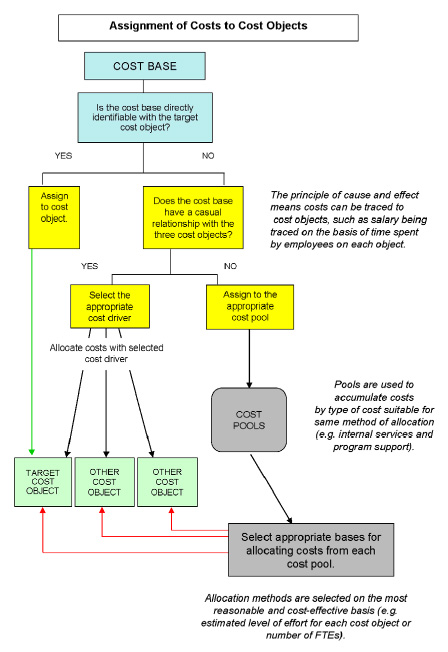
Text version: Assignment of Costs to Cost Objects
Results
The result of this process is a document that describes the allocation methodologies, causul relationships, and pools of costs that were accumulated for allocation and describes the specific cost drivers and methodologies required to allocate these pools of costs. the document defines the route to be taken in moving costs from where they are captured in the department to where they are required for the costing of cost objects. it should also present all assumptions, data sources, and working papers used (e.g. tables and spreadsheets).
Tips
The business knowledge held by the IS and program areas, combined with the costing expertise held by the DCFO organization, is fundamental and necessary to identifying cost drivers and recommending allocation methodologies.
Care should be taken to balance materiality, affordability, and benefits.
The information derived from the cost assignment step will greatly assist future costing exercises and serve as the basis for efficiency measurement.
Additional cost assignment considerations
Causal relationships
Matching resources to results is challenging since there is not always a clear causal relationship between resources and each step in the results chain of activities, outputs, and various levels of outcome. For resources that are used directly, such as the salaries of employees fully engaged in carrying out a specific activity, the causal relationship is quite clear. In many cases, a direct relationship does not exist because employees often contribute to a number of activities. This is equally the case for other resources, such as equipment and buildings. Another challenge is determining a causal relationship between results and resources consumed from support and stewardship services.
Other times, a clear causal relationship makes direct allocation of a portion of program support or IS (e.g. finance, HR, IM-IT, legal services, and communications) to a cost object possible. For example, a significant amount of communication costs may be specifically incurred for the benefit of two cost objects rather than for the department as a whole. In such an instance, the specifically incurred costs should be directly allocated to the two cost objects. These kinds of dedicated IS costs have a direct cause-and-effect relationship. Only the remaining communications costs would be pooled with the other IS costs that do not have a causal relationship with any particular cost object.
Attentive management of causal factors is the best means of maximizing the economical, efficient, and effective use of resources. These causal factors are mostly non-financial and can be both quantitative and qualitative. They emanate from many sources, such as client demands (internal and external) and new or changed regulations or service standards. Since these causal factors are the drivers of resource requirements, it is critically important to know how to interpret and use them effectively in resource management — one of the main purposes of costing.
Cost pools
It is important to assess at each stage in the allocation process whether a direct assignment can be made or whether the costs should be pooled for subsequent allocation. Cost pools efficiently allocate costs to cost objects when the cost drivers are homogeneous and the volume warrants.
For the sake of efficiency, cost pools are often created to facilitate the allocation of indirect costs to cost objects. Judgment and consultation are needed to create pools of costs that share similar relationships to the cost objects to which they will be assigned. For instance, in the case of IS, it is normally not appropriate to accumulate all of the IS costs in a single pool with the same basis for allocation, such as percentage of budget. Rather, consultation may reveal that in a particular department, HR, security, administration, and facilities costs could be accumulated in a separate pool for allocation on the basis of the number of FTEs, while procurement costs could be pooled separately for allocation on the basis of the number of purchase orders. Some other IS services, such as finance and program evaluation, could be pooled together and allocated based on estimated level of effort. The precision of information derived from the creation and maintenance of cost pools must be balanced against the financial cost of doing so.
Analysis and consultation often reveal that 80 per cent of an effect is represented by 20 per cent of the causes — this is known as the Pareto principle, sometimes called the 80-20 rule. For example, assume that the HR branch of a particular department has ten main activities that it performs for the rest of the department. Many of these activities are relatively insignificant, while the two largest of those activities represent approximately 80 per cent of HR expenses. If it is determined that these two activities could be allocated to the rest of the department based on the number of FTEs (in other words, both of the two activities could be allocated to their clients on the same causal basis) then the department could efficiently and reasonably allocate 100 per cent of its HR costs using one cost pool. Alternatively, two cost pools may be recommended. The affordability of creating and maintaining multiple cost pools is a factor that must be considered.
The allocation of IS requires significant analysis and judgment. There are few "right answers," but consultation and reasonable assumptions should result in fair and consistent costing practices. Using judgment, some departments may be able to pool several IS activities or subactivities in several cost pools—each with its own causal relationship with its clients. Where there is a clear cause-and-effect relationship, such as the quantity of units consumed, this relationship should be the cost driver used for allocation. Where there is no such relationship, judgment should be used to determine the most reasonable cost driver, such as number of FTEs or percentage of budget. Depending on the size of the organization, the scope of the costing exercise, and the affordability of creating and maintaining cost pools, CMA Management Accounting Standard 2400-1 suggests that fewer than five cost pools is insufficient for a proper treatment of indirect costs, while more than fifty is excessive.
Standard costs and fixed percentages
The use of standard costs is a practical strategy in cases where volumes and similarity of processes within the department warrant it. The establishment of standard costs itself requires a costing exercise, using the steps described in this Guide. Those standard costs are then used, along with other cost information, in the costing of objects. Departments must establish their own standard costs — to base them on the percentages used in OGDs is not acceptable, as the purpose of a costing exercise is to demonstrate and justify a department's own costs; it is not a benchmarking exercise.
At a minimum, standard costs should be reviewed and updated every two years.
In addition to establishing standard costs for some specific program processes, some departments may decide to further invest in the analysis of causal relationships and develop standard costs, or a standard percentage of costs, to represent the program support or IS consumed by cost objects. However, caution must be exercised to ensure that the composition of these pre-calculated standards or percentages is well-documented, well-understood, and properly scaled to the particular exercise at hand. Questions that need to be answered include the following:
- Exactly what cost elements does the calculation include?
- Does the calculation represent purely incremental costs, or does it include a fixed cost component?
- Are all of the component costs of the pre-determined standard or percentage relevant to the costing purpose at hand?
- How frequently are these standards and percentages updated?
If not properly understood and applied, a standard percentage for IS may result in serious distortions of the true cost. For example, if the percentage factor for IS is 5 per cent, a program with a $300 million budget is automatically allocated $15 million for IS costs, even though, in practice, the program only consumes the same amount of IS as another program with, for example, a $25 million budget. Knowledge of cost behaviours, sound reasoning, and good judgment are necessary to validate the results.
Choice of cost driver
The choice of an allocation base can motivate managers to adopt a desired behaviour. The following example illustrates the motivational effects of three methods for allocating the $1 million annual cost of a corporate branch. The branch's sole task is to review Treasury Board submissions from three internal organizations: X, Y, and Z.
A. The first method allocates the cost among the three organizations based on FTEs. The results are shown below.
| X | Y | Z | |
|---|---|---|---|
| No. of FTEs | 250 | 300 | 450 |
| Share of total | 25% | 30% | 45% |
| Allocation | $250,000 | $300,000 | $450,000 |
The manager of Z is not pleased with this method of allocation, because Z does not initiate any Treasury Board submissions and the manager feels that Z is subsidizing the other two organizations. Left this way, organizations X and Y will not be motivated to reduce their consumption of financial services, since they are enjoying the subsidization of their costs by Z. Organization Z will not be able to influence the reduction of the overall costs, since it has no dealings with the Treasury Board submission review branch.
B. The second method distributes the cost among the three organizations based on the number of Treasury Board submissions reviewed. The results are shown below.
| X | Y | Z | |
|---|---|---|---|
| No. of TB submissions | 50 | 50 | 0 |
| Share of total | 50% | 50% | 0% |
| Allocation | $500,000 | $500,000 | $0 |
The manager of organization Z is now satisfied as this method recognizes that it does not consume any review services.
The management of organization X, however, is not satisfied because it is being allocated the same amount as organization Y. They point out that Organization X always respects lead times and provides complete information to the Treasury Board submission review branch, whereas they know that organization Y normally does not respect the lead time requirements and often provides incomplete information — thereby causing the review branch to expend more effort and incur overtime costs in support of organization Y.
Left this way, organization Y will continue to be subsidized by X and will not be motivated to respect the deadlines and provide more complete information.
C. The third method used to distribute the cost to the organizations is based on the level of effort estimated by the review branch. The results are below.
| X | Y | Z | |
|---|---|---|---|
| Level of effort | 40 | 60% | 0 |
| Share of total | 40% | 60% | 0% |
| Allocation | $400,000 | $600,000 | $0 |
Organization X is now satisfied that it is paying its "fair" share and is no longer subsidizing organization Y. If the managers of organization Y wish to reduce the amount allocated to it, they can do so by reducing the effort that organization Y causes the review branch to expend in support of its Treasury Board submissions.
In summary, the choice of the cost driver can motivate a desired behaviour. The economic consumption estimated by the driver must be credible, and the measurement of the driver must be affordable.
Step 5 — Cost Assignment Template*
|
Total Amount to Assign $ |
Amount Assigned Due to Direct Relationships(1) $ |
Amount Allocated Based on Causal Relationships(2) $ |
Amount Allocated by Means of Cost Pools(3) $ |
Total Amount Assigned $ |
|
|---|---|---|---|---|---|
|
|||||
Direct costs:
|
|
y |
|||
IS:
|
x |
x |
y |
||
| Program support | x | y | |||
| Services provided without charge |
x |
y |
|||
| Total | z | x | x | x | z |
*This is not meant to be an all-inclusive example. Departments are encouraged to add to this template to meet their own needs and develop as many supporting spreadsheets as necessary.
Step 5 — Cost Assignment Checklist*
- Have you assigned your direct program costs to the cost objects?
- In what sequence did you allocate the following indirect costs? Please explain.
- Internal services (IS)
- Program support costs
- In designing a costing approach, did you assess the investment in time and resources and level of precision necessary against the benefits to be derived from that investment to ensure that there is a balance?
Internal services (IS) costs
- In consultation with the IS managers, have you identified any IS areas that provide a significant amount of service to another IS area, and will you reflect those interactions in the cost base and allocation (as per CMA Management Accounting Standard 2400-4)? This approach requires judgment.
- In consultation with the IS managers, have you identified IS costs that can be attributed directly to the target cost objects? If yes, have you attributed these costs to the cost objects and excluded them from the IS costs to be allocated using another basis of allocation?
- For the remaining IS costs, have you consulted the IS managers for the purpose of assessing the extent to which there is a cause-and-effect relationship between their costs and the target cost object? Explain how you assessed the cost drivers. Is it appropriate to pool some or all of them before allocating them to the cost objects? Describe and justify the use of the pooling process. Describe the cost drivers identified.
- For those IS costs that bear no causal relationship with the target cost objects, have you pooled and allocated them using a reasonable basis, such as the number of FTEs, salary budget, or operating budget?
Program support costs
- In consultation with the program support managers, have you identified the program support costs that can be directly traced to the target cost objects (such as dedicated units)? If yes, have you attributed these costs to the cost object and excluded them from the remaining program support costs to be allocated using another basis of allocation?
- For the remaining program support costs, have you consulted the appropriate managers for the purpose of assessing to what extent there is a cause-and-effect relationship between these costs and the target cost object? Explain how you assessed the cost drivers. Is it appropriate to pool some or all of them before allocating them to the cost objects? Describe and justify the use of the pooling process. Describe the cost drivers identified.
- For indirect program support costs that bear no causal relationship with the target cost objects, have you pooled and allocated them using a reasonable basis?
Documentation
- Have you documented your cost assignment process, assumptions, and details of data sources?
Signature:
*Departments are encouraged to add to this checklist to meet their own needs.
Step 6 — Calculate, validate, and confirm results
This step has two phases: the first step is to perform the actual calculations once all the allocation bases have been determined; the second step is to validate the calculations, assumptions, and results and confirm that they meet the cost purpose defined in Step 1.
Phase 1 — Perform calculations
- The first phase, a culmination of the preceding steps, brings together information from all of the supporting tables and uses that information to calculate the costing information required.
- The example below, along with two related templates, assumes a complex costing exercise that uses an iterative approach: in the first template the costs are allocated at the program activity level of detail; in the second template those costs are further allocated at the level of detail of the cost object.
- Departments are encouraged to add to and reformat the templates as required, adding the necessary explanatory footnotes to meet their specific information requirements.
- The sample templates that follow assume a complex costing exercise with a cost object that has the full range of all the potential cost elements that could be identified in a cost base. Depending on the cost purpose defined in Step 1, some of the cost elements may not be included in all costing applications. For example, depending on the defined purpose, some non-cash costs such as EBP, amortization, and the financing costs of revolving funds may be excluded. This is why the phrase "where applicable" precedes some of the tasks in the following list.
The two templates that follow are provided for illustrative purposes only. Departments are encouraged to develop spreadsheets that meet their own needs.
- In Column 1 of the first sample table, enter the name of the direct program activity.
- In Column 2, itemize each of the direct costs for each direct program activity at the level of detail available and appropriate.
- Where applicable, enter in Column 3 of the spreadsheet the EBP and the insurance premium percentages pertaining to the personnel costs included in each direct program activity's costs. These percentages are available in the detailed instructions for the preparation of the ARLU issued by the Secretariat. Be sure to select the ARLU instructions for the relevant year or years. If you are forecasting, use the EBP rate in the latest ARLU instructions.
- Where applicable, enter the cost of amortization in Column 4 of the spreadsheet. This amount can be calculated from a list of the historical costs, book values, and useful lives of fixed assets associated with each direct program activity. If not already available within your department, it is necessary to calculate an annual amortization charge based on historical cost using straight-line or another method that is more appropriate to the asset. For guidance on the valuation and amortization of physical assets, please review the Treasury Board Accounting Standards.
- Where applicable, the financing costs on the monthly drawdown of revolving funds should be entered in Column 5 of the spreadsheet. The monthly drawdown is calculated by applying the Consolidated Revenue Fund lending rate (based on the government's cost of borrowing). This rate is adjusted monthly by the Department of Finance. If the cost object is not the entire revolving fund, it is necessary to attribute a portion of the monthly financing cost to the portion of the revolving fund being costed.
- In Column 6, enter program support costs using appropriate allocation bases such as FTE and personnel costs. The calculations are best performed in separate, supporting spreadsheets with the methodology, assumptions, and source data clearly stated.
- In Column 7, enter the IS costs allocated to the department's program support and direct program activities, using appropriate allocation bases, such as FTE and personnel costs. The calculations of the IS allocations are best performed in separate, supporting spreadsheets with the methodology, assumptions, and source data clearly stated.
- Where applicable, enter in Column 8 the costs of services provided without charge by OGDs. These costs or standard application factors are available from the departments themselves (or from the receiving department's RPP or DPR). The calculations are best performed in separate, supporting spreadsheets with the methodology, assumptions, and source data clearly stated.
- Total the costs of each direct program activity for each program and enter the total in Column 9.
- In Columns 10 to 13 of the second sample template below, enter all cost objects, direct program activities, bases for allocating direct program activities' costs to cost objects, and the costs of objects. This information can be obtained by the following means:
- listing the cost objects of each program;
- relating the direct program activities to the cost objects;
- where necessary, adding several direct program activities' costs together to relate them to one cost object; and
- where necessary, splitting particular direct program activities' costs into segments related to several different cost objects. Where it is necessary to split the costs of a direct program activity among several cost objects, split them using an allocation basis agreed to or provided by program management, such as a fixed percentage allocation.
- In Column 14, enter volumes. Depending on the purpose of the costing information, consider citing the average volumes over a number of years rather than a single year's volume or a maximum capacity volume. Citing the average volume will ensure that unit costs do not vary dramatically from year to year and are set at realistic rather than "ideal" levels.
- In Column 15, enter unit costs. These are determined by dividing cost object costs (Column 13) by volumes (Column 14).
| 1 | 2 | 3 | 4 | 5 | 6 | 7 | 8 | 9 |
| Direct Program Activity Title and Code | Direct Costs | Employee Benefits | Amortization | Financing Costs | Program Support | IS | Services Provided Without Charge | Total Costs |
| $ | $ | $ | $ | $ | $ | $ | $ | $ |
| 10 | 11 | 12 | 13 | 14 | 15 |
| Cost Object Description | Total Program Activity Costs Related to Cost Objects (from previous table) | Basis for Allocating Direct Program Activity Costs to Cost Objects | Cost Object Costs | Output Volumes | Unit Cost of Cost Objects (Column 13 divided by Column 14) |
| $ | $ | $ |
*Departments are expected to add to these templates to meet their own needs and develop as many supporting spreadsheets as necessary.
Departments should perform the necessary reconciliations with the source documents to ensure that they have accounted for all costs.
Responsibility
The DCFO organization is responsible for performing the calculations and providing the functional guidance required. Once the DCFO organization completes the calculations, the resulting information should be reviewed in Phase 2 with the appropriate program and IS managers.
Tasks
The financial officers' exercise of professional judgment and expertise is essential as they develop the necessary spreadsheets and complete the calculations and reconciliations.
Results
Upon the completion of this step, the unit costing of cost objects has been achieved. If all the tasks are performed and costs included as identified above, the result is a full unit costing of the cost objects. This costing is appropriate in determining full cost relating to a cost-recoverable service. For a make-or-buy decision, only those costs that will be affected by the decision are relevant.
Phase 2 — Validate and confirm result
- In Phase 2, the information that resulted from Phase 1 is reviewed with the appropriate program and IS managers. The mathematical calculations are verified and the assumptions, methodologies, reconciliations, and documentation are reviewed for completeness, accuracy, and reasonableness and to confirm that the results meet the cost purpose defined in Step 1.
- In highly complex or sensitive cases, the department should consider using an outside organization to validate its results.
- Once the results are judged to be mathematically sound and prepared in a manner consistent with this Guide and generally accepted management accounting principles, the department should confirm with the end-user that the results satisfy its needs as defined in Step 1.
- See the following checklist, to which departments should add to meet their own needs.
Responsibility
The responsibility for validating the calculations rests with the DCFO organization, while the responsibility for confirming that the costing information satisfies the defined cost purpose rests with the DCFO organization and program management. In the case of horizontal or joint initiatives, it may be necessary to consult other stakeholders.
Tasks
In light of the defined cost purpose, the DCFO organization validates the data sources, assumptions, methodology, and calculations. It also ensures that the foregoing is properly documented. In complex or highly sensitive cases, the DCFO organization or senior management may choose to contract a qualified, neutral third party to undertake this task.
In consultation with each other, the DCFO organization and program management provide confirmation that the costing information satisfies the defined cost purpose and is at the level of detail required.
Results
This phase results in properly calculated costing information that satisfies the defined cost purpose.
Note: At this point, managers may use the cost information to undertake a cost-benefit analysis (in support, for instance, of a choice among alternative program options) or a risk assessment if the situation warrants it. The Secretariat's Canadian Cost-Benefit Analysis Guide provides a detailed methodology for performing such analyses, including the recommended discount rates to use. Guidance on performing risk assessments is available in the Secretariat's risk management policies and publications.
Tips
Adequate consultation throughout the preceding steps ensures a smooth validation and confirmation process.
Well-documented assumptions, data sources, and methodologies enhance the credibility of the costing initiative. They also enable the DCFO organization to respond effectively to any questions raised by decision makers and serve as valuable points of reference for future costing exercises.
Step 6 — Calculations and Results Validation Checklist*
Calculations
- Please describe the customized spreadsheets and specify the costing software and other methods you used.
- Did you ensure that that all the headings and data (cost objects, cost base, cost pools, cost drivers, and related volumes) were accurately entered into the spreadsheet or software program? Did you add footnotes where needed? Did you confirm that the formulae are correct?
- Have you performed all the relevant calculations up to the unit cost (if needed)?
Results validation
- Did you review the checklists and sign-offs of the first five steps to ensure that all work was completed, at a minimum, in compliance with this Guide?
- Did you ensure that the data sources, assumptions, methodology, and calculations are valid by reconciling them with the financial reports corresponding to the time period covered by the costing exercise?
- Have you reconciled the resulting cost information (in the cost objects) with your cost base?
- Have you collected the appropriate financial information from the appropriate sources?
- Have you verified the mathematical accuracy of your calculations?
- Have you confirmed that the resulting cost information is reasonable?
- Have you collected the appropriate non-financial information, such as the drivers' volumetrics, from the appropriate sources? Please describe the non-financial data and its sources.
- Did you need to calculate a unit cost? If yes, have you collected the appropriate output and outcome volumes from the appropriate sources?
- Have you reviewed the supporting checklists for Steps 1 through 5 for completeness?
- Have you consulted with stakeholders (internal and external) and senior management and confirmed that the results of the costing exercise respond to the purpose statement that was defined at the outset?
Signature:
*Departments are encouraged to add to this checklist to meet their own needs.
Step 7 — Sign-off
CFOsign-off of costing is required for Memoranda to Cabinet and Treasury Board submissions.
- Additionally, departments are expected to design a supporting hierarchy of internal sign-offs to strengthen quality assurance, internal control, and internal accountability and to ensure adequate consultation.
- At a minimum, the sign-off hierarchy should implicate the DCFO organization, the end-user of the information, and all other significant stakeholders.
- In designing their own internal sign-off procedures, departments are expected to factor in any areas of risk or other unique needs that would benefit from a diligent sign-off.
- A sample of the minimum sign-off requirement for the CFO is on the following page. Departments are encouraged to add to it to meet their own internal sign-off needs.
- Departments are also encouraged to design and implement additional sign-offs to be used at various levels and in various parts of their organizations in support of the CFO sign-off as well as to strengthen internal control and accountability.
Responsibility
It is the responsibility of the CFO to confirm that the costing information is sound and complete and was performed in accordance with this Guide and generally accepted management accounting principles. This confirmation is supported by other internal sign-offs of the costing information, as designed and implemented by the individual department.
Tasks
It is highly recommended that the CFO have an internal process in place to ensure that departmental costing is performed and documented in accordance with this Guide and other pertinent financial management policies.
Results
Sign-off by the CFO signifies his or her attestation of the quality and completeness of the costing information. Departments are encouraged to design and impose additional internal sign-offs. The sign-off checklist provided in this Annex should be considered a minimum requirement.
Tips
Additions to the templates and sign-off checklists at each of the seven steps effectively demonstrate the state of departments' internal controls and cost accounting capabilities.
These additions also improve accountability, transparency, credibility, and the quality and accuracy of cost management information.
Step 7 — CFO Sign-off Template*
|
Yes/No (If negative, please explain) |
|
|---|---|
| 1. Has the DCFO signed-off to confirm that adequate consultation with the end-user took place in order to clearly define the purpose of the need for the cost information? | |
| 2. Has the DCFO signed-off to confirm that adequate consultation for the purpose of capturing all relevant costs took place between the DCFO organization, program and IS managers, and OGDs? | |
| 3. Has the DCFO signed-off to confirm that all methodologies used, data sources, and assumptions were documented? | |
| 4. Has the DCFO signed-off to confirm that all other supporting internal sign-offs have been completed by the necessary stakeholders? | |
| 5. Has the DCFO signed-off to confirm that the first six steps detailed in the Secretariat Guide to Costing have been followed and that the templates and checklists have been completed for each? (This, the CFO sign-off, is the seventh step.) |
CFO signature:
In my capacity as [CFO], I attest that in my professional opinion the costing information was prepared in accordance with the Guide to Costing ; the information is fairly presented; proper analysis has been performed; and due diligence has been exercised.
*Departments are encouraged to add to this checklist to meet their own needs.
Summary of the seven steps
| Step | Organization Responsible | Results |
|---|---|---|
| 1. Define the purpose of the costing exercise | Departmental management in consultation with the department's DCFO organization | A clearly defined purpose for which the information is needed; for instance, the information may be intended to support a specific management decision or respond to a central agency requirement
Timeframe and level of detail needed to support the defined purpose |
| 2. Define the cost object | Program management and the department's DCFO organization | Definition of the cost objects needed to support the purpose and the level of detail required
Underlying assumptions — document these as they emerge |
| 3. Determine the cost base | The department's DCFO organization in consultation with IS and program management and other stakeholders as required | Determine whether the cost base will use budgets, actuals, forecasts, or a combination as appropriate; document the sources and assumptions Direct program costs, program management support costs, and IS costs Capital costs Fixed assets with historical costs and net book values for calculating amortization Useful lives of assets Cost of inventories used in program activities, if material Consolidated Revenue Fund lending rate Costs of services provided by other government departments such as accommodation from PWGSC; EBP and other insurance premiums paid by the Secretariat; workers' compensation coverage paid by HRSDC; and legal services funded by JUS |
| 4. Determine the cost classification | The DCFO organization with program and IS management and other stakeholders as required | Segregate relevant costs in the cost base into either direct or indirect costs |
| 5. Select cost allocation bases | The DCFO organization in consultation with IS and program management and other stakeholders as required | Cost drivers — select these on a cause-and-effect basis to the extent reasonably possible and affordable Cost pools — pool like costs into cost pools |
| 6. Perform calculations Validate and confirm |
The DCFO organization The DCFO organization in consultation with IS and program management and other stakeholders as required |
Costs, by program support, IS, and direct service activity Allocation bases Output units Calculations and assumptions — validate these Confirmation that costing information satisfies the cost purpose defined in Step 1 |
| 7. Sign off | CFO
DCFO and other internal stakeholders |
CFO sign-off of costing information in TB submissions and MCs Internal sign-off of all other costing exercises |
Application of the seven steps to costing
Below is an example of how to apply the seven-step approach.
Background: A department with service centres across the country has established that there is sufficient demand in a region to warrant a new service centre there. The Deputy Minister (DM) has asked how much the introduction of a new service centre would cost. The seven-step costing approach (see below) is used to calculate the answer to this question. How the costs were assigned is illustrated on the next page.
Step 1 — Purpose
- The purpose is to determine the cost of opening a new regional service centre.
Step 2 — Cost object
- The cost object is the new service centre.
Step 3 — Cost base
- The program manager and financial officers from the DCFO organization consulted with appropriate managers from the program and IS branches on the start-up and ongoing needs of the new service centre and determined that the following costs are relevant to the cost base:
- salaries and salary-related costs (such as annual training of all on-site staff);
- equipment and supplies used by all on-site staff (such as personal computers, forms, and office supplies);
- facility costs (such as rental fees for space and charges for telephone and telecommunication services);
- the incremental HQ and regional program management costs of providing direction and guidance to and monitoring the new service centre; and
- the incremental IS costs of supporting the new service centre.
Step 4 — Cost classification
- The direct costs identified are for direct services to the centre's clients (i.e. client services); the indirect costs are for all other costs not directly identifiable with actually serving clients (such as all the relevant program management and IS costs and the costs of on-site support to the client centre).
Step 5 — Cost assignment
- Given that the department already has a number of service centres, the program development manager and DCFO financial officer agree that it is reasonable to use the same cost drivers that are used for those centres.
Step 6 — Calculate, validate, and confirm results
The DCFO organization, in consultation with IS and program management and other stakeholders as required, does the following:
- assigns costs related directly to the client service; accumulates, where appropriate, all indirectly related costs in cost pools; and allocates all costs using appropriate cost drivers;
- summarizes all information at the level of detail required and performs reconciliations with source data;
- reviews the calculations for accuracy and the results, assumptions, documentation, and methodologies to ensure they are reasonable; and
- confirms with the DM's office that the cost information responds to the DM's needs.
Step 7 — Sign-off
Get sign-off at the appropriate levels to indicate that the department's internal sign-off procedures, checklists, and templates were used.
Annex C — Case study of a make-or-buy decision
1.1 Introduction to make-or-buy
Deciding whether to "make or buy" is one of the decisions that departmental managers commonly make in considering alternative program delivery options. Typically, a make-or-buy decision means comparing the incremental costs and benefits of performing a departmental function in-house with contracting the function out, such as to a private firm, a non-profit organization, or another order of government. Contracting a government function is often referred to as outsourcing. The function being considered for a make-or-buy decision may be new or existing.
The reasons for make-or-buy decisions vary. The make-or-buy decision may be based on economic factors, but it may also be based on other factors; for example, the decision might permit the reallocation of scarce resources, such as highly skilled employees, from a secondary function to a higher priority function of a department.
There are other, qualitative factors to consider in a make-or-buy decision. These factors include but are not limited to the following:
- the need or ability to reassign existing resources to other in-house priorities;
- the consequences of the absence of in-house expertise as a result of outsourcing;
- the impact on stakeholders, which may include clients and, of course, the employees who perform the function;
- the risk that an outside contractor may underbid with the expectation that it will be in a position later, when the department is dependent on the contractor, to negotiate a higher price;
- the requirement for external contractors to meet Government of Canada quality and performance standards; and
- the risk of dependency on external contractors.
Although it is difficult to place a reliable dollar value on the considerations outlined above, their potential risks should not be overlooked. Indeed, these qualitative factors may prove significant and may even take precedence over the quantitative results favoured in the cost analysis.
This case study focusses exclusively on the costing aspects of a make-or-buy decision.
1.2 Objective
The objective of this case study is to demonstrate the application of the seven-step approach outlined in Annex B. A make-or-buy decision shows how this Guide's logical costing approach applies to a strategic issue, such as an alternative program delivery decision, as effectively as it applies to the costing of an ongoing service.
1.3 Assumptions
This case study is based on the following assumptions:
- Only the costing aspects of the make-or-buy decision will be presented;
- The function being analyzed is a departmental service to external clients (although make-or-buy can apply to other departmental functions, such as support activities and special one-time projects);
- All the in-house staff who are currently directly involved in the delivery of the program will be reassigned to a higher priority within the department — in consequence, there are no workforce adjustment issues;
- The case study applies to an existing departmental service (make-or-buy can also pertain to a decision regarding a potential new service);
- An apples-to-apples comparison is being made (i.e. the in-house and outsourced service performance will be the same, including the same outputs of the same quality and quantity);
- The in-house service is being performed as efficiently as possible (i.e. an efficiency study has revealed that an unfair advantage is not being given to the contractor because of inefficient in-house processes — as such, there is no requirement to factor such inefficiencies into the case study);
- It is necessary to determine the cost of the in-house service so that there will be appropriate information for determining the relevant costs (avoidable costs) for the make-or-buy analysis — this part of the make-or-buy case study example is not necessary in a department with a costing system that already provides details of the costs of its operations (e.g. the causal relationships between the costs and the cost objects);
- Only an estimated bid price is available to the department; and
- The purpose of this analysis is to determine the economic impact of the alternatives, so non-cash items are included.
Throughout the case study, many of the steps will be in two parts: Option A will address the in-house data while Option B will address the data for the outsourcing option.
1.4 Net present value (NPV)
In order to make a fair comparison in a make-or-buy decision, the available information on the cost differential needs to cover both the short-term and the medium-to-long-term. The purpose of the cost comparison over the longer period is to capture any cost changes that will occur in later years; for example, after leases and contracts expire and are renewed and as capital assets are replaced. In deciding on a reasonable time frame to cover, one should consider the length of contracts and leases that are relevant to the function and the useful lives and value of significant capital assets. A shorter time period may be covered for functions that are considered uncomplicated and low-risk. The minimum recommended time period to cover is normally the current year plus the following five years. Guidance on the appropriate discount rates to use is available in the Canadian Cost-Benefit Analysis Guide that is published by the Regulatory Affairs Division of the Secretariat.
2.0 Application of the seven-step approach to costing
Step 1: Costing purpose
The purpose of this make-or-buy costing exercise is to determine the cost differential between costs avoided by not performing a service in-house and all the costs, net of any revenues, of having the service performed externally.
More specifically:
- For the in-house option, the purpose is to determine the total net avoidable costs if the function is outsourced; and
- For the outsourced option, the purpose is to determine the net cost of outsourcing.
This make-or-buy costing analysis covers the current year plus the following five years.
Except in the case of a new service, a make-or-buy decision is not based on a comparison between the cost of the government's performing the service and the cost of contracting out the service: such a comparison could create distortions. If a department makes a decision to outsource on the basis of this comparison, the decision could be in error by not taking into account some of the in-house costs that may not be completely avoidable; for example:
- Unless there is a direct causal relationship, the portion of program management and IS costs that are attributed to a service are not completely avoided if the service is contracted out. For example, costs related to policy and governance issues may be unaffected by one of the departmental services' being delivered by a contractor rather than in-house; and
- The amortization cost of a departmental fixed asset, such as a research laboratory, could be shared by a number of services on the basis of the extent of their usage of this facility. If one of these services is discontinued, the total amortization cost of the facility does not change because the cost relates to capital investments already made. Consequently, this cost would have to be allocated to a smaller number of users.
Step 2: Cost objects
This make-or-buy decision involves two cost objects, each of which contributes to determining the cost differential between the two options:
Option A. In-house service cost object
The purpose is to determine which costs among the following would be avoided: the total net avoidable costs (such as all direct costs); the portion of any program support and IS costs; and any costs of services provided without fee.
Option B. Outsourced service cost object
The purpose is to determine the net cost of outsourcing, which includes the estimated bid price, one-time transitional costs, the new costs of managing the contract, program management and IS costs required to support the management of the new outsourcing contract, the cost of services provided without charge, and any offsetting revenues.
Step 3: Cost base
Option A. Cost base of in-house service cost object
It is first necessary to isolate the costs of performing the service in-house before it is possible to determine, in subsequent steps, the costs that are avoidable and therefore relevant to this make-or-buy decision. The costs to consider are detailed below. They include departmental costs, the costs of services provided without charge by OGDs, and the costs of employee benefits controlled by the Secretariat.
| Costs for In-house Delivery | $ |
|---|---|
| Salaries | X |
| Supplies | X |
| Travel | X |
| Training | X |
| Telephone | X |
| Rental of equipment | X |
| Vehicle maintenance | X |
| Amortization of assets | X |
| Program support | X |
| Internal services (IS) | X |
| Total departmental costs | X |
| Services provided without charge by OGDs | X |
| Employee benefits | X |
| Total | X |
Option B. Cost base of outsourced service cost object
The relevant costs of the outsourced cost object are the costs that result from the contractor's performing the required service. These costs include the estimated price that the contractor charges for the service, less any new, resulting revenues that might benefit the department or the government as a whole. In addition, the department must also take into account any relevant transitional costs, such as those relating to penalties for cancelling a rental contract in advance of the maturity date, as well as any new costs, such as for monitoring contract performance. This is demonstrated below.
| Cost Items | Cost | Comments |
|---|---|---|
| Estimated bid price | X | This would be the estimated bid price, which could be based on an RFP |
| Transition costs | X | The one-time costs of transition, including amounts owed to employees under collective bargaining agreements |
| Program management (salaries and O&M) |
X | Costs of administering the contract, including monitoring and evaluating performance and dealing with disputes |
| Program support | X | Program support costs for the contract administration of the outsourcing option |
| Internal services (IS) | X | IS costs to support the contract administration of the outsourcing option |
| Fee to dispose of assets | X | Cost of disposing of assets that will become surplus; this cost would apply mainly to vehicles dedicated to the in-house service |
| Rentals | X | Cost of penalties for early cancellation or for making payments until rental contracts expire |
| Subtotal | X | |
| Revenues: Proceeds from disposal of assets | (X) | Primarily from sale of dedicated vehicles |
| Total cost of outsourcing to department | X | |
| Services provided without charge by OGDs | X | |
| Employee benefits | X | |
| Total | X |
Step 4: Cost classification
Option A. Classification of in-house costs
The relevant costs of the in-house service in a make-or-buy decision are those that are avoidable. Determining which costs are avoidable is greatly facilitated when the classification (direct and indirect), assignment (directly assigned or allocated), and causal relationship of these in-house costs are known.
The purpose of classifying the in-house service costs is to facilitate consultation among the DCFO organization, the program manager, and the parties providing program support and IS to the program, in order to determine which in-house service costs are avoidable or partially avoidable. Direct costs are normally avoidable because of their cause-and-effect relationship with the service being outsourced, whereas indirect costs are often only partially avoidable. A portion of indirect costs will usually continue to be incurred regardless of a decision to contract out the service. Information on the direct and indirect costs of the service is demonstrated in the table below.
| Cost Items | Total | Direct | Indirect | Comments |
|---|---|---|---|---|
| Salaries | X | X | ||
| Supplies | X | X | ||
| Travel | X | X | ||
| Training | X | X | ||
| Telephone | X | X | ||
| Rental of equipment | X | X | For dedicated equipment for this service | |
| Vehicle maintenance | X | X | For dedicated vehicles for this service | |
| Amortization of assets | X |
|
X | For facility shared with other services |
| Program support | X | X | Program support | |
| Internal services (IS) | X | X | IS support | |
| Total Departmental Costs | X | X | X | |
| Services provided without charge by other government departments | X | X | PWGSC: accommodation; HRSDC: workers' compensation benefits; TBS: employer's share of employees' health premiums; JUS: legal services | |
| Employee benefits | X | X | Allocation based on salary | |
| Total Costs | X | X | X |
Option B. Classification of outsourcing costs
The purpose of classifying the outsourcing costs is to facilitate consultation among the DCFO organization, the program manager, and the parties providing program support and IS to the program to determine how a decision to outsource will affect the direct and indirect costs of all parties. This is demonstrated on the page following.
| Cost Items | Total Cost | Direct | Indirect | Comments | |
|---|---|---|---|---|---|
| Estimated bid price | X | X | |||
|
Program management (salaries and O&M) |
X | X | New costs that are a direct result of outsourcing | ||
| Program support | X | Costs in support of the administration of the outsourced function | |||
| Internal services (IS) | X | X | IS costs in support of contract administration | ||
| Transition costs: |

|
These costs would be a direct result of the discontinuance of the in-house service | |||
| Salaries and O&M | X | X | |||
| Fee for disposal of equipment | X | X | |||
| Rentals | X | X | |||
| Total departmental costs | X | X | X | ||
| Services provided without charge by other government departments | X | X | PWGSC: Accommodation; HRSDC: workers' compensation benefits; the Secretariat: employer's share of employees' health care premiums; JUS: legal services | ||
| Employee benefits | X | X | |||
| Total costs | X | X | X | ||
The bid price is quite clearly a direct cost of the service. Program management is a direct cost because specific employees are dedicated to administering, monitoring, and evaluating the outsourced program. Program support and IS costs are the only indirect costs; they represent the support costs related to managing the outsourced program.
Step 5: Cost assignment
Cost assignment for in-house delivery
The cost assignment step for the in-house delivery is done in two stages. Option A-1 addresses the assignment of costs, while Option A-2 estimates what portion of those assigned costs are avoidable if the in-house delivery ceases.
Option A-1. Assignment of in-house costs
The cost classification of the in-house service costs is needed to calculate the amounts of costs that will not be avoidable; i.e., those that would continue if the in-house service is contracted out. The table below details how the direct and indirect costs shown in a previous table are assigned to the in-house service.
| Cost Items | Total | Direct | Indirect | Methodology |
|---|---|---|---|---|
| Salaries | X | X | Directly assigned | |
| Supplies | X | X | Directly assigned | |
| Travel | X | X | Directly assigned | |
| Training | X | X | Directly assigned | |
| Telephone | X | X | Directly assigned | |
| Rental of equipment | X | X | Directly assigned | |
| Vehicle maintenance | X | X | Directly assigned | |
| Amortization of assets | X | X | Estimated usage | |
| Program support | X | X | Number of employees | |
| Internal services (IS): | ||||
| Communications | X | X | Level of effort | |
| Information technology | X | X | Level of effort | |
| Other IS | X | X | Number of employees | |
| Total departmental costs | X | X | X | |
| Services provided without charge by other government departments | X | X | Most of these pooled costs are assigned based on number of employees; accommodation is a percentage of salaries | |
| Employee benefits | X | X | As a percentage of salary costs | |
| Total Costs | X | X | X |
The next table shows that while the costs of most of the IS functions are allocated on the basis of the number of employees, the IT, document processing, and communications functions are allocated to the in-house service on the basis of estimated level of effort. In this case, the level of effort corresponds to the proportion of resources that the manager of each of these functions estimates is expended in support of the in-house service.
The cost drivers used in the "Methodology" column of the above table are examples only. Through their own internal consultations and analysis, departments will determine the most appropriate cost drivers for their own purposes.
The following services provided without charge by OGDs have been pooled and are allocated by the department in this case study based on the number of FTEs, which was considered a reasonable method for allocating these costs:
- PWGSC — accommodation services;
- HRSDC — workers' compensation claims;
- JUS — legal services; and
- the Secretariat — employer's share of employees' health care premiums.
For EBP costs, the department allocates the costs based on salary dollars.
Option A-2. Avoidable costs of in-house delivery
The preceding information is used to further analyze the costs and determine those that are avoidable based on causal relationships. Consultation with the managers of the department's program management support and IS activities is necessary to understand cost behaviours for the purpose of ultimately estimating the costs that are avoidable. The relevant costs are the ones that are avoidable. This is demonstrated below.
| Cost Items | Direct | Indirect | Avoidable or Partially Avoidable | Comments |
|---|---|---|---|---|
| Salaries | X | 100% | These costs are avoidable because they are all directly related to the in-house service and would cease if the activity was outsourced; any transition costs are shown under the outsourcing option | |
| Supplies | X | 100% | ||
| Travel | X | 100% | ||
| Training | X | 100% | ||
| Telephone | X | 100% | ||
| Rentals of equipment | X | 100% | ||
| Vehicle maintenance | X | 100% | ||
| Amortization of assets | X | Nil | For these assets, amortization is influenced by the passage of time, not usage | |
| Program support | X | 80% | 20% of costs cannot be avoided | |
| Internal services (IS): | ||||
| Communications | X | Nil | ||
| IT | X | Nil | ||
| Other IS | X | 30% | 70% of these costs cannot be avoided | |
| Total avoidable departmental costs | X | X | ||
| Services provided without charge by other government departments | X | 75% | 25% of these costs will continue in support of managing the outsourced program | |
| Employee benefits | X | 75% | 25% of these costs will continue in support of the direct salary amount used in managing the outsourced program | |
| Total avoidable costs | X | X |
Costs are either totally, partially, or not avoidable. The table above shows the same cost items as in the preceding table but with an extra column for the portion that is avoidable: 100 per cent indicates costs that are completely avoidable; less than 100 per cent indicates costs that are partially avoidable; and "Nil" indicates costs that are not avoidable.
Through the consultation process, it is determined that the departmental document processing, communications, and IT support continue to be needed for this service.
Option B. Assignment of costs to the outsourced service
It is necessary to assign the direct and indirect costs to the outsourced service in accordance with the cost classification. Since the only indirect costs relate to program management support and IS, appropriate cost drivers need to be found for them.
In this case study, the department's consultations reveal that program management support costs can be best attributed on the basis of the number of program employees involved in the management of the outsourced program (which includes administering and monitoring the contract and evaluating the performance of the outsourced service).
A review of IS costs revealed that the finance and procurement functions are the only ones that will be consumed in a material way, so it was decided that only their costs will be allocated. The cost driver will be the estimated time and effort each give to the service. After these amounts have been calculated, the balance of costs remaining in these functions would be allocated to the rest of the department in the normal fashion (i.e. the balances are pooled with the other IS costs, which are allocated on the basis of the appropriate drivers).
While some other IS costs might also be attributable to administering the outsourced service, they are so minor it is not considered worthwhile to calculate them. If these costs increase in the future they may be allocated in the same way as the costs of the finance and procurement functions. The following table illustrates the assignment of the outsourcing costs classified in a preceding table.
| Assignment of Costs to Outsourced Service | |||||
|---|---|---|---|---|---|
| Cost Items | Total Cost | Direct | Indirect | Assignment/Allocation | |
| Estimated bid price | X | X | Directly assigned | ||
| Program management | X | X | Directly assigned (costs of administering, monitoring and evaluation of contract) | ||
| Program support | X | X | Allocated on basis of number of employees | ||
| Internal services (IS): | |||||
| Finance | X | X | Level of effort in supporting contract administration | ||
| Procurement | X | X | Level of effort in supporting contract administration | ||
| Transition costs: |
|
These costs would be a direct result of the discontinuance of the in-house service | |||
| Salaries | X | X | |||
| Net proceeds from disposal of government equipment | (X) | (X) | |||
| Rentals | X | X | |||
| Subtotal | X | X | X | ||
| Services provided without charge by other government departments | X | X | |||
| Employee benefits | X | X | |||
| Total | X | X | X | ||
It is important to understand that any outsourcing costs beyond the contract price should only be included in departmental costs if they are new costs directly resulting from administering the alternative service delivery arrangement.
Step 6: Cost calculation
Option A. Costs of in-house service that would be avoided
The calculation for make-or-buy has two stages: first, it is necessary to determine the avoidable costs of outsourcing; second, it is necessary to determine the NPV of these costs over a reasonably extended period (normally the base year plus the five following years). Guidance on NPV can be found in the Secretariat's Canadian Cost-Benefit Analysis Guide.
To calculate the total of the avoidable and partially avoidable costs, multiply the relevant direct or indirect cost by the percentage shown in the table. For example, 80 per cent of the program support (branch and regional management) indirect costs are shown as avoidable, whereas 75 per cent of the employee benefit costs are shown as avoidable.
The table that follows shows the NPV of the in-house costs that could be avoided by outsourcing.
| Cost Items |
Current Year (X=In-House Costs) |
Year 1 | Year 2 | Year 3 | Year 4 | Year 5 | |
|---|---|---|---|---|---|---|---|
| Salaries | X | X | X | X | X | X | |
| Supplies | X | X | X | X | X | X | |
| Travel | X | X | X | X | X | X | |
| Training | X | X | X | X | X | X | |
| Telephone | X | X | X | X | X | X | |
| Rentals of equipment | X | X | X | X | X | X | |
|
Vehicle main- tenance |
X | X | X | X | X | X | |
|
Amortiz- ation of assets |
Nil | Nil | Nil | Nil | Nil | Nil | |
| Program support |
80% is avoid- able |
80% is avoid- able |
80% is avoid- able |
80% is avoid- able |
80% is avoid- able |
80% is avoid- able |
|
| Internal services (IS): |
30% is avoid- able |
30% is avoid- able |
30% is avoid- able |
30% is avoid- able |
30% is avoid- able |
30% is avoid- able |
|
|
Document processing and communic- ations |
Nil | Nil | Nil | Nil | Nil | Nil | |
| IT | Nil | Nil | Nil | Nil | Nil | Nil | |
| Other IS |
30% is avoid- able |
30% is avoid- able |
30% is avoid- able |
30% is avoid- able |
30% is avoid- able |
30% is avoid- able |
|
| NPV of in-house costs | |||||||
| Services provided without charge |
75% is avoid- able |
75% is avoid- able |
75% is avoid- able |
75% is avoid- able |
75% is avoid- able |
75% is avoid- able |
|
| Employee benefits |
75% is avoid- able |
75% is avoid- able |
75% is avoid- able |
75% is avoid- able |
75% is avoid- able |
75% is avoid- able |
|
| Total | X | X | X | X | X | X | |
|
|
|
|
|
|
|
||
|
|
|
|
|
|
|
||
| Current future years to present value | X/(1+r)1 | X/(1+r)2 | X/(1+r)3 | X/(1+r)4 | X/(1+r)5 | ||
|
Cost of out- sourcing on NPV basis |
$X | + $X | + $X | + $X | + $X | + $X | = $ ZX |



Option A. Costs of outsourcing
The following table shows the NPV of the net costs of outsourcing the service. This cost information is from the preceding table.
| Cost Items | Current Year | Year 1 | Year 2 | Year 3 | Year 4 | Year 5 | ||
|---|---|---|---|---|---|---|---|---|
| Estimated bid price | X | X | X | X | X | X | ||
|
Program manage- ment |
X | X | X | X | X | X | ||
|
Program manage ment support (ongoing) |
X | X | X | X | X | X | ||
| Internal services (IS) (ongoing) | X | X | X | X | X | X | ||
| Transition costs: | ||||||||
| Salaries | X | X | X | X | X | X | ||
|
Program manage ment support |
X | X | X | X | X | X | ||
| IS | X | X | X | X | X | X | ||
| Net proceeds from disposal of equipment | (X) | Nil | Nil | Nil | Nil | Nil | ||
| Rentals | X | X | X | Nil | Nil | Nil | ||
|
NPV of depart- mental costs |
X | X | X | X | X | X | ||
| Services provided without charge | X | X | X | X | X | X | ||
| Employee benefits | X | X | X | X | X | X | ||
| Total NPV | X | X | X | X | X | X | ||
|
|
|
|
|
|
|
|||
| Current future years to present value | X/(1+r)1 | X/(1+r)2 | X/(1+r)3 | X/(1+r)4 | X/(1+r)5 | |||
|
Cost of out- sourcing on NPV basis |
$X | + $X | + $X | + $X | + $X | + $X | = $ YX | |
Calculation of cost differential
The final step in this make-or-buy analysis is to deduct the cost of outsourcing from the in-house costs that could be avoided by outsourcing. If the result is positive, it will cost the department less to outsource the service than to provide it in-house; i.e. the avoidable costs exceed the costs of outsourcing. If the result is negative, it appears more cost-efficient to continue to provide the service in-house; i.e. the outsourcing costs exceed the costs avoided by discontinuing the in-house service.
Given the uncertainties inherent in calculating future costs, it is a good idea to do some sensitivity analysis, such as recalculating forecast information in both optimistic and pessimistic scenarios. This information should be provided to decision makers along with the anticipated forecasts.
The following summarizes what was done in this case study to achieve the final result.
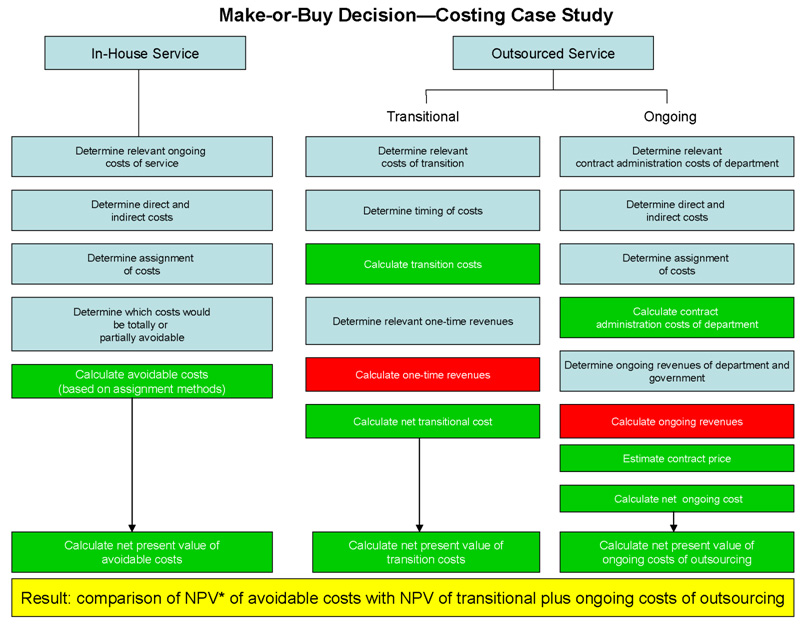
Text version: make-or-buy decision - costing case study
*NPV = Net present value
Annex D — References
Legislation
- Financial Administration Act , section 19
- User Fees Act, 4.(1)(d); 4.(2)
- Department- or agency-specific legislation
Policy instruments
- Common Services Policy
- Policy on Interdepartmental Charging and Transfers Between Appropriations
- Policy on Special Revenue Spending Authorities
- Management, Resources, and Results Structur Policy
- Policy on Service Standards for External Fees
- Policy on Transfer Payments
- Treasury Board Accounting Standards
- Treasury Board Accounting Standard 3.1 — Capital Assets
- Treasury Board Accounting Standard 3.1.1 — Software
- Financial Information Strategy Accounting Manual
- CICA 3060
- "Consolidated Revenue Fund Monthly Lending Rates for Periods of One Year and Over"
- Guide to Establishing the Level of a Cost-Based User Fee or Regulatory Charge
- Canadian Cost-Benefit Analysis Guide
- A Guide to Preparing Treasury Board Submissions
- Profile of internal services
- Privy Council Office — Memoranda to Cabinet
- Risk Management — Policies and publications
Other references
- Treasury Board of Canada Secretariat Program Sector Analysts
- Financial Management Strategies, Costing and Charging Division of the OCG